

Homage vs Parody for Designers & Fans: Spot a Tribute Before You Sell
Homage pays tribute; parody critiques. The creator’s intent and whether the audience recognizes the source decide which one you’re looking at. A tribute nod copies a style to honor it; comedic mimicry exaggerates that same style to poke fun at it. Everything else, from film scenes to t-shirt designs, comes down to that split.
TL;DR:
- Parody relies on audience recognition and exaggeration to critique, while homage is a respectful nod that signifies admiration without mockery.
- Humorous parody depends on exaggerated traits and timing cues, whereas homage uses subtle cues like reverent music or framing to signal respect.
- Legal protection favors parody under fair use because it adds critique, while close copies without commentary risk infringement when commercialized.
- Effective tribute designs add unique elements like new colors or phrases, avoiding direct frame-to-frame reproductions that invite legal issues.
- The key to staying within legal bounds is ensuring the work adds commentary or transforms the original, not just copying for recognition.
Table of Contents
- Homage Vs Parody: The Core Difference in Intent and Function
- Why Audience Recognition Changes the Whole Equation
- Homage and Parody in Film and Literature: Real Examples
- Fair Use, Copyright, and What It Means for Merch
- A Quick Checklist: Homage, Parody, or Just a Copy?
- Curating Tribute Designs Without Crossing the Line
- Shop Original Tribute Designs Without the Legal Gray Area
- Sources
- FAQ
Homage Vs Parody: The Core Difference in Intent and Function
Parody is imitation built to critique, satirize, or comment on a work, and it only lands if the audience recognizes what’s being mocked. StudioBinder’s breakdown of homage in film frames parody as commentary that depends entirely on that shared recognition between creator and viewer. No recognition, no joke.
Homage works differently. It’s a respectful reference, borrowing a shot, a phrase, or a compositional choice to signal admiration rather than aim a punchline at it. The Wikipedia entry on homage in the arts) traces the word back to a formal show of respect, and that root still shapes how the term gets used in film and literature today: allusion or imitation that acknowledges a source instead of undercutting it.
The practical test comes down to two questions:
- Intent: Did the creator set out to celebrate the source or to expose its flaws for laughs?
- Function: What does the reference actually do for the audience? Prompt a knowing nod or trigger a punchline?
Writer’s Digest puts it bluntly: parody is loud and exaggerated for comedic effect, while homage (and its cousin pastiche) imitates respectfully, copying tone or style without mockery. That’s the dividing line creators need before they pick up a pen or a design tool.
Why Audience Recognition Changes the Whole Equation
A joke that nobody gets isn’t a joke. Parody depends on the audience spotting the original underneath the exaggeration, because the humor lives in that gap between the source and the distortion. Homage runs on a quieter mechanism: the viewer notices the echo and feels a flicker of recognition, not a laugh.
Tone does a lot of the signaling here. A slow-motion shot, a reverent score, or narration that treats the reference with weight tells the audience “this is a nod,” even when the visual is nearly identical to the source. Flip that same shot into a jarring cut with a goofy sound effect, and the same visual reads as a jab instead of a bow.
A few things shift how a reference lands:
- Placement matters: a callback tucked into a serious dramatic beat reads as tribute; the same image dropped into a farce reads as a gag.
- Music and pacing can turn an identical camera angle into either reverence or ridicule.
- Audience expectation plays a role too. A comedy-trained crowd will hunt for the joke even in a scene that was meant sincerely.
That’s why some references sit in gray territory. A film that recreates a famous frame with total sincerity, then immediately undercuts it with a sight gag, is doing both at once, and viewers will read it differently depending on what they expect from the genre going in.
Homage and Parody in Film and Literature: Real Examples
- Clear parody: sketch comedy and genre spoof films built entirely around lampooning a target work’s tics, exaggerating recognizable dialogue patterns, plot beats, or visual clichés until they become the joke itself. The humor only works because viewers already know the source cold.
- Clear homage: directors like Quentin Tarantino and Brian De Palma have built entire careers on replicating shots, camera moves, and musical cues from earlier films as a kind of ongoing conversation with cinema history, according to StudioBinder’s analysis of homage in film. The goal is admiration, not commentary, and there’s no punchline waiting at the end of the shot.
- Gray-area case: a novel or film that recreates a beloved scene with genuine affection, then layers in a wink of self-aware humor, blurs the line on purpose. Readers or viewers pick up on both signals: the reverent staging says homage, the wink says parody is at least partly in play. Literaryterms notes that pastiche, imitation of style without mockery, often sits inside homage rather than parody, which explains why so many “loving tribute” works also read as gentle sendups depending on who’s watching.
Fair Use, Copyright, and What It Means for Merch
Parody tends to get stronger legal footing under U.S. fair-use analysis because it’s considered “transformative,” meaning it adds new commentary or criticism rather than just reproducing the original. A tribute that copies a scene or design closely, without adding that critical layer, doesn’t get the same automatic protection and carries more legal exposure for anyone selling it. One long-running discussion among film fans on Reddit frames this as the practical line separating plagiarism, homage, and parody: transformation and critique tend to hold up better than faithful copying, though the line is never perfectly clean.
For anyone designing or selling reference-driven apparel, a few habits reduce risk:
- Document what your design adds, commentary, exaggeration, or a new context, rather than a straight reproduction.
- Ask whether a stranger would recognize instant parody, or just a copy with a different color palette.
- When a design leans closer to faithful reproduction than commentary, treat that as a signal to seek permission or consult a legal guide before selling it.
Pro Tip: When you’re unsure which side of the line a design falls on, ask whether it could exist without referencing the original at all. If the answer is no, you’re probably in tribute or parody territory, and it’s worth reading Mclarenteehub’s guide on parody merch legality before you list it.
A Quick Checklist: Homage, Parody, or Just a Copy?
- Ask about intent. Was the goal to critique, to celebrate, or just to borrow a recognizable look without adding anything new?
- Examine the transformation. Does the piece add commentary, a new context, or comedic critique, or is it a near-identical restaging?
- Test audience readability. Will an average viewer recognize the source, and does that recognition produce a laugh or a nod of respect?
- Watch for red flags. Minimal alteration, no added commentary, and reliance on the original’s exact likeness to sell a product all point toward a ripoff rather than homage.
Industry observers describe the whole distinction as a kind of cinematic conversation, where homage signals influence and parody adds critique, and the creator’s underlying intent is what actually separates the two in practice, per StudioBinder. That framing holds up just as well for a t-shirt design as it does for a feature film.
Curating Tribute Designs Without Crossing the Line
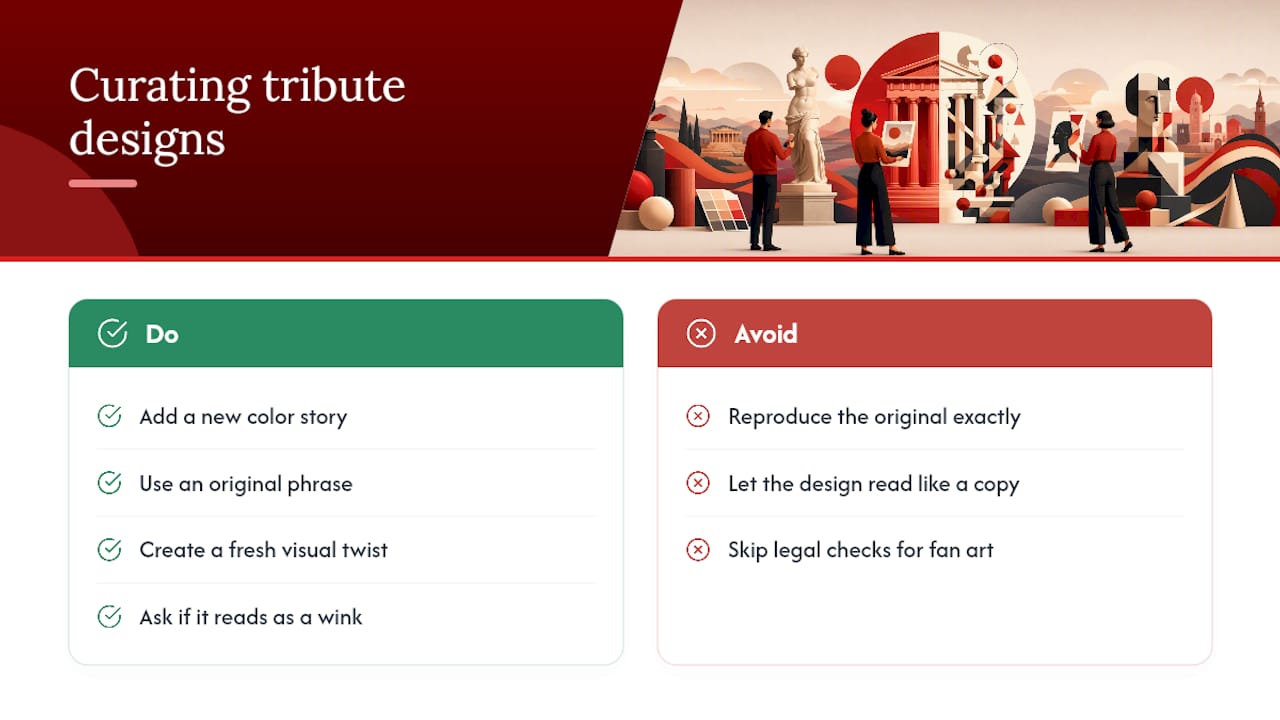
Reviewing reference-driven apparel designs teaches you fast that the safest tributes add something: a new color story, an original phrase, or a fresh visual twist like the Unisex Quote Series Tee: Wasted that makes the piece stand on its own even if you strip the reference away. Straight reproductions age poorly and invite trouble.
The one habit worth adopting: before finalizing any design that leans on a recognizable film or show, ask whether it reads as a wink or a copy. If it’s a copy, it’s time to add more of your own voice or check the legal considerations around fan art before moving forward.
— Nicholas
Shop Original Tribute Designs Without the Legal Gray Area
This store sells tees, mugs, and hoodies built around original tribute art rather than direct reproductions, so you get the nod to a favorite film or show without the risk of a design that’s really just a copy in a different font. Every piece starts as its own artwork, inspired by movies, anime, sci-fi, and horror, but redrawn and restyled rather than lifted frame for frame.

If you want to see what a responsibly made homage looks like in practice, check out the Pulp Fiction inspired tee or the Alien facehugger mug, both built as tributes rather than straight lifts. For a deeper look at where the legal line actually sits, read Mclarenteehub’s guide on whether parody merch is legal to sell before you buy or commission a custom piece. Browse the current tribute collection and pick the design that says exactly what you want it to say.
Sources
- What is Homage — Definition & Examples in Art and Film | StudioBinder
- Parody vs. Pastiche | Writer’s Digest
- Literaryterms
- Homage example sentences — Merriam-Webster
FAQ
What’s the difference between a parody and a spoof?
“Parody” and “spoof” are used almost interchangeably. Both refer to comedic imitation that exaggerates a work’s traits for laughs, and both rely on the audience recognizing the target.
Is homage the same as tribute?
Yes, functionally. Both describe a respectful reference to a source’s style, tone, or imagery, done to honor it rather than mock it, as Merriam-Webster’s usage examples of “pay homage” confirm across film, music, and literature.
What’s the difference between a ripoff and an homage?
Homage adds something, a new context, original artwork, or a personal spin, while a ripoff copies the source closely with little transformation and often exists mainly to trade on the original’s recognizability.
What counts as a parody?
A parody imitates a specific work or genre closely enough to be recognized, then exaggerates or distorts it to deliver commentary or comedy, a definition consistent with how Writer’s Digest separates parody from pastiche and homage.
Is homage the same as satire?
Not quite. Satire critiques broader social or political targets, often through irony, while homage is aimed narrowly at honoring one specific source without any critical edge.