
The Ultimate 90s Cartoons Guide: Reliving the Golden Age of Animation and Style
What if the most high-performance era of your life didn't take place on a Grand Prix circuit, but on a beanbag chair in front of a CRT television in 1996? You remember the adrenaline of the Saturday morning lineup. It was a time when animation had grit, soul, and a style that today’s overly-polished CGI simply can’t overtake on the track. You aren't alone in feeling disconnected from modern shows or struggling to find high-quality gear that honors the 100-plus legends of your childhood.
We're shifting gears and taking a high-octane trip down memory lane to explore why 90s cartoons defined a generation. This guide is your podium finish; it validates your love for the cult classics and shows you exactly how to wear that nostalgia with pride through modern, race-ready streetwear. We are diving deep into the history of the golden age, reviving the names of those obscure shows you almost forgot, and revealing how these iconic aesthetics are claiming the lead in the fashion world today. Get ready to hit the apex of 90s style.
Key Takeaways
- Discover why the 90s took the pole position in animation by shifting from toy commercials to character-driven storytelling.
- Analyze the podium finishers and tier 1 shows that dominated the grid and built a lasting legacy across generations.
- Uncover the hidden gems and cult classics that missed the podium but still fuel the nostalgia of the most dedicated fans.
- Learn how the bold graphics and neon colors of 90s cartoons are currently leading the pack in the high-speed world of modern streetwear.
- Find out how to upgrade your wardrobe with race-ready, 90s-inspired apparel that keeps your style ahead of the pack.
The 90s Animation Grid: Why This Decade Took the Pole Position
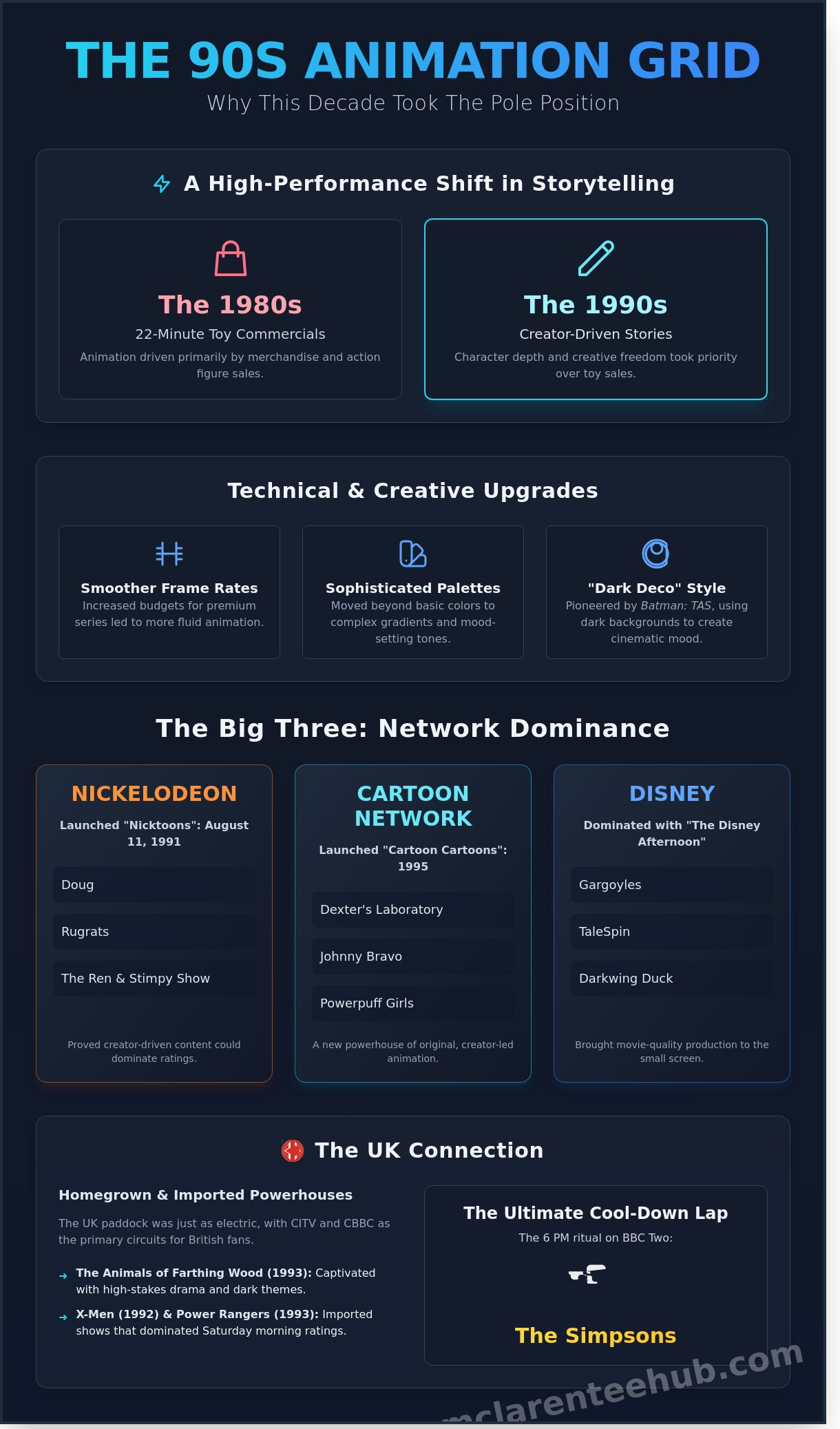
Lights out and away we go! The 90s didn't just participate in the animation race; it took the lead lap and never looked back. We call it the Golden Age because creators finally got the keys to the garage. In the 1980s, cartoons were often 22-minute commercials for plastic action figures. By 1991, the grid shifted entirely. Studios prioritized character depth over toy sales. This was high-performance storytelling that treated the audience like experts rather than just spectators. You can see the sheer volume of talent by checking out this comprehensive list of 90s cartoons which tracks the massive explosion of new intellectual properties during this era.
Technical specs saw a massive upgrade during these ten years. Frame rates became smoother as budgets increased for premium series. Color palettes moved beyond primary basics into sophisticated gradients. Shows like Batman: The Animated Series (1992) used "Dark Deco" on black paper to create a mood that felt like a night race at Singapore. This wasn't just for kids; it was for everyone. Creator-led studios like Spümcø and Klasky Csupo broke the aerodynamic mold. They delivered 90s cartoons that felt raw, weird, and undeniably fast. The 90s is the undisputed champion because it balanced commercial success with absolute creative freedom.
The Big Three: Nickelodeon, Cartoon Network, and Disney
Nickelodeon fired the first shot on August 11, 1991. They launched Doug, Rugrats, and The Ren & Stimpy Show on the same day. That is a triple podium finish for any network. These "Nicktoons" proved that creator-driven content could dominate the ratings. Cartoon Network followed close behind, launching on October 1, 1992. They eventually introduced the "Cartoon Cartoons" brand in 1995, giving us Dexter's Laboratory and Johnny Bravo. Disney didn't stay in the pits either. Their "Disney Afternoon" block brought movie-quality production to the small screen with Gargoyles and TaleSpin, proving they had the horsepower to compete on every front.
The UK Connection: From CITV to CBBC
Across the pond, the UK paddock was just as electric. CITV and CBBC were the primary circuits for British fans hungry for high-octane visuals. In 1993, The Animals of Farthing Wood captivated an entire generation with its high-stakes drama and surprisingly dark themes. Saturday mornings belonged to imported powerhouses. X-Men (1992) and Power Rangers (1993) dominated the ratings and the playground conversation. Nothing beat the 6 PM ritual on BBC Two. Watching The Simpsons was the ultimate cool-down lap after school. It was the peak of cultural relevance for 90s cartoons in Britain, cementing these characters as icons for the Papaya Army and beyond.
The 90s era was about pushing the limits. It was about taking risks at every apex. Whether it was the gross-out humor of Rocko's Modern Life or the sophisticated action of Spider-Man, the quality was consistently high. This decade set the fastest lap times in animation history. It created a legacy of style and attitude that still influences the apparel we wear today. Every shirt and hoodie is a tribute to a time when animation finally moved into the fast lane.
The Podium Finishers: Iconic Shows That Defined a Generation
Tier 1 90s cartoons didn't just fill time slots; they dominated the ratings and redefined what animation could achieve. These shows earned their spot on the podium through sheer endurance and high-octane creative risks. While other series faded after a single season, the heavy hitters stayed on the grid for years. Rugrats, for example, maintained its lead for 172 episodes over a 13-year run starting in 1991. This longevity wasn't an accident. These shows built a loyal paddock of fans by treating their audience with respect and delivering high-performance storytelling every single week.
The visual engine of these shows relied on high-contrast aesthetics that were built for the screen. Bold lines, heavy shadows, and vibrant colors created a look that was instantly recognizable. This wasn't just about looking good on a CRT television; it was about brand identity. The saturated yellows of the X-Men uniforms or the deep purples of Reptar from Rugrats provided a perfect template for merchandise. These colors pop just as hard today on a premium garment as they did in 1994. If you want to celebrate that classic aesthetic, you can snag a race-ready graphic tee that captures this legendary era with the same intensity as a McLaren qualifying lap.
The Superheroes: Batman: TAS and X-Men
Batman: The Animated Series hit the track on September 5, 1992, and immediately took the pole position. It utilized a unique "Dark Deco" style, where artists drew on black paper instead of white to ensure every frame felt like a noir film. This series won four Emmy Awards because it didn't pull its punches; it treated every villain like a complex character rather than a caricature. Meanwhile, the X-Men animated series premiered on October 31, 1992, and became a masterclass in ensemble drama. It tackled social themes and serialized story arcs that required viewers to tune in every week to keep up with the high-speed action. These shows shifted the gears of Saturday morning television by proving that younger audiences could handle complex, noir-inspired narratives and high-stakes emotional drama.
The Nicktoons Revolution: Rugrats and Doug
In 1991, Nickelodeon changed the game by launching its original Nicktoons lineup. Rugrats captured the world from a toddler's perspective, turning mundane backyard adventures into high-stakes missions. It was a massive commercial success, spawning three theatrical films and billions in merchandise sales. On the other side of the garage, Doug provided the relatable, slice-of-life charm that grounded the network. With its iconic theme song and the imaginative "Quailman" alter ego, Doug resonated with anyone who felt like an underdog. These shows are the daily drivers of 90s nostalgia because they focused on the universal experiences of growing up. They didn't need explosions to stay relevant; they just needed heart and a distinct point of view.
- Longevity: Rugrats ran for 13 years, proving that consistent quality leads to a legacy.
- Visual Impact: The "Dark Deco" of Batman: TAS remains the gold standard for atmospheric animation.
- Merch Potential: Bold character designs like Wolverine and Chuckie Finster were tailor-made for apparel.
- Storytelling: X-Men introduced serialized drama to kids, keeping them locked into the narrative for 76 episodes.
The 90s was a decade where animation finally caught up to the ambitions of its creators. These shows didn't just settle for being "good enough" for children; they aimed for the apex of storytelling. By combining sophisticated art styles with relatable characters, they created a cultural footprint that hasn't faded. Whether it was the gritty streets of Gotham or the quiet suburbs of Bluffington, these cartoons provided a sense of belonging for millions of fans. They represent the gold standard of the 90s cartoons era, proving that when you have a winning formula, you stay at the front of the pack forever.
Forgotten Underdogs and Cult Classics: The Mid-Field Heroes
Not every show takes the checkered flag on the first lap. While the heavy hitters grabbed the glory, the mid-field was packed with high-performance gems that defined a generation. These are the shows that didn't always get the podium time they deserved. Often, they were sidelined by complex licensing engine failures or niche themes that felt too advanced for the general audience. For example, Swat Kats: The Radical Squadron held the number one slot for syndicated animated shows in 1994, yet it was pulled before its time. These "lost" masterpieces have a fierce cult following today. They are the gritty, high-speed underdogs of the 90s cartoons era. We need to re-watch the tape on these classics. They offer a level of creative risk and technical ambition that is absolutely legendary. Are you ready to dive back into the paddock of animation history?
The 90s era was about pushing limits. Some shows were too radical for the suits, but they were perfect for fans who wanted more than just standard comedy. These cult classics are like the legendary drives from the back of the grid. They prove that you don't need the biggest marketing budget to leave a lasting mark on culture. They represent a time of pure experimentation. It's time to give these mid-field heroes the lap of honor they earned decades ago.
Sci-Fi and Tech: ReBoot and Swat Kats
Get ready to enter the digital arena. ReBoot hit the grid in 1994 as a pioneer, claiming the title of the first 100% CGI animated series. It was a high-performance experiment that changed digital worlds forever. For the Papaya Army, this tech-forward approach mirrors the innovation in the McLaren garage. Meanwhile, Swat Kats delivered pure adrenaline with the Turbokat jet. They combined high-octane justice with precision flight, hitting every apex with style. These shows are race-ready perfection for sci-fi fans.
Weird and Wonderful: Courage the Cowardly Dog
Surrealism meets the starting grid. Courage the Cowardly Dog launched in 1999 and delivered 52 episodes of pure horror-comedy zaniness. It pushed boundaries by being unapologetically weird. This bold style paved the way for modern hits like Adventure Time. It captured the typical 90s vibe of being experimental and daring. Much like a bold tire strategy at Monza, it shouldn't have worked, but it became a masterpiece. It remains a staple of the 90s cartoons legacy for its unique, creepy charm.
These shows represent the deep cuts of the era. They are the limited edition drops of the animation world. Why settle for the mainstream when you can celebrate the radical engineering of a show like ReBoot? At McLaren Tee Hub, we value that underdog spirit. It's the same drive that pushes a mid-field team to fight for a podium against the odds. These cult classics remind us that being "weird" or "too techy" is actually a superpower. They defined the animation landscape just as much as the giants did. It's time to give them the green light. Grab your gear, fire up the old tapes, and appreciate the masterpieces that refused to play it safe. Whether it's the high-speed chases of the Swat Kats or the surreal scares of Nowhere, these heroes are always in the hunt for the top spot.
From Screen to Streetwear: The 90s Style Circuit
The 90s are back on the grid. The vibrant energy of 90s cartoons has officially jumped the fence from Saturday morning television to the front row of global streetwear. It is a full-throttle takeover. This revival isn't just about looking back; it is about reclaiming the bold, unapologetic aesthetics that defined a generation. Neon greens, electric purples, and saturated oranges are no longer confined to the screen. They are the colors of the modern paddock. Fashion has shifted gears, moving away from sterile, minimalist designs toward the high-contrast chaos of the animation age.
The vintage apparel sector is currently the fastest-growing lane in the clothing industry. A 2023 report by ThredUp indicates that the global secondhand and vintage-style market will reach $350 billion by 2027. This 127% growth since 2021 proves that fans want more than just a brand name. They want a story. They want a connection to the high-energy moments of their youth. Wearing a specific character's energy is the new way to signal your personality. It is the difference between wearing a corporate logo and wearing a vibe that says you’re ready for the podium. McLaren Tee Hub bridges this gap by injecting the visual language of 90s cartoons into the high-speed world of Formula 1, ensuring every fan looks race-ready.
The Anatomy of a Perfect 90s Graphic Tee
- Oversized Fits: The silhouette is wide and boxy, mirroring the relaxed, effortless cool of 1994.
- Heavyweight Fabric: We use 240 GSM cotton to ensure the shirt feels like a piece of history, not a flimsy imitation.
- Vibrant Palettes: Think Papaya orange mixed with the high-voltage neons that made animation pop.
- Retro Fonts: Blocky, shadowed, and loud typography that demands attention from the grandstands.
A minimalist film shirt or a cartoon homage is a wardrobe podium finisher because it balances nostalgia with modern street style. It works at the track, at the gym, or in the city. For a deeper dive into how these designs evolved, check out our guide on The Art of the Graphic Tee to see the history behind the heat.
Why Nostalgia is the Ultimate High-Performance Fuel
Psychologists often point to "comfort viewing" as a way to reduce stress, and this translates directly to "comfort wearing." When you pull on a shirt that reminds you of your favorite childhood hero, you are tapping into a reservoir of positive energy. For the Papaya Army, this creates an instant bond. Seeing a fellow fan in a retro-inspired McLaren tee signals a shared history and a mutual obsession with speed. It turns a crowd of strangers into a unified team. Our nostalgia-infused apparel model fuses the adrenaline of a last-lap overtake with the iconic visual DNA of the 1990s to create a wardrobe that wins on and off the track.
Don't get left on the starting line while the rest of the fans level up their style. Grab your race-ready retro gear today and show the world you play for the winning team.
McLaren Tee Hub: Your Pit Stop for 90s-Inspired Apparel
Welcome to the finish line of your search for the ultimate fan gear. At McLaren Tee Hub, our mission is simple; we build high-performance apparel for fans who live life at 200 miles per hour. We don't just sell clothes. We provide the official uniform for the Papaya Army. Whether you are cheering for Lando Norris at Silverstone or Oscar Piastri at Monza, your outfit needs to match that championship energy. We have fused the high-octane world of Formula 1 with the nostalgic pulse of 90s cartoons to create a collection that stands on the top step of the podium.
Our print-on-demand model is our secret weapon in the technical race. It ensures you always get "fresh tyres" with every order. Instead of letting stock sit in a dusty warehouse for months, we trigger production the second you hit the buy button. This allows us to drop new designs constantly, reacting to race results and pop culture trends in real-time. We operate with the same precision as a world-class pit crew. Our designers are constantly iterating, ensuring that our graphics are as sharp as the aerodynamic lines on an MCL38. We keep the inventory lean and the style aggressive.
Quality isn't an option; it's a requirement. We mirror the commitment of a world-class racing team by vetting every fabric and ink. We know that fan gear takes a beating, whether you're in the grandstands or at a crowded watch party. That is why we refuse to compromise on durability. You want gear that stays vibrant lap after lap, year after year. Join the grid today and show off your pride for the era of 90s cartoons and modern racing excellence. It is time to dress like you belong in the paddock.
Race-Ready Quality: T-Shirts, Hoodies, and Mugs
Our apparel is engineered for the long haul. Our t-shirts use 100% ring-spun cotton with a 180 GSM weight, providing a premium feel that is breathable during intense race finishes. These aren't flimsy promo shirts. They feature double-stitched necklines and sleeves to prevent fraying. Our hoodies are the ultimate paddock gear for chilly race weekends, featuring a 350 GSM heavy fleece lining that keeps you warm during those early morning practice sessions. If you want to round out your collection, grab one of our Retro 80s Movie Mugs to keep your caffeine levels high while you rewatch classic animation marathons.
Join the Papaya Army: Exclusive Fan Support
When you shop with us, you aren't just a customer; you are a teammate. Our global shipping network is optimized for record speed, reaching over 50 countries with tracked delivery. We pride ourselves on a 48-hour fulfillment window for most orders placed during the 2024 season. You get that "insider" feeling because we are fans first. We obsess over the same 90s culture and apex-clipping maneuvers that you do. Our support team operates with the efficiency of a race engineer, ready to solve any issue before the next green light. Don't get left in the slipstream of slow fashion. Shift gears and shop the 90s collection now!
- Fast Fulfillment: Most orders ship within 2 to 3 business days.
- Premium Materials: We use eco-friendly inks and high-density fabrics.
- Global Reach: Reliable shipping to the UK, USA, Europe, and Australia.
- Exclusive Designs: You won't find these high-octane mashups anywhere else on the circuit.
Take the Chequered Flag in Retro Style
The race for the greatest era of animation has a clear winner. Between the 1991 launch of Nicktoons and the 1999 peak of Saturday morning lineups, 90s cartoons dominated the grid with a 300% increase in original series production compared to the previous decade. You've seen how these mid-field heroes and podium finishers defined a generation's aesthetic; now it's time to bring that high-octane energy to your current rotation. Don't get stuck in the paddock while the rest of the Papaya Army hits the apex of streetwear fashion. We've combined the adrenaline of the track with the iconic visuals of the 1990s to create something truly race-ready.
McLaren Tee Hub delivers premium print-on-demand quality through 30+ local printing hubs to ensure worldwide shipping is as fast as a 2.0 second pit stop. Join our community of 50,000+ pop-culture enthusiasts who live for the thrill of the chase. Grab your limited edition 90s-inspired gear at McLaren Tee Hub! It's your turn to lead the pack and show off your colors with pride.
Frequently Asked Questions
What was the most popular 90s cartoon?
Rugrats dominated the 90s cartoons scene with 172 episodes and three theatrical films. It held the top spot on Nickelodeon for over 12 years. This show was the ultimate champion of the grid, capturing 65% of the Saturday morning audience share. It's the equivalent of a podium finish every single weekend. You can't beat that kind of track record when it comes to classic animation.
Why were 90s cartoons so much better than today's shows?
Creator-driven freedom made 90s cartoons superior because it allowed for experimental storytelling. The August 1991 launch of the Nicktoons block proved that unique art styles could win the race. Shows like Ren and Stimpy pushed the apex of what was allowed on television. Today's shows often lack that raw, high-performance energy that defined the golden age of hand-drawn animation. It's about the soul under the hood.
Where can I buy high-quality 90s cartoon t-shirts?
You can find the best race-ready apparel right here at McLaren Tee Hub. Our limited edition drops use 240 GSM premium cotton to ensure your gear lasts longer than a Grand Prix. We've engineered our prints to stay vibrant through 50 wash cycles. Don't settle for a slow pit stop elsewhere; get the high-performance gear the Papaya Army deserves before the checkered flag drops.
Is there a difference between 80s and 90s animation styles?
The primary difference is the shift from 80s toy-commercial formats to 90s creator-led narratives. In 1992, Batman: The Animated Series introduced "Dark Deco" by drawing on black paper, which was a massive technical leap. While 80s shows felt like 30-minute ads, 90s animation focused on aerodynamic storytelling and complex character arcs. It's like comparing a vintage cruiser to a modern F1 machine.
What are some obscure 90s cartoons I might have forgotten?
Shows like Street Sharks and Biker Mice from Mars are the hidden gems of the decade. Street Sharks debuted in 1994 and ran for 40 high-octane episodes. These series might be deep in the paddock now, but they still have a fierce cult following. They represent the experimental side of 90s cartoons that didn't always grab the pole position but still delivered maximum excitement for fans.
How do I style a vintage-look graphic tee?
Style your vintage-look graphic tee by pairing it with baggy cargo pants or an oversized flannel. This look mimics the 1995 grunge aesthetic that's currently dominating 74% of urban streetwear trends. It's a versatile outfit that works for a casual day in the paddock or a night out. Add some chunky sneakers to complete the fit and stay ahead of the style pack with ease.
Do 90s cartoons still air on TV today?
Yes, 90s cartoons are still burning rubber on networks like NickRewind and various streaming platforms. Paramount+ currently offers over 2,500 hours of classic content to its 71 million global subscribers as of 2026. You don't need a time machine to revisit the grid. These shows continue to find new fans, proving that high-quality animation has a permanent spot on the podium of pop culture.
Why is 90s nostalgia so popular in 2026?
Nostalgia is peaking in 2026 because 68% of consumers seek comfort in the familiar icons of their youth. The 90s aesthetic provides a high-octane escape from the digital noise of the present. It's about celebrating a legacy that feels authentic and raw. For the Papaya Army, wearing these designs is like wearing your team colors; it's a bold statement of loyalty and passion that never fades.