

Tri-Blend vs Cotton: Which T-Shirt Fabric Fits Your Style?
Choose tri-blend when you want the softest possible drape and a lived-in, vintage feel. Choose 100% cotton when you need absorbency, opacity, or a crisp print. A standard tri-blend runs 50% polyester, 25% cotton, and 25% rayon, while cotton’s natural fiber holds roughly 7 to 8% moisture regain against polyester’s 0.4%. This is why cotton feels cooler against skin over a full day.
- Want the softest hand and a heathered look? Go tri-blend.
- Want a bold, high-contrast graphic and natural breathability? Go ringspun cotton.
- Not sure? Check the tag: if it lists three fibers, it drapes; if it’s 100% cotton, it prints sharp and holds its shape in the wash.
Key Takeaways
Tri-blend delivers the softest drape and vintage feel through its rayon content, while 100% ringspun cotton delivers better print clarity, absorbency, and opacity.
| Point | Details |
|---|---|
| Know the ratio | Standard tri-blend runs 50% polyester, 25% cotton, and 25% rayon, which drives its soft, light drape. |
| Match fabric to print | Cotton gives crisper DTG and screen prints; tri-blend suits muted, vintage-style graphics. |
| Read the label first | Look for composition percentages, ringspun or combed notes, and a pre-shrunk mention before buying. |
| Care determines lifespan | Cold water and low heat protect both fabrics, though rayon needs extra caution when saturated. |
| Shop by use case | McLaren Tee Hub stocks both fabric types, from soft tri-blend graphics to sharp cotton prints. |
Table of Contents
- Tri Blend vs Cotton: A Quick Side-by-Side
- Why Do Tri-Blend and Cotton Feel So Different?
- Will Tri-Blend or Cotton Shrink More After Washing?
- Which Fabric Prints Better for Graphic Tees?
- How Do You Choose Between Tri-Blend and Cotton?
- What an Apparel Curator Actually Looks for in a Blank
- Fiber Marketing vs. Fiber Reality
- Where to Find Both Fabrics Done Right
- Frequently Asked Questions
- Sources
Tri Blend vs Cotton: A Quick Side-by-Side
Before you dig into the fiber science, here’s the fast version. A tri-blend blank typically mixes 50% polyester, 25% combed ring-spun cotton, and 25% rayon. Cotton tees come in a few grades, but the two you actually want are ringspun and combed cotton, both of which beat basic carded cotton on smoothness and pilling resistance.
- Feel: Tri-blend is silkier and lighter; ringspun cotton is smooth but denser.
- Shrinkage: Tri-blend shrinks less thanks to polyester content; unsanforized cotton shrinks more.
- Print outcome: Cotton produces crisper, brighter graphics; tri-blend mutes and textures prints slightly.
- Cost per shirt: Cotton blanks are usually cheaper; tri-blend commands a premium for the softness.
- Sustainability trade-off: Cotton is a renewable natural fiber, but tri-blend’s polyester content adds durability that can extend garment life.
Neither fabric wins outright. It depends on what you’re printing and how you plan to wear it.
Why Do Tri-Blend and Cotton Feel So Different?
The difference comes down to what each fiber is doing inside the yarn. Polyester is the workhorse: it resists wrinkling, holds its shape wash after wash, and keeps the shirt from stretching out at the collar. Cotton anchors ink during printing and pulls moisture away from skin. Rayon, the third player in tri-blend, is where the “buttery soft” reputation actually comes from. It’s a semi-synthetic fiber made from wood pulp, and it drapes more like silk than cotton ever will.
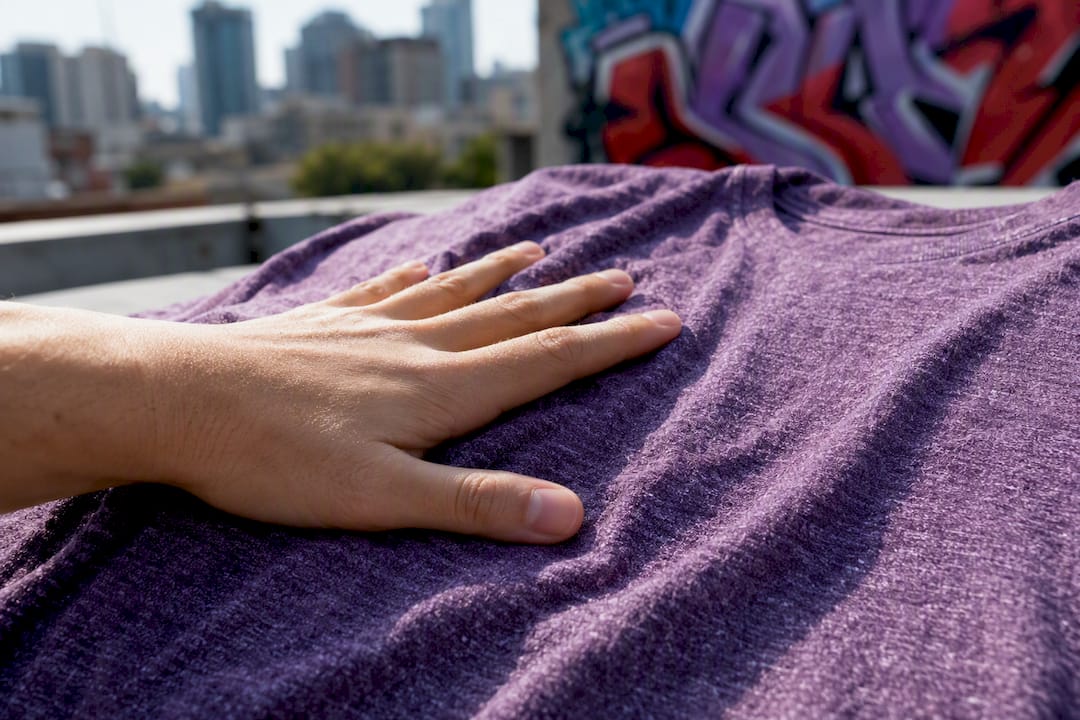
That combination is also why trade guides consistently name tri-blend among the softest commonly available tee fabrics. It isn’t marketing spin. Rayon’s fiber structure plus a lighter knit genuinely produces a broken-in feel straight out of the package, no washing required.
Weight tells the rest of the story. Tri-blend tees typically run 3.8 to 4.3 ounces per square yard, or about 130 to 145 GSM, while standard cotton tees land closer to 5.0 to 6.0 ounces. That lighter build explains three things at once:
- Why tri-blend drapes rather than structures.
- Why lighter colors in tri-blend can look faintly see-through under bright light.
- Why tri-blend runs cooler in warm weather but offers less coverage.
Pilling and odor retention follow a similar logic. Polyester resists pilling better than low-grade cotton, but it also traps body odor more stubbornly because synthetic fibers don’t absorb moisture the way cotton does. Ringspun cotton, meanwhile, pills less than basic carded cotton simply because its fibers are twisted tighter and have fewer loose ends to tangle.
Will Tri-Blend or Cotton Shrink More After Washing?
Polyester content is the reason tri-blend shirts generally hold their size better wash after wash. Polyester doesn’t absorb water the way natural fibers do, so it doesn’t relax and contract the same way cotton fibers can. The catch is rayon: when it gets fully saturated and agitated in a machine wash, it can lose some strength and shrink slightly on its own, even inside a tri-blend.
Cotton’s shrink story depends almost entirely on how the fabric was finished. A shirt marked “pre-shrunk” or “sanforized” has already gone through a mechanical shrinking process before it ever reached the printer, so you’re not fighting a surprise size drop after wash one. Skip that label and a raw cotton blank can shrink several percentage points in the first hot wash.
Pro Tip: Wash both fabrics cold, skip the dryer’s high heat setting, and turn tees inside out before washing to cut down on pilling and surface fading.
- Wash tri-blend and cotton in cold water on a gentle cycle.
- Tumble dry low, or air dry tri-blend to protect the rayon content.
- Use a mild detergent without fabric softener buildup, which can dull prints over time.
A well-made ringspun cotton tee and a quality tri-blend blank both last years with basic care. The real replacement driver usually isn’t the fiber blend. It’s cheap construction sold under either label.
Which Fabric Prints Better for Graphic Tees?
Cotton wins on print clarity, full stop. Its flat, uniform surface gives ink and toner a clean, even base, which is why cotton is generally easier for DTG and fine-line screen printing. If you’re running a high-detail illustration or a solid color block that needs to look flawless, cotton is the safer blank.
Tri-blend’s heathered texture works against sharpness, but that’s exactly why designers reach for it on purpose. The slightly muted, textured print outcome suits vintage-style graphics, distressed logos, or anything meant to look already worn in.
- Vintage retail tees: tri-blend.
- High-detail or high-contrast art: cotton.
- Activewear or hot-weather layering: tri-blend for the lighter weight and softer drape.
- Everyday layering pieces: cotton for structure and opacity.
Picking the right type of graphic tee for your art style matters as much as the printer you use.
How Do You Choose Between Tri-Blend and Cotton?
Match the fabric to how you’ll actually wear or sell the shirt, not to whichever one sounds more premium on a hang tag.
- Everyday casual wear: pick ringspun or combed cotton for structure, breathability, and print clarity.
- Pop-culture merch and graphic tees: pick tri-blend for a broken-in feel customers notice the moment they open the package.
- Performance or hot-weather use: pick tri-blend for its lighter weight, or a cotton-poly performance blend if moisture-wicking matters more than softness.
- Layering pieces: pick cotton for opacity and shape retention under a hoodie or jacket.
When you’re reading labels, look for exact composition percentages, “ringspun” or “combed” on cotton tags, a GSM or ounce-per-square-yard figure, and a pre-shrunk or sanforized note. Be skeptical of vague terms like “premium blend” with no percentages listed. That’s a sign the tag is selling a feeling, not a fiber content.
What an Apparel Curator Actually Looks for in a Blank
Nicholas, who curates apparel for McLaren Tee Hub, treats fabric selection as the first design decision, not an afterthought. A pop-culture parody print with fine linework needs a cotton blank with a smooth ringspun surface. A retro-style graphic meant to look decades old belongs on tri-blend, where the texture does half the design work for you.
Construction beats marketing every time. A well-made ringspun cotton tee will outlast and out-print a cheap tri-blend, no matter what the swing tag claims.
That’s why spec numbers, not label buzzwords, drive real ordering decisions. Readers weighing their own graphic tee outfit choices should apply the same logic: check the fiber percentages before checking the price.
Fiber Marketing vs. Fiber Reality
The “premium soft” label attached to tri-blend tees deserves a second look. Half the blend is polyester, which means half of that shirt is synthetic, not natural. That’s not a knock on tri-blend. Rayon genuinely earns the soft reputation, and the lighter knit really does feel broken in from day one. But calling it a natural-fiber upgrade over cotton gets the story backward.
The bigger failure in most buying advice is treating this as a binary choice between “soft” and “durable,” as if one fabric wins across every use case. It doesn’t. A high-quality ringspun cotton tee can outperform a cheap tri-blend on both durability and print sharpness, because construction quality swings results more than the fiber name on the tag.
If you take one thing from this comparison, prioritize the spec sheet over the marketing copy. Composition percentages, GSM, and whether the cotton is ringspun tell you more about how a shirt will wear and print than any word like “premium” or “luxury” ever will. Fabric choice should follow your actual use case, not the fabric with the better story.
Where to Find Both Fabrics Done Right
McLaren Tee Hub carries pop-culture graphic tees across both fabric families, so you don’t have to choose between soft drape and print clarity when you shop, only decide which one matches the shirt you actually want.

If a muted, worn-in look is calling to you, browse tri-blend styles built for exactly that. If you’d rather have a bold, high-contrast print on a sharp cotton blank, a piece like the Pulp Fiction inspired unisex tee shows what crisp cotton printing looks like in practice. Pair it with a Facehugger mug if you’re building out a full gift set. Check the product page for exact composition and sizing, then add your pick to the cart. That’s the whole decision, made simple.
Frequently Asked Questions
Is tri-blend better than cotton? Neither fabric is universally better. Tri-blend wins on softness and drape; cotton wins on print clarity, absorbency, and opacity. The right pick depends on the shirt’s use case.
What’s the difference between tri-blend and cotton t-shirts? Tri-blend mixes polyester, cotton, and rayon for a lighter, softer, more heathered fabric, while cotton tees are a single natural fiber that prints sharper and holds more moisture.
Does tri-blend shrink less than cotton? Generally yes, because polyester resists the moisture-driven shrinkage that affects natural fibers. Unsanforized cotton can shrink noticeably in the first hot wash, while pre-shrunk cotton behaves much closer to tri-blend.
Is ringspun cotton softer than regular cotton? Yes. Ringspun cotton uses a tighter, smoother yarn than basic carded cotton, which reduces pilling and creates a softer hand and a better print surface.
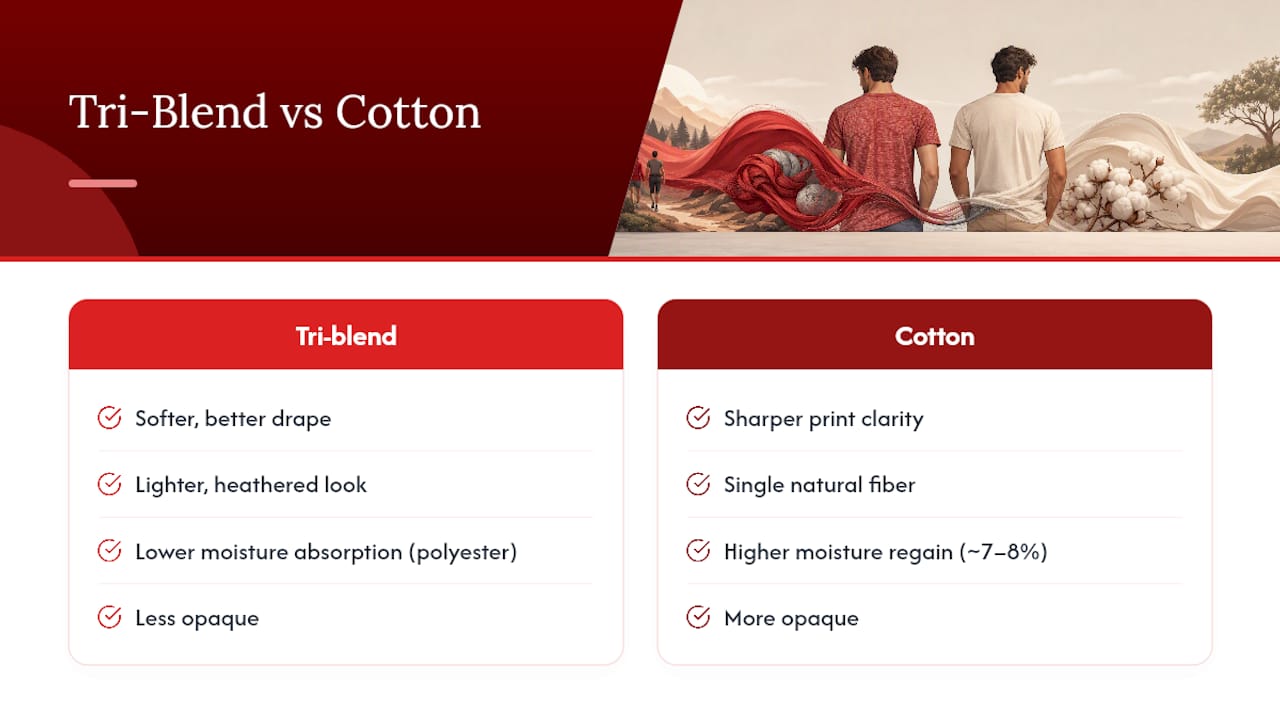
Which fabric is more breathable, tri-blend or cotton? Cotton has higher moisture regain, roughly 7 to 8% versus polyester’s 0.4%, so it manages sweat and feels cooler against skin over long wear. Tri-blend’s lighter weight helps it feel airy, but the polyester content limits true moisture absorption.
Sources
- What Is a Tri-Blend T-Shirt? Composition and Feel
- What are the pros and cons of ring-spun cotton vs regular cotton?
- The 4 Softest T-Shirt Materials | Bonfire