

Measure Your Hat Size in Under a Minute for Online Shoppers
Measure the circumference of your head where the hat will actually sit, about 1/2 to 1 inch above your eyebrows and above your ears. Take that number to a conversion chart to find your matching US fitted, UK, EU, or S/M/L size. If your measurement falls between two sizes, it is recommended to choose the larger size. Padding a hat down is easy; stretching one bigger usually isn’t.
TL;DR:
- Measure your head about 1/2 to 1 inch above your eyebrows and ears, then convert the measurement to your preferred sizing system using a chart.
- Always measure twice, keep the tape level and snug, and consider measuring with hair styled as you will wear it under the hat.
- Rounding up to the larger size is recommended when between sizes, as adding padding is easier than stretching a hat smaller.
- For fitted hats, precise measurements are essential, but adjustable styles like snapbacks can fit a range of sizes based on product details.
- Re-measure if your readings differ by more than a quarter inch or if your hairstyle changes, as adult head size remains fairly stable over time.
Table of Contents
- What You Need Before You Measure Your Hat Size
- Step-by-Step: How to Measure Your Head for a Hat
- Hat Size Conversion Chart: Inches, Centimeters, and More
- What If Your Measurement Falls Between Sizes?
- Does Hat Style Change How You Should Measure?
- Fixing Bad Readings and Measuring Without a Tape
- Why Trust This Hat Sizing Guide
- An Editor’s Take on Measuring for a Hat
- Sources
What You Need Before You Measure Your Hat Size
A flexible tailor’s tape is your best tool because it curves with your skull instead of fighting it. No tape on hand? A non stretch string or shoelace and a ruler work almost as well as a backup.
A few things to sort out before you start:
- Style your hair the way you’ll actually wear it under the hat. If you’re buying a winter hat with a liner, measure with the liner in mind, since thick or bulky hair can add real width to the reading.
- Grab a mirror or ask someone to help hold the tape level.
- If you normally wear your hair up, consider measuring both ways and splitting the difference.
Step-by-Step: How to Measure Your Head for a Hat
Once you’ve got your tape and your hair settled, the actual measuring takes less than a minute.
- Position the tape. Wrap it about 1/2 to 1 inch above your eyebrows, over your ears, and across the occipital bone at the back of your skull, which is the bump where your skull curves inward toward your neck.
- Keep it level and snug. The tape should sit parallel to the floor all the way around, not tilted up in back or down in front. Snug beats loose, but you should still be able to slide one finger under the tape without a struggle.
- Read it two or three times. Pull the tape off, reset it, and measure again. Averaging multiple readings cuts down on the small errors that throw off online orders far more than people expect. Write down both the inches and centimeters.
- Using string instead? Mark the exact overlap point with your finger or a pen, then lay the string flat against a ruler. Skip metal construction tape measures. They’re rigid and won’t curve around your head, which skews the reading in ways a fabric tape avoids.
Write down not just the number but where the tape sat. That detail matters later, because brands don’t all define “hat sits here” the same way.
Pro Tip: Measure at night and again in the morning if you can. Head size shifts slightly with hydration and even sinus swelling, so two readings a few hours apart give you a more honest average than one rushed measurement.
Hat Size Conversion Chart: Inches, Centimeters, and More
Once you’ve got your average circumference, converting it to a shoppable size is mostly a matter of matching rows on a chart. Most adult heads fall within a common size range suitable for a majority of hats., with US fitted sizes 7 through 7 3/8 covering the bulk of shoppers.

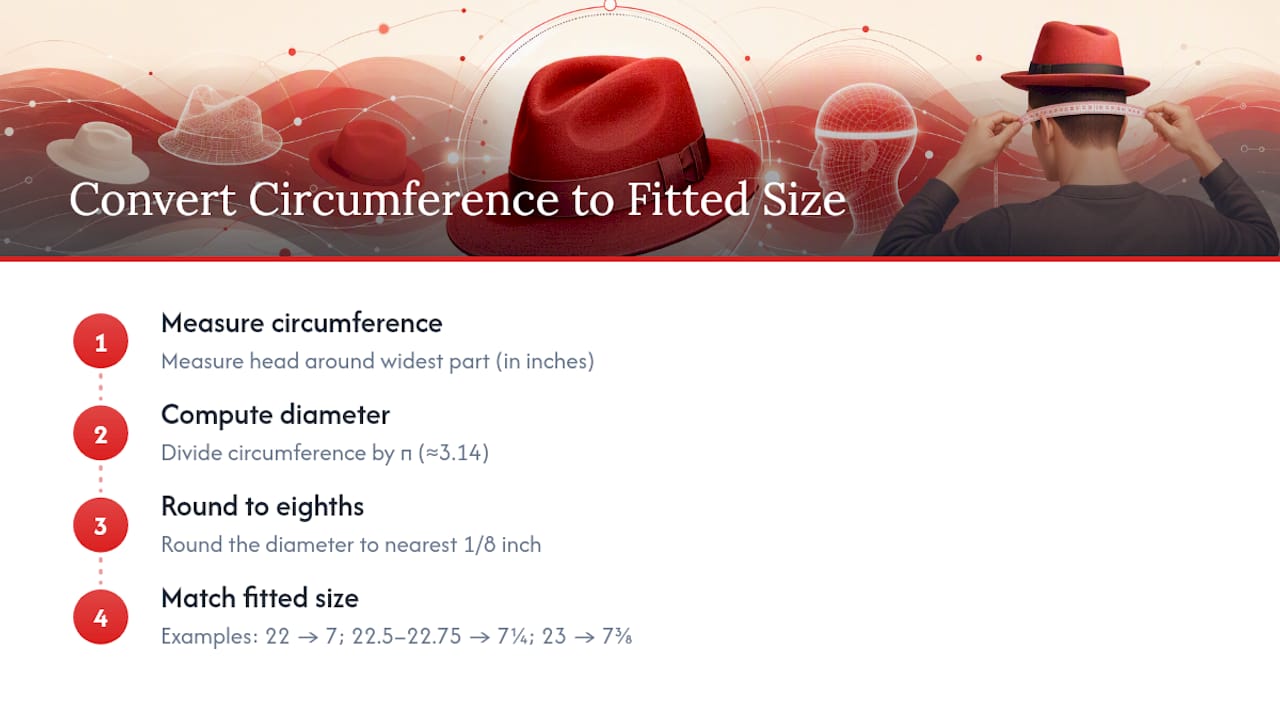
If you want to understand the math rather than just trust the chart, fitted sizes are based on the diameter of your head, not the circumference directly. Divide your circumference by pi (about 3.14), then round to the nearest eighth of an inch. A 23 inch circumference works out to roughly 7 3/8 in the US fitted system, while 22 inches lands close to a 7. A 7 1/4 fitted hat is the size most brands stamp “Medium” on, and it typically corresponds to a head circumference between 22.5 and 22.75 inches.
What If Your Measurement Falls Between Sizes?
This happens to a lot of people, and the fix is simpler than it feels. Hat experts consistently recommend rounding up rather than down, because adding padding to a slightly loose hat is far easier than trying to stretch a tight one without warping the brim or crown.
Once your hat arrives, run a few quick checks before you decide it’s a keeper:
- Slide one finger between your forehead and the brim. If it fits with light resistance, you’re in good shape.
- Talk, chew, and shake your head side to side. A well fitted hat shouldn’t shift or need constant adjusting.
- Check for red marks or pressure lines after wearing it for 15 to 20 minutes. Hatmakers generally describe the right fit as snug enough to survive a gust of wind but never tight enough to leave marks.
Pro Tip: If a hat runs slightly loose, foam hat tape or thin cork strips can be used inside the sweatband to improve the fit without sewing. Both are cheap fixes that beat returning a hat you otherwise love.
Does Hat Style Change How You Should Measure?
Not every hat needs the same precision, and knowing which ones do saves you from overthinking a beanie purchase.
- Beanies and stretch knit hats cover a wide range of head sizes on their own. Pick the mid-range size unless you have a strong preference for a slouchier or tighter look. A ribbed beanie is a good example of a style that’s forgiving by design.
- Adjustable hats like snapbacks and strapbacks fit a range through their closure, so check the product page for the adjustable range rather than your exact measurement.
- Fitted caps need your precise circumference since they come in eighth-inch steps with no adjustment mechanism.
- Structured dress hats and cowboy hats sometimes need extra room for crown depth. If you’re buying a fedora or a similar structured silhouette, sizing up slightly for comfort is common practice among hat sellers.
Fixing Bad Readings and Measuring Without a Tape
Inconsistent numbers almost always trace back to a handful of mistakes: tilting the tape so it rides higher in front than in back, measuring above a bun or thick updo, or pulling the tape too tight against the scalp.
- Reset and re-measure if your two readings differ by more than a quarter inch.
- Lower a bun or ponytail before measuring, or account for it separately if you’ll always wear the hat that way.
- For the string method, wrap non-stretch string at the same placement, mark the overlap, then lay it flat against a ruler for the final number.
Adult head size stays fairly stable, so one accurate measurement usually lasts years. Re-check only if your hairstyle changes significantly or your original numbers seem off.
Why Trust This Hat Sizing Guide
Mclarenteehub has spent years writing sizing guides for graphic tees, hoodies, and footwear, so hat fit follows the same logic we already apply across the catalog. Validation here is simple: measure twice, compare your number against a hat that already fits well, and test the result in motion before calling it done. If a size still feels off after that, reach out to customer support and we’ll help you sort it out before you order.
An Editor’s Take on Measuring for a Hat
Most sizing guides overcomplicate this. You don’t need five paragraphs of theory before you pick up a tape measure. What the research actually supports is a short, repeatable loop: measure, average, convert, choose the larger size if you’re unsure. That’s it.
Where conventional advice falls short is in treating every hat like a fitted cap. A snapback and a wool fedora don’t demand the same precision, and pretending otherwise just makes people anxious about a beanie purchase that would fit them fine within a two inch range. Structured hats deserve careful measuring. Stretch knits do not.
If you’re buying online, prioritize the size up rule over everything else. A slightly loose hat gets fixed with a few cents of foam tape. A hat that’s a half size too small gets returned, and that costs you shipping time and a second guess on your next order. Measure once, average your readings, and trust the larger number when you’re stuck between two sizes.
— Nicholas
Sources
- How to measure hat size accurately — Eric Javits
- Size
- How to Measure Your Head for a Hat — Tailor Size Guide