

Organic vs Regular Cotton: Spend on Pieces You Wear 6+ Hours
Choose organic cotton when reducing pesticide exposure and supporting healthier soil matter more to you than price, especially for items that touch your skin for hours at a time. Choose regular cotton, particularly long-staple varieties, when you need lower cost or wider availability and softness matters more than farming method. Look for GOTS or USDA organic labels to confirm any organic claim is real.
TL;DR:
- Organic cotton significantly reduces pesticide use and reliance on irrigation, especially in dry regions, leading to lower chemical exposure and water demand.
- Certifications like GOTS and USDA Organic are essential for verifying true organic claims, while processing standards affect garment durability and skin friendliness.
- Organic cotton yields are generally lower than conventional, increasing land use and retail prices, making it a premium choice for skin-contact items.
- Fiber quality depends on staple length and processing, not farming method, so high-quality conventional long-staple cotton can match or exceed organic softness and durability.
- Proper garment care, such as washing in cold water and air drying, has a greater environmental impact than organic certification alone.
Table of Contents
- Organic Cotton vs Regular Cotton: A Quick Comparison
- What’s the Real Environmental Difference Between Organic and Conventional Cotton?
- Does Organic Cotton Actually Feel Softer or Last Longer?
- What Do GOTS, USDA Organic, and OEKO-TEX Actually Certify?
- What Are the Real Trade-Offs of Buying Organic Cotton?
- Where Should You Actually Spend More on Organic Cotton?
- How Much Does Garment Care Affect Cotton’s Environmental Footprint?
- How Mclarenteehub Approaches Fabric and Certification Claims
- Buy Less, Choose Wisely, and Take Care of What You Own
- Shop the Organic Cotton Options at Mclarenteehub
- Sources
- FAQ
Organic Cotton vs Regular Cotton: A Quick Comparison
The differences break down cleanly once you separate environmental impact from fabric quality. Here’s the snapshot:
- Pesticides and chemicals: Organic bans synthetic pesticides and fertilizers; conventional cotton is one of agriculture’s heavier pesticide users. Best for reducing chemical exposure: organic.
- Water use: Organic cotton is mostly rain-fed and retains soil moisture better; conventional often relies on irrigation. Best for lower irrigation demand: organic, though this varies by region.
- Greenhouse gas emissions: Life cycle studies show organic production can cut energy demand and warming potential substantially per unit of fabric. Best for lower carbon footprint: organic.
- Fiber quality: Softness and durability track staple length, not farming method. Best for guaranteed softness: neither, check the staple length instead.
- Price: Organic carries a real premium tied to lower yields and certification costs. Best for budget shoppers: conventional.
- Certifications: GOTS and USDA NOP verify real organic claims; vague marketing language does not. Best for verification: GOTS-certified organic.
What’s the Real Environmental Difference Between Organic and Conventional Cotton?
Pesticide use is where the gap is widest and best documented. Conventional cotton farming has long relied on synthetic pesticides and fertilizers, and herbicide-resistant weeds have pushed some conventional growers toward even heavier herbicide use in recent years. Organic systems prohibit those synthetic, persistent chemicals along with GMO seed, relying instead on crop rotation, beneficial insects, and approved lower-toxicity inputs, according to the Organic Center’s research on cotton and the environment. That last point matters: organic does not mean pesticide-free. It means restricted to substances that don’t persist in soil and waterways the way synthetic compounds do, a distinction researchers studying permitted organic inputs make explicit.
Life cycle assessments back up the climate claims, with caveats. One analysis cited by The Organic Center found organic cotton production used substantially less energy and generated notably lower global warming potential than conventional cotton, measured per unit of yield. That per-yield framing matters. Organic fields often produce less fiber per acre, so the comparison shifts depending on whether you measure emissions per hectare, per kilogram of lint, or per finished garment. Studies that use different system boundaries can produce different headline numbers, which is why The Organic Center’s own methodology notes urge comparing like metrics rather than cherry-picking the most favorable figure.
Water use tells a similarly nuanced story. Organic cotton is grown predominantly without irrigation, and healthier, more organic-matter-rich soil holds moisture better, cutting blue-water demand by wide margins in some comparisons against irrigated conventional fields. But this advantage depends heavily on geography. A conventional cotton farm in a naturally wet region may use less irrigation than an organic farm in an arid one. Regional rainfall, not farming philosophy alone, drives a lot of the variation.
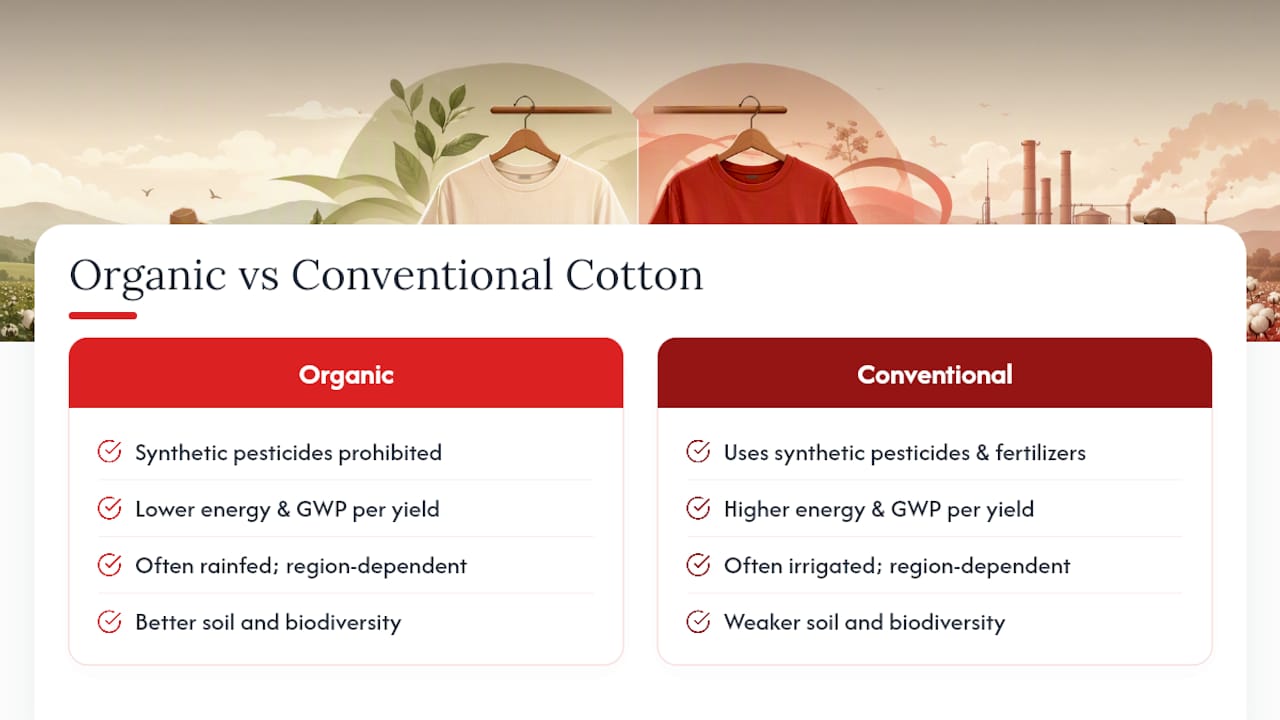
Soil and biodiversity benefits round out the picture. Crop rotation, cover cropping, and the absence of persistent synthetic pesticides in organic systems tend to support healthier soil microbiology and more resilient farmland ecosystems over time. That’s a slower-moving, harder-to-quantify benefit than a GHG number, but it’s consistent across the research base on organic agriculture generally.
Does Organic Cotton Actually Feel Softer or Last Longer?
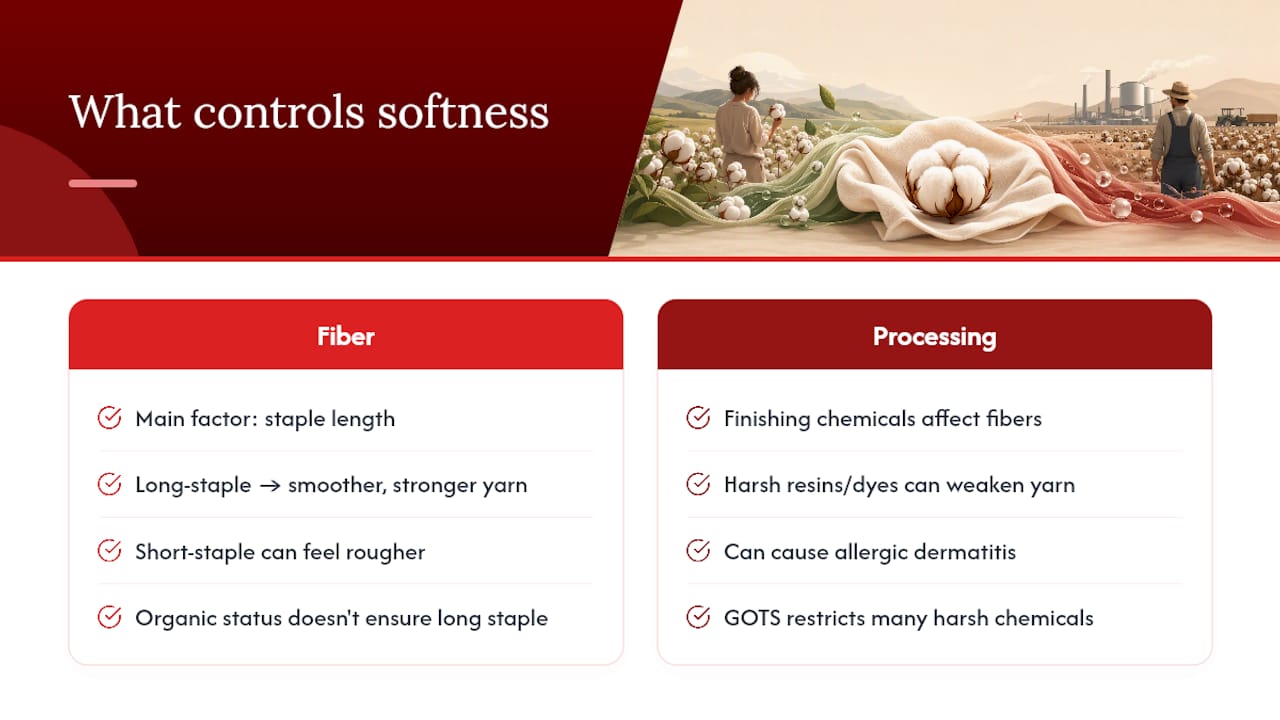
Here’s where a lot of shoppers get misled: organic status has almost nothing to do with how soft a shirt feels in your hand. Fiber quality comes down to staple length, the measurement of individual cotton fiber strands, according to NC State textile researcher Kavita Mathur. Long-staple varieties like Pima and Supima produce smoother, stronger yarn regardless of whether the plant was grown organically or conventionally. Some organic cotton is actually shorter staple than premium conventional cotton, which means a cheap organic tee can feel noticeably rougher than a well-made conventional long-staple shirt.
Processing plays a second, underrated role. Harsh finishing chemicals, including certain formaldehyde-based resins and dye treatments, can weaken fiber structure and have been linked to allergic contact dermatitis in sensitive skin, per NIH-indexed dermatology research. GOTS certification restricts many of these chemicals across the entire fiber-to-finish process, which is one real reason a certified organic garment might hold up better and feel gentler over repeated washes, independent of the farming method itself. The lesson: check staple length and processing standards, not just the word “organic,” before you judge quality.
What Do GOTS, USDA Organic, and OEKO-TEX Actually Certify?
Three labels come up constantly in organic cotton marketing, and they cover very different things.
- GOTS (Global Organic Textile Standard) governs the entire supply chain from fiber to finished product, requiring a minimum percentage of certified organic fiber and banning many hazardous processing chemicals, dyes, and finishes.
- USDA NOP (National Organic Program) certifies how the cotton was farmed, meaning no synthetic pesticides or GMO seed at the field level, but it does not govern dyeing, printing, or finishing once the fiber leaves the farm.
- OEKO-TEX Standard 100 tests the finished product for harmful chemical residues, regardless of whether the fiber was grown organically, which makes it a useful complement rather than a substitute for the other two.
Because USDA NOP stops at the farm gate, a genuinely organic-grown shirt can still pick up questionable finishing chemicals unless it also carries GOTS certification, a gap the USDA and textile standards bodies both acknowledge. Watch for red flags like “contains organic cotton” without a percentage, or logos with no certifying body listed. Those phrases are marketing, not verification.
What Are the Real Trade-Offs of Buying Organic Cotton?
Organic isn’t a free upgrade, and pretending otherwise does readers a disservice. Yield is the biggest issue: some analyses report organic cotton yields are reported to be lower than conventional per acre, though exact figures vary by region and study, according to research published in Renewable Agriculture and Food Systems. Lower yield per acre means more land is needed to produce the same amount of fiber, which partially offsets organic’s other environmental advantages depending on how you weigh land use against chemical use.
That yield gap feeds directly into cost. Certification fees, lower output, and more labor-intensive pest management all push organic cotton prices higher at the farm level, and that premium flows through to retail. Supply is another real constraint. Certified organic cotton makes up a small share of global cotton production, so certain categories, like specialty performance fabrics or certain colorways, simply don’t have a certified organic version available yet.
Where Should You Actually Spend More on Organic Cotton?
If you’re going to prioritize organic anywhere, prioritize skin contact time. Here’s a practical order of operations:
- Bedsheets and pillowcases — hours of direct, overnight skin contact make chemical residue avoidance most valuable here.
- Underwear and bras — close, prolonged contact with sensitive skin.
- Towels — frequent contact plus repeated washing, which matters for durability too.
- Sleepwear — extended wear time, often against bare skin.
- Everyday t-shirts and casualwear — still worth choosing organic when price allows, but lower priority than the categories above.
Before you buy, check three things on any product page: does it name a specific certification (GOTS, USDA organic) rather than a vague claim, does it list staple length or fiber origin, and does it disclose dyeing or finishing process? A shirt from McLaren Tee Hub’s tri-blend and cotton comparison guide walks through exactly this kind of fabric-spec reading if you want a deeper primer before you shop.
If organic isn’t available or affordable in a category you need, a high-quality long-staple conventional cotton item is a reasonable substitute, especially for short-wear pieces where residue exposure matters less.
Pro Tip: Save your organic budget for anything that touches your skin for six or more hours at a stretch. For a graphic tee you wear for an afternoon, a well-made conventional cotton shirt with good care will serve you just as well.
How Much Does Garment Care Affect Cotton’s Environmental Footprint?
Fiber choice matters less than most shoppers assume once a garment is actually in rotation. How you wash, dry, and repair it often has a bigger cumulative impact than whether it started as organic or conventional.
- Wash in cold water on a gentle cycle to reduce fiber breakdown and energy use per load.
- Skip high heat drying when you can; air drying preserves elastic fibers and cotton structure longer.
- Mend small tears and replace buttons instead of retiring a garment early.
- Resell or thrift items you’ve outgrown rather than sending them to a landfill.
A shirt worn and washed for five years has a lower per-use footprint than a new organic shirt replaced every six months, no matter how it was grown. That’s a point sustainability researchers frequently emphasize: the fiber decision matters less than the “buy less, wear longer” decision.
How Mclarenteehub Approaches Fabric and Certification Claims
We sell pop culture apparel, mugs, and gifts built around fan art and movie tributes, and fabric transparency shapes how we describe those products. When a listing mentions organic materials, like the Bay 12 Organic Ribbed Beanie in our accessories lineup, we aim to state the certification and material makeup plainly on the product page rather than leaning on vague “eco-friendly” language.
That approach extends across our editorial content, including Nicholas’s earlier breakdown of tri-blend versus cotton fabric performance, which applies the same staple-length and processing lens used above. If you want a broader checklist for spotting real eco claims versus marketing language, our guide to verifying eco-friendly graphic tees covers the same certification literacy from a different angle.
Buy Less, Choose Wisely, and Take Care of What You Own
The organic versus conventional debate isn’t really about picking a winner. It’s about matching the fiber to the job. Organic earns its premium on sheets, underwear, and anything against your skin all night. Conventional, especially long-staple conventional, holds its own on a graphic tee you’re wearing for a few hours at a concert or a movie marathon.
The highest-leverage move isn’t switching fibers at all. It’s buying fewer things, choosing better-made ones, and keeping them in rotation longer. When a product page doesn’t tell you what you need to know, ask the seller directly. Real certifications come with real documentation, and a seller who can’t produce it usually can’t back the claim.
— Nicholas
Shop the Organic Cotton Options at Mclarenteehub
Our organic-cotton pieces list their certification and material makeup right on the product page, so you’re not stuck guessing whether “eco-friendly” means anything.

The Bay 12 Organic Ribbed Beanie is a good example of what we mean. It’s built from organic materials and labeled as such on the listing, no vague marketing copy standing in for an actual spec sheet. If you’re shopping pop culture tees, mugs, or hoodies and want to know exactly what a shirt is made of before you commit, check the material section on any product page first. Questions about sourcing or traceability? Reach out to customer service directly and ask before you buy.
Browsing for a gift or a piece for yourself right now? Start with something concrete, like this Alien-style mug or this Escape from New York mug, and browse our organic apparel collection from there.
Sources
The claims above draw on the Organic Center’s environmental report on cotton, NC State’s fiber quality research, Cambridge’s yield and land-use study, and NIH-indexed research on textile chemical dermatitis. For a parallel look at how organic certification works in a different supply chain, see this explainer on organic coffee certification.
- Organic Cotton and the Environment — Organic Center
- Organic cotton production may alleviate the environmental impacts of intensive conventional cotton production — Cambridge
- Kavita Mathur — NC State Textile and Apparel faculty page
FAQ
What are the downsides of organic cotton fabric?
Organic cotton typically costs more, comes from lower-yield harvests that require more land per unit of fiber, and isn’t automatically softer or more durable than conventional cotton since quality depends on staple length, not farming method.
Is 100% organic cotton the same as 100% cotton?
No.
What’s the healthiest fabric to wear?
GOTS-certified organic cotton reduces exposure to synthetic pesticide residue and restricted finishing chemicals linked to skin irritation, making it a strong choice for extended skin contact, though any well-processed natural fiber with OEKO-TEX certification also limits chemical residue risk.
Is organic cotton very soft?
Not inherently. Softness comes from fiber staple length, with long-staple varieties like Pima and Supima outperforming shorter-staple cotton regardless of whether it’s organic or conventional.