

US to EU Shoe Size: The Quick Conversion Everyone Gets Wrong
Quick answer: EU size is roughly US men’s size plus 33, and roughly US women’s size plus 31. A US men’s 9 corresponds approximately to EU 42.5. A US women’s 8 corresponds approximately to EU 39. A US men’s 10 corresponds approximately to EU 44.
Treat those numbers as a starting point, not gospel. The offset method is the same shortcut Smart Calculators uses in its own converter, and it works fine for a rough estimate, but it breaks down at the small and large ends of the size range where brands round differently.
- US men’s 8 approximates EU 41
- US men’s 9 approximates EU 42.5
- US women’s 7 approximates EU 38
- US women’s 8 approximates EU 39
Pro Tip: Skip the math entirely when you can. Measure your foot length in centimeters and read straight across a size chart. It’s the single most reliable step before you check out, and it takes about two minutes with a ruler and a wall.
Key Takeaways
Measuring foot length in centimeters and cross-checking a brand’s own size chart beats any fixed US to EU offset formula for getting a reliable fit.
| Point | Details |
|---|---|
| Use the quick offset only as a start | Add 33 for men’s sizes or 31 for women’s sizes to get a rough EU estimate, not a final answer. |
| Measure in centimeters | Foot length in cm, checked against a chart, is the most reliable way to find your true EU size. |
| Expect drift and rounding | Paris points and barleycorns step differently, so conversions often land on half sizes. |
| Round up when uncertain | Choose the larger whole EU size for kids, wide feet, thick socks, or brands known to run small. |
| Shop Mclarenteehub with your measurement in hand | Mclarenteehub’s footwear listings pair with its own measurement guide so you can convert accurately before ordering. |
Table of Contents
- US to EU Shoe Size Conversion Chart for Men, Women, and Kids
- How to Measure Your Foot for an Accurate EU Size
- Why US and EU Shoe Sizes Don’t Convert Cleanly
- When to Round Up and How Width Changes Everything
- McLaren Tee Hub’s Approach to Sizing Footwear Right
- Sizing Differences Across European Countries
- Sizing Inconsistencies Among Popular EU Shoe Brands
- Trying On Shoes You Bought From International Sellers
- How Foot Width Changes Your EU Size Conversion
- Boots vs. Sneakers: Why Shoe Style Changes the Size You Need
- What the Research Actually Supports
- Find Your Fit With Mclarenteehub’s Pop Culture Footwear
- Sources
US to EU Shoe Size Conversion Chart for Men, Women, and Kids
Here’s a general reference table lining up US sizes with EU equivalents plus typical foot lengths in centimeters, which is useful for brand comparisons.
Men’s sizing
Women’s sizing
Kids’ sizing
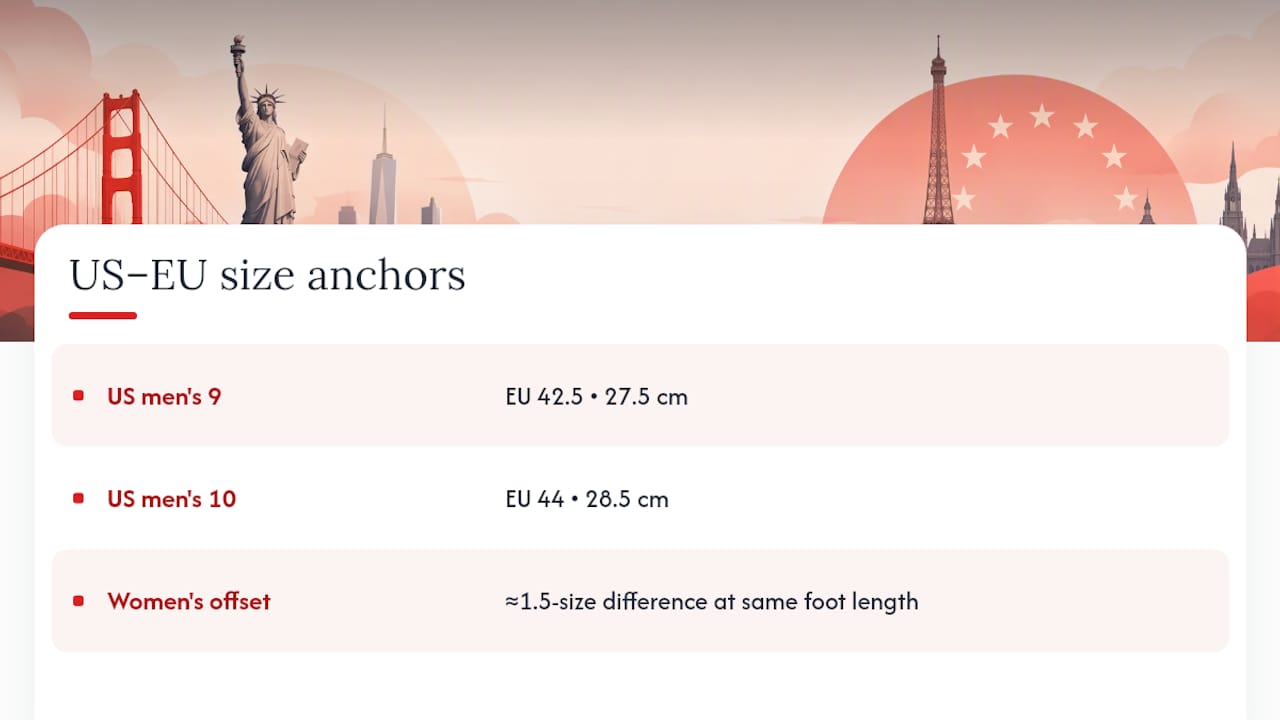
Those anchor points hold up well: a US men’s 9 maps to EU 42.5 at 27.5 cm, and a US men’s 10 lands at EU 44 around 28.5 cm. Notice the women’s column runs about a size and a half apart from the men’s column at the same foot length. That’s not a rounding error. It’s baked into how the two scales are numbered, which we’ll get into shortly.
One caveat worth repeating: these are standard references, not brand law. A New Balance 9 and a Vans 9 will not always land on the same EU number, even though the chart says they should.
How to Measure Your Foot for an Accurate EU Size
Skip the guesswork and measure directly. This takes five minutes and beats any size chart math you could do in your head.
- Tape a sheet of paper to a hard floor, against a wall.
- Stand on the paper with your heel touching the wall.
- Mark the floor at the tip of your longest toe (not always the big toe).
- Measure the distance from the wall to the mark in centimeters.
- Repeat for the other foot, since most people have one slightly larger foot.
- Record the longer measurement. That’s the one you size from.
- Do this in the evening. Feet swell throughout the day, and measuring both feet at day’s end prevents the classic mistake of buying too small.
Once you have your measurement in centimeters, you can estimate EU size using the Paris-point formula: EU size is roughly 1.5 times (foot length in cm plus 1). For instance, a 26.7 cm foot corresponds approximately to EU 42, close to typical size charts.
This method beats label-to-label math because it sidesteps the guesswork entirely. Your foot doesn’t change when you shop a new brand. Its labeling system does. Foot length is the one constant you can trust, so start there and use the label as a final gut check against the specific brand’s chart.
Why US and EU Shoe Sizes Don’t Convert Cleanly
The two systems were never designed to talk to each other. That’s the honest answer, and it’s why every conversion chart, including this one, comes with an asterisk.
EU sizes are built on the Paris point, a unit equal to two thirds of a centimeter, or roughly 6.67 mm. US sizes are built on the barleycorn, an old English unit equal to a third of an inch, or about 8.47 mm. Neither unit was designed with the other in mind, which is why the two scales drift apart as sizes get larger.
| Unit | Step Size | System |
|---|---|---|
| Paris point | 6.67 mm | EU |
| Barleycorn | 8.47 mm | US/UK |
That 1.8 mm gap per step is why conversions often land you on a half size instead of a clean whole number.
Then there’s the last, the foot-shaped mold a shoe is built around. Two brands can label a shoe the same EU 42 and still produce different internal volumes, because the last shape varies by manufacturer, not just by size number.

Add gender scaling on top of that. EU sizing runs largely unisex, while US sizing splits men’s and women’s numbering with roughly a 1.5-size offset between them. A US women’s 10 and a US men’s 8.5 both correspond to about EU 42. Three different systems, three different logics, one shared shoe.
When to Round Up and How Width Changes Everything
Rounding is where most people guess wrong, so here’s the rule: if your converted size lands between two EU numbers and the retailer only stocks whole sizes, round up. A US men’s 9 that converts to EU 42.5 should become EU 43 if half sizes aren’t available.
- Round up when the brand is known to run small or narrow.
- Round up half a size for thick socks, orthotics, or winter boots.
- For kids, order one EU size up when you’re between two, since children’s feet grow about a centimeter a year between ages 6 and 10.
- Remember the EU scale runs continuously across ages, while US kids’ sizing restarts at youth and again at adult, so don’t assume a straight EU number carries over from toddler to youth charts.
Pro Tip: Width matters as much as length here. If you’ve got a wide foot and you’re already rounding up for a snug brand, go up a full size rather than stacking two half rounds. Two small adjustments compound into a shoe that fits the tape measure but not your foot.
McLaren Tee Hub’s Approach to Sizing Footwear Right
Measuring your foot once means never guessing again, whether you’re ordering sneakers for your commute or the horror-movie boots on your wish list. Mclarenteehub built its shoe sizing guide around exactly this problem: measure in centimeters with your phone, then cross-reference the EU chart above before you check out.
A few habits we recommend to shoppers browsing pop-culture footwear:
- Check the specific product page for a brand size note before assuming standard conversion applies.
- Measure both feet at the end of the day and size from the larger one.
- Favor a seller with a clear returns policy when you’re between two sizes, since even careful measuring leaves some margin for error.
This article was reported and written by Nicholas, drawing on published sizing standards and measurement guidance rather than a single brand’s marketing claims.
Sizing Differences Across European Countries
“EU size” suggests one tidy standard, but a few European countries run their own parallel systems alongside it. The United Kingdom uses its own scale entirely, roughly one full size below the EU number for the same foot. France, Germany, Italy, and Spain generally follow the same core Paris-point sizing, but retailers within those countries still round differently on borderline sizes.
Italian brands in particular have a reputation for running narrow and half a size small compared to French or German labels using the identical EU number. This isn’t official policy, it’s a pattern shoppers and reviewers report consistently enough that it’s worth knowing before you order Italian-made boots or dress shoes online.
Scandinavian retailers often add a bit of extra room in the toe box even at the same labeled EU size, a holdover from sizing conventions built around thicker socks and colder climates. None of this shows up on a standard conversion chart, because the chart reflects the official Paris-point math, not the manufacturing habits layered on top of it.
The practical takeaway: treat the EU number as your starting point, then let the country of origin adjust your expectations. A size 42 dress shoe from Italy and a size 42 hiking boot from Germany are both technically the same EU number and can fit noticeably differently on the same foot.
Sizing Inconsistencies Among Popular EU Shoe Brands
Brand-to-brand variation inside the EU system is arguably the bigger headache, more than any country-level quirk. A German-made athletic shoe and a French-made casual sneaker can both carry an EU 42 label while differing by nearly half a size in actual internal length, because each brand builds its own last.
Athletic brands tend to run closer to true-to-size against the standard chart, since performance footwear is engineered around precise foot measurements. Fashion-forward European brands, especially those making narrow dress shoes or boots, frequently run a half size small and noticeably narrow through the midfoot.
Budget and fast-fashion labels sit at the other extreme, often running generously sized to accommodate a wider range of feet with fewer width options. That’s a deliberate manufacturing tradeoff, not an error, but it means the same EU number can feel completely different depending on which shelf you pulled it from.
This is exactly why a manufacturer’s own last matters more than the printed number: the label tells you a rough size class, but the specific mold determines how the shoe actually sits on your foot. Whenever you’re buying a brand for the first time, spend the extra minute checking that brand’s specific chart instead of trusting the general EU conversion table.
Trying On Shoes You Bought From International Sellers
Buying footwear from an overseas retailer removes your ability to try before you buy, so the return window becomes your real safety net. Before you order, read the seller’s return policy closely, because international returns sometimes carry shipping costs that domestic ones don’t.
When the shoes arrive, try them on indoors, on carpet, and in the afternoon rather than first thing in the morning. Feet are at their smallest before you’ve been on them all day, so a morning try-on can trick you into thinking a slightly tight shoe fits fine.
Wear the socks you’d actually wear with that shoe style. Trying on a hiking boot with thin dress socks tells you nothing useful about how it’ll feel on the trail. Walk on both carpet and a hard floor if you can, since some shoes feel fine standing still and reveal a pinch point only once you’re moving.
Keep the original packaging until you’re sure. A shoe that feels close but not quite right after ten minutes of wear rarely improves with more time, particularly with stiffer materials like leather boots that don’t break in the way canvas sneakers do. If something feels off, that’s your signal to start the return process rather than hoping it loosens up.
How Foot Width Changes Your EU Size Conversion
Length gets all the attention in conversion charts, but width is where fit actually falls apart. Two people with identical 27 cm feet can need completely different shoes if one has a narrow foot and the other has a wide one, and no length-based EU conversion accounts for that difference.
European brands generally offer fewer width options than American ones, which have long included D, EE, and other width designations on top of the numeric size. Because EU sizing wasn’t built with a formal width system layered in the way US sizing sometimes is, a wide-footed shopper converting from US to EU should expect to size up in length to compensate, since going wider isn’t usually an option.
If you have a wide or narrow foot in US sizing, you should expect the same characteristic with EU sizes. For example, someone who wears a wide US men’s 9 might consider sizing up to EU 43 rather than using the standard EU 42.5 conversion, since European shoes often run narrower.
Boots vs. Sneakers: Why Shoe Style Changes the Size You Need
The same converted EU number doesn’t mean the same fit across every shoe style you own. Sneakers are typically built with more forgiving, flexible uppers that accommodate small sizing errors better than stiffer footwear. A sneaker a half size off is usually tolerable. A boot a half size off usually isn’t.

Boots, especially leather work boots or fashion boots, often call for sizing down slightly from your standard EU conversion, because the material stretches and molds to your foot over the first few wears in a way canvas or mesh sneakers don’t. Buy a leather boot true to the converted chart size and you may find it feels loose within a month.
Sandals and open footwear behave differently again, since there’s no upper material to stretch and adjust, which means the converted size should be closer to exact. If you’re padding the foot with thick wool socks for winter boots, factor that into your decision the same way you would for sneakers, going up half a size to leave room rather than assuming the boot will stretch to compensate. Sock thickness affects fit and comfort more than most shoppers expect, particularly in athletic and outdoor footwear where friction and blisters are the real cost of guessing wrong.
What the Research Actually Supports
Most sizing advice online treats the US to EU conversion like a fixed formula you can memorize and forget. That’s the part I’d push back on hardest. The +33 and +31 shortcuts are useful for a ballpark, but they were never built for precision, and treating them as exact is how people end up with a drawer of shoes that don’t fit.
What the numbers actually support is a two-step habit: measure your foot in centimeters, then check that figure against the specific brand’s chart rather than a generic conversion. The math explains why sizes drift, the last explains why brands disagree, and neither problem gets solved by adding a fixed number to your usual size.
If I had to name the one thing conventional advice underweights, it’s width. Length conversion gets all the attention because it’s easy to chart. Width is harder to standardize, so most guides skip it, even though it’s often the actual reason a “correctly converted” shoe still feels wrong. Measure first. Check the brand second. Treat the offset trick as a rough guess, never the final word.
— Nicholas
Find Your Fit With Mclarenteehub’s Pop Culture Footwear
Mclarenteehub sells footwear alongside its pop-culture apparel and gifts, which means the same measure-first approach from this guide applies directly to what’s in the catalog. Instead of guessing between a US and EU listing on a themed sneaker or boot, you can measure your foot length once, use the chart above, and shop with a real number instead of a size label that might run differently than you expect.

Browse the current lineup, from graphic tees to character-inspired footwear, and check each product page for its specific size notes before you order. If you’re shopping for apparel at the same time, the site’s hoodie sizing guide uses the same measurement logic, so you only need to learn the method once. Ready to put it into practice? Start browsing the collection and measure your foot before you check out.
Sources
- Shoe size - Wikipedia
- US to EU Shoe Size Converter — Smart Calculators
- Size
- US vs EU shoe size: why every conversion table disagrees — Convertitive