

Common Movie Merchandise Mistakes and How to Fix Them
TL;DR:
- Most common movie merchandise mistakes involve intellectual property misuse and inadequate quality checks.
- To avoid legal issues, sellers must verify IP clearance, order physical samples, and maintain detailed licensing documentation.
The most common movie merchandise mistakes are avoidable. Most stem from IP misuse, weak production QA, and listing errors that invite takedowns or returns. Here is the short version before anything else:
Pre-publish checklist:
- IP misuse — using copyrighted characters or logos without a license. Fix: build original fan-art or parody designs with legal counsel.
- Trademarked names in metadata — franchise titles in your tags trigger automated flags. Fix: describe the aesthetic, not the property.
- Skipping samples — digital mockups lie about color and fit. Fix: order at least one physical sample per SKU before launch.
- Low-res or wrong color profile — files under 300 DPI or in CMYK instead of sRGB produce muddy prints. Fix: export at 300 DPI in sRGB.
- Missing bleed and safe zones — artwork gets clipped at the edges. Fix: add 0.125 inches of bleed and keep text 0.25 inches inside the safe zone.
- Inaccurate sizing info — no flat-measure chart means returns. Fix: publish garment measurements in inches alongside standard U.S. sizes.
- Misleading mockups — renders that oversell print vibrancy. Fix: use real product photos from your sample run.
- No documented license — no paper trail when a rights holder sends a cease-and-desist. Fix: keep dated drafts, source files, and any license agreements on file.
Pro Tip: Run this checklist as a shared document with your print provider. Both parties sign off before any file goes to production.
Table of Contents
- What are the most common movie merchandise IP mistakes?
- How do marketplaces detect and remove infringing listings?
- What design and production errors cause the most returns?
- How do sizing mistakes drive up your return rate?
- Why do lead time and cost miscalculations kill launches?
- What listing and photo mistakes reduce conversions?
- What does a prelaunch quality-control checklist look like?
- When do you actually need a movie IP license?
- What red flags should stop a listing from going live?
- Key Takeaways
- Why the real risk is the one sellers think they have covered
- Mclarenteehub makes it easier to get this right
- Authoritative sources and further reading
What are the most common movie merchandise IP mistakes?
Altering or redrawing a copyrighted film image for commercial merchandise is usually infringing, regardless of how much you change it. Under the U.S. Copyright Act, a derivative work requires authorization from the rights holder. Legal analysis confirms that resized, recolored, or redrawn “inspired by” artwork still qualifies as an infringing derivative work when sold commercially, and fair use rarely protects those sales.
Fair use has four factors — and commercial merchandise almost always fails at least two of them: the commercial nature of the use and the market substitution effect. A T-shirt sold for profit that replaces a licensed product the studio could sell is not transformative enough to qualify.
The disclaimer trap is real. Writing “unofficial fan art” or “not affiliated” on your listing does not shield you from takedowns or legal liability. Print-on-demand copyright guidance is explicit: the commercial nature and market substitution factors structurally undermine a fair-use defense for merch sellers.
Steps to reduce legal exposure:
- Audit every design for recognizable characters, logos, and titles before production.
- Check the U.S. Copyright Office’s public domain records if the source material predates 1928.
- Remove all franchise names, character names, and trademarked slogans from titles, tags, and descriptions.
- Keep dated source files and design drafts — they establish your creative process if a dispute arises.
- Consult an IP attorney before launching any design that references a specific film property.
Pro Tip: Search the USPTO trademark database for any word or phrase you plan to use in metadata. A hit means you drop it, full stop.
How do marketplaces detect and remove infringing listings?
Marketplaces use automated content ID systems and trademark filters that scan listing titles, tags, images, and descriptions continuously. Enforcement is routine, not exceptional. Automated IP detection means a single flagged keyword in your metadata can trigger a listing removal before any human reviews it.
The typical enforcement sequence runs like this:
- Automated scan flags a trademark or image match.
- The listing is removed and the seller receives a policy violation notice.
- Repeat violations escalate to account warnings, withheld funds, and permanent suspension.
Studios treat IP protection as brand integrity. Major studios actively monitor storefronts and enforcement intensity increases as a seller scales or gains visibility. A small shop with ten listings gets less scrutiny than one running paid ads on a franchise keyword.
Practical safeguards: avoid trademarked keywords in every metadata field, maintain licensing records in a dedicated folder, use the platform’s official dispute template if you receive a wrongful takedown, and audit your active listings monthly.
Pro Tip: Set a Google Alert for your shop name plus “DMCA” or “takedown.” Early warnings give you time to respond before a violation escalates.
What design and production errors cause the most returns?
Design-to-production mismatches are the leading cause of returns and one-star reviews. The gap between a screen preview and a printed garment is wider than most sellers expect.
Preproduction file checklist:
- Minimum 300 DPI at print size (vector files preferred for logos and text)
- Color profile: sRGB for direct-to-garment (DTG) and sublimation; confirm with your provider
- Bleed: 0.125 inches beyond the cut line; safe zone: 0.25 inches inside
- File format: PNG with transparent background for apparel; PDF for hard goods
- Version naming: include date and revision number in the file name
| Print method | Best substrate | Common failure |
|---|---|---|
| DTG | Cotton, cotton-blend | Low color vibrancy on dark garments below 300 DPI |
| Sublimation | Polyester, hard goods | Color shift on anything below all-polyester |
| Screen print | Cotton | Cracking if ink layer is too thick or cure temp is off |
| UV print | Mugs, phone cases | Adhesion failure without proper surface prep |
Ordering physical samples before a full run is the single most reliable way to catch these failures. Real-world print quality, color vibrancy, and sizing regularly differ from digital previews.
Experienced sellers also focus on original niche art rather than franchise imagery. Genre-style designs with no character names or logos sidestep both IP risk and the design-approval bottlenecks that come with licensed properties. Mclarenteehub’s guide to designing legally compliant movie-inspired merch walks through this approach in detail.
Pro Tip: Keep a timestamped photo of every sample you approve. If a production run comes back wrong, that photo is your proof of the agreed standard.
How do sizing mistakes drive up your return rate?
Incorrect sizing information is a top driver of returns, and it costs more than the refund. You lose the product, the shipping, and often the customer.
Size chart checklist:
- Measure garments flat (chest, length, sleeve) in inches
- Include a conversion guide for U.S. sizes (S, M, L, XL, 2XL)
- Note fabric shrinkage: most cotton garments shrink 3–5% after the first wash
- Add tolerance notes: ±0.5 inches is standard for cut-and-sew
- For hats and beanies: list circumference range in inches, not just “one size”
- For mugs: state capacity in fluid ounces and overall height
| Product type | Key measurement | Common mistake |
|---|---|---|
| T-shirts / hoodies | Chest width (flat), body length | Publishing only S/M/L without measurements |
| Hats / beanies | Head circumference range | Listing “one size fits all” with no measurement |
| Mugs | Capacity (fl oz), height | No dimension info; customers guess wrong |
Order samples in at least two sizes before launch. Try them on or have someone with the target measurements wear them. A hoodie that fits a size chart on paper can still run narrow in the shoulders or short in the body depending on the cut.
Why do lead time and cost miscalculations kill launches?
Miscalculating production lead times and total landed cost causes stockouts, missed launch windows, and negative margins. The formula most sellers skip:
- Unit cost (production)
- Inbound shipping to fulfillment center or customer
- Import duties if sourcing internationally
- Returns allowance (budget 5–10% for apparel)
- Platform fees (typically 15–20% on major marketplaces)
- Packaging materials
Print-on-demand (POD) generally ships within a matter of business days per unit, while bulk production and shipping can take multiple weeks depending on scale and transit. Add a two-week buffer for peak periods: holiday season and major film release windows. Crossover film hype cycles can compress your launch window to days, so having hero SKUs ready before the announcement is the only reliable play.
One often-overlooked cost: your print provider will produce infringing files if you submit them. The legal responsibility stays with you as the seller, not the manufacturer. Factor potential legal costs into your risk model.
For collectibles shipping specifically, the CGC submission guide on packaging and shipping covers damage-prevention practices that apply equally to fragile merch like mugs and enamel pins.
What listing and photo mistakes reduce conversions?
Poor listings and misleading mockups reduce conversions and generate complaints. Real product photos outperform renders on conversion rate every time.
Photo checklist:
- Hero shot: clean background, full product visible
- Scale shot: product next to a common object or on a model
- Print detail close-up: shows resolution and color accuracy
- Packaging shot: builds perceived value
- Wash/after-use photo: proves durability for apparel
Metadata rules:
- Write titles that describe the aesthetic, not the franchise (“retro sci-fi horror mug” not “[Film Title] mug”).
- Use descriptive tags: genre, color, style, occasion.
- Never include character names, film titles, or trademarked slogans in any metadata field.
- Write descriptions that set accurate expectations for size, material, and print placement.
Pro Tip: Order a lifestyle sample specifically for photography before your full launch. Real photos on a real person convert better and reduce “not as pictured” returns.
What does a prelaunch quality-control checklist look like?
Sample testing and simple QC routines catch the vast majority of product issues before they reach customers. Run this plan for every new SKU:
- Order a minimum of two samples per SKU (different sizes for apparel).
- Wash test: run through a standard warm-water cycle and tumble dry. Check for color fade, cracking, and shrinkage.
- Colorfastness check: compare the washed sample to the original under consistent lighting.
- Adhesion test: for DTG and UV prints, flex the substrate and check for cracking or peeling.
- Inspect stitching, seams, and label placement on apparel.
- For mugs and hard goods: drop test from counter height onto a padded surface; check for chips.
- Verify care label accuracy against the actual fabric content.
For POD, inspect every fifth order from a new provider until you have 20 clean results. For bulk runs, inspect 10% of units on arrival. Packaging checks matter too: use bubble wrap or foam inserts for mugs, and test moisture resistance for anything shipped in humid conditions.
Pro Tip: Photograph every sample test with a timestamp. If a print provider disputes a quality complaint, dated photos are your evidence.
When do you actually need a movie IP license?
If your design uses specific characters, recognizable logos, or film titles, you need a license. No license means you should expect takedowns and potential legal claims.
Steps to pursue licensing:
- Identify the rights holder: studios, production companies, or licensing agents (search the film’s distributor).
- Contact the licensing department directly with a brief describing your product, territory (U.S.), intended print run, and retail price.
- Confirm these terms in writing: commercial scope, territory, duration, royalty rate or flat fee, print run limits, and sample approval requirements.
- Retain all correspondence, signed agreements, and approved sample photos.
Documents to keep on file:
- Signed license agreement with effective dates
- Approved artwork files (the exact version the licensor approved)
- Sample approval photos with timestamps
- Royalty payment receipts
If a license is unavailable or too costly, the practical alternatives are: public-domain properties (pre-1928 U.S. works), original characters in a genre style, or aesthetic-based designs that reference a mood rather than a specific property. Mclarenteehub’s minimalist film shirt guide shows how genre-inspired designs work in practice.
Pro Tip: Never launch on a license “pending.” If approval is not in writing, treat it as unapproved.
What red flags should stop a listing from going live?
If any of these conditions exist, pause the listing until resolved:
- Trademarked name, character name, or franchise title appears anywhere in the metadata
- No physical sample photo on file for this SKU
- Size chart uses only S/M/L labels with no measurements in inches
- No documented license for a design that uses recognizable IP
- Print method is incompatible with the substrate (e.g., sublimation on a cotton garment)
- Artwork file is below 300 DPI at print size
- “Unofficial fan art” or “not affiliated” disclaimer is the only IP protection in place
After fixing any red flag, re-run the pre-publish checklist from the opening section before the listing goes live.
Key Takeaways
Avoiding common movie merchandise mistakes requires IP clearance, physical sample testing, and honest listings before any product goes live.
| Point | Details |
|---|---|
| IP clearance is non-negotiable | Altered or “inspired by” art is usually infringing; remove franchise names from all metadata. |
| Physical samples prevent returns | Digital mockups do not reflect real print quality, color, or fit — order samples for every SKU. |
| Metadata triggers enforcement | Trademarked keywords in titles or tags trigger automated takedowns even when artwork is original. |
| Total cost includes returns and fees | Budget unit cost, shipping, duties, a 5–10% returns allowance, and platform fees before pricing. |
| Mclarenteehub as a reference | Mclarenteehub applies IP checks, sample testing, and metadata audits before every listing goes live. |
Why the real risk is the one sellers think they have covered
The sellers who get hit hardest are not the ones who knowingly copy a franchise. They are the ones who genuinely believe they have done enough: they redrew the character, they added a disclaimer, they checked that their print provider would accept the file. Each of those steps feels like due diligence. None of them is.
What actually protects a seller is a combination of original creative work, clean metadata, and documented process. The disclaimer does nothing. The redrawn character is still a derivative work. The print provider’s acceptance is not legal clearance. The only durable protection is a design that does not depend on someone else’s IP to sell.
The sellers who build sustainable catalogs are the ones who invest in a distinct visual identity: a genre mood, a color palette, a recurring graphic language that fans recognize as theirs. That is harder than copying a franchise character, but it compounds. Every original design you build is an asset. Every infringing one is a liability waiting to be called in.
Mclarenteehub makes it easier to get this right
Pop culture merch done right is specific: the right print method for the substrate, honest product photos from real samples, and listings that accurately describe what you actually made. Mclarenteehub builds every product with those standards in place, from the film-inspired tees to the movie-themed mugs that show exactly what you get before you order.
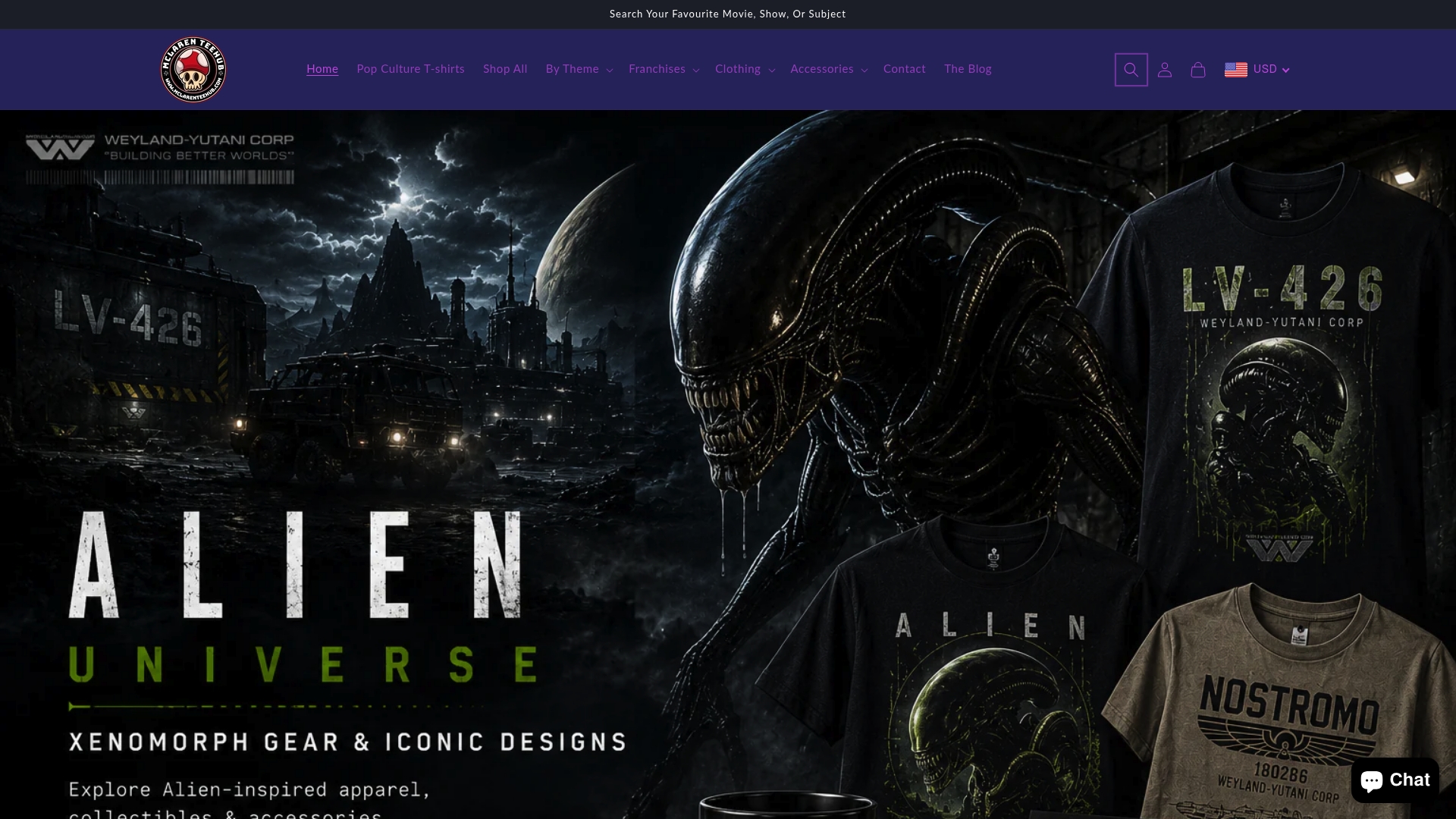
Every listing goes through an IP check, a sample review, and a metadata audit before it goes live. Size charts include flat measurements in inches. Product photos come from real samples, not renders. If you want to see what that standard looks like in practice, browse the pop culture collector’s guide or go straight to the store and order a sample for yourself.
Authoritative sources and further reading
- Is it legal to sell T-shirts with altered movie images without permission? - Texas Business Law Questions & Answers - Justia Ask A Lawyer
- How to Turn Fan Art into Custom Pins (Legally) | CreatePins
- Print on Demand Copyright 2026: Legal Guide for Sellers | merchOne
- How to avoid copyright infringement in print on demand | Bootstrapping Ecommerce
- How to Make Merch Like Your Favorite Creators in 2026 | Fourthwall
- How to sell merch: guide | merchTitans
This article provides general information about U.S. intellectual property and merchandising practices. It is not legal advice. Confirm current rules with a qualified IP attorney or the U.S. Copyright Office before making licensing or compliance decisions.