

Wash a Baseball Cap Safely: 10–20 Min Soak, 12–24 Hr Air Dry
The safest way to wash a baseball cap is by hand, in cool water with a mild detergent, working the sweatband with a soft brush and skipping the wringing entirely. Machine washing works only under specific conditions: a snug hat cage, a cold gentle cycle, and a brim that isn’t cardboard. Skip the dishwasher and the dryer no matter what you’ve heard, and always check the care label and brim material before you touch water.
TL;DR:
- Hand washing with cool water, mild detergent, and careful scrubbing preserves a cap’s shape and color better than machine washing or drying.
- Use a snug hat cage or mesh bag and avoid heat or high agitation when machine washing if the cap’s materials and care label permit spot cleaning.
- Avoid using a dishwasher or dryer, as heat and harsh detergents can warp or discolor the cap, especially with cardboard brims or delicate materials.
- Pre-treat sweatbands with a gentle detergent or enzyme cleaner before soaking to effectively remove sweat stains and odors.
- Always reshape and air-dry caps on rounded supports in shaded areas, never flat or in direct sunlight, to maintain their original form.
Table of Contents
- How Do You Hand Wash a Baseball Cap Step by Step?
- What’s the Best Way to Remove Sweat Stains From a Cap?
- Can You Wash a Baseball Cap in the Washer?
- Why Are Dishwashers and Dryers Bad for Baseball Caps?
- How Do You Know If a Cap’s Brim or Material Can Be Washed?
- How Should You Dry and Reshape a Cap After Washing?
- How Often Should You Wash a Baseball Cap?
- What’s the Best Way to Store a Freshly Washed Cap?
- Author Perspective: What We See Customers Get Wrong
- Caps Built to Handle Regular Wear and Regular Washing
- Sources
- FAQ
How Do You Hand Wash a Baseball Cap Step by Step?
Hand washing is still the gold standard for cap care, and the Stanford research on cap cleaning backs that up: it’s the method most likely to keep the shape and color intact over repeated washes. It also takes less gear than you’d think.
What you need:
- A sink or basin large enough to submerge the crown
- Mild detergent (dish soap or a gentle laundry detergent)
- A soft-bristle brush or an old toothbrush
- Two or three microfiber cloths
- A clean towel
- A rounded object to dry the cap on (more on that below)
Here’s the actual process:
- Check the care label first, then feel the brim. If it flexes without cracking, you’re likely dealing with plastic or fabric-wrapped foam, not cardboard.
- Dab a damp cloth on a hidden spot inside the cap and press a white towel against it. If color transfers, stop and treat the cap more gently, using cooler water and less scrubbing.
- Mix cool water with a small amount of detergent in your basin. Cool matters here, not lukewarm.
- Submerge the cap and let it soak for 10 to 20 minutes.
- Scrub the sweatband and any visible dirt with your soft brush, using small circles instead of hard back-and-forth strokes.
- Rinse thoroughly under cool running water until no suds remain.
- Press water out with a towel. Do not wring or twist the cap.
- Reshape it immediately and set it to dry (see the drying section below).
Active hand-washing usually takes several minutes, followed by a full day or more of air drying, according to the same Stanford guide. If your cap has embroidered logos or patches, wipe those areas with a cloth instead of brushing directly. Aggressive scrubbing on stitched logos is one of the fastest ways to fray thread or lift a patch edge.
Pro Tip: If the sweatband still smells after one wash, don’t reach for more detergent. Do a second short soak with plain cool water. Residual soap trapped in foam padding is a more common cause of lingering odor than dirt.
What’s the Best Way to Remove Sweat Stains From a Cap?
Sweat stains concentrate along the inside band, and that’s exactly where pre-treatment needs to happen before you soak the whole cap. Rubbing detergent directly into the fabric there, ahead of a full wash, breaks down the salt and oil buildup that plain water alone won’t touch.
- Apply a small amount of mild detergent or an enzyme-based cleaner directly to the sweatband and work it in with a soft toothbrush.
- Avoid bleach entirely. It can weaken fibers and discolor logos even on white caps.
- For a light refresh, a few minutes of soaking is usually enough, while a deeper clean on heavily soiled bands can call for a longer soak as recommended by the Stanford cap-cleaning research.
- Run the hidden-spot colorfastness test before any of this if you haven’t already.
- Rinse thoroughly. Leftover detergent residue attracts more dirt over time and can leave a stiff, sticky feel.
One detail people skip: heat sets sweat stains permanently into fabric, so never pre-treat with hot water or toss a stained cap through a hot dryer cycle hoping it’ll “bake out.” The American Cleaning Institute’s stain removal guide is blunt about this. Cool water and patience beat heat every time.
Can You Wash a Baseball Cap in the Washer?
Yes, but only if your cap qualifies. Machine washing is a convenience trade-off, and it only makes sense for caps built to survive it.
Your cap qualifies if:
- The brim is flexible plastic, not cardboard.
- The care label doesn’t explicitly say “hand wash only.”
- The crown holds its shape without stiff internal structuring that could crease under agitation.
How to do it safely:
- Fit the cap snugly into a hat cage or a mesh laundry bag. A device like a hat-washing cage supports the crown and brim so the machine’s tumbling doesn’t crush them, though not every hat frame fits every cap style.
- Wash it alone, or with a very light load. Never toss it in with jeans or towels.
- Use cold water on a gentle or delicate cycle with a mild detergent.
- Skip bleach and fabric softener completely.
What to avoid:
- Front-load machines tend to be riskier than top-loaders because of how aggressively they tumble items during the wash.
- Never put the cap in the dryer afterward, cage or no cage.
Once the cycle finishes, inspect the brim and crown immediately and reshape the cap while it’s still damp, before it has a chance to dry in a bent position.
Pro Tip: If you’re not sure whether your machine’s gentle cycle is truly gentle, run an old towel through it first and watch the agitation speed. If it looks aggressive, hand washing is the safer bet regardless of what the cap cage claims to protect.
Why Are Dishwashers and Dryers Bad for Baseball Caps?
The dishwasher trick shows up in a lot of forum threads, but it’s a shortcut that tends to backfire. Dishwasher detergents are formulated for grease and food residue, and many contain bleach-adjacent brighteners that can discolor and warp a cap over just one or two cycles. The heated dry cycle that follows makes it worse, since it applies sustained high heat directly to the brim.
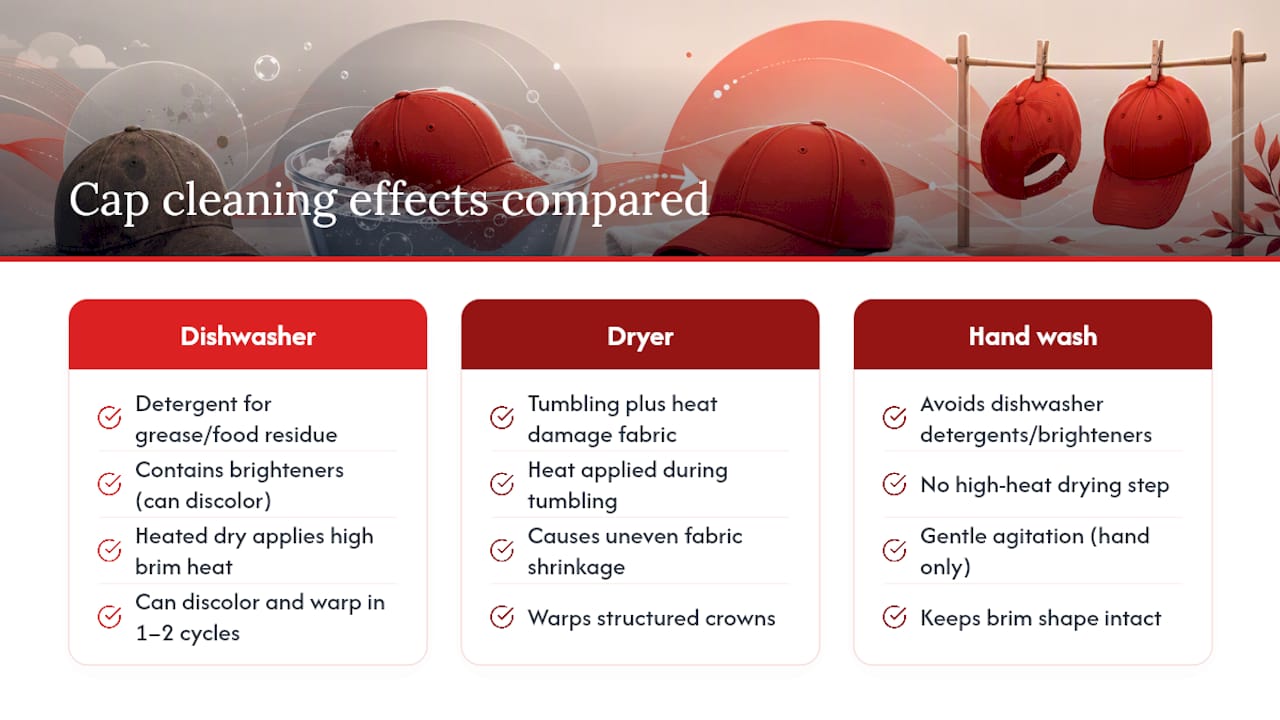
Dryers cause similar damage from a different angle: tumbling combined with heat shrinks fabric unevenly and warps structured crowns. If you take away one thing from this section, make it this: hand washing consistently outperforms both shortcuts for keeping shape and color intact.
How Do You Know If a Cap’s Brim or Material Can Be Washed?
Not every cap can handle water, and figuring that out before you start saves you from ruining something that can’t be fixed.
Cardboard brims show up mostly in vintage caps made before the 1980s, though some budget caps still use them today. A quick flick test helps: press gently on the underside of the brim near the edge. Cardboard feels papery and gives a soft, dull sound, while plastic feels firmer and flexes back into shape. If you suspect cardboard, spot-clean only, using a barely damp cloth and never full submersion, since the Stanford guide notes cardboard brims warp permanently once wet.
Wool caps, suede panels, and leather trim don’t respond well to standard detergent and water. Use a fabric-specific cleaner made for that material, or send it to a professional cleaner if the piece has real sentimental or resale value. If you’re unsure whether a beanie-style cap or a structured dad hat in your closet uses a delicate material, this breakdown on cuffed beanies versus dad hats covers common construction differences worth knowing before you wash anything.
Colorfastness gets a final check with a damp cloth pressed against a hidden interior seam. Any dye transfer means you dial back to cooler water and a gentler touch.
How Should You Dry and Reshape a Cap After Washing?
Drying is where most caps actually get ruined, not washing. A cap left to dry flat on a counter tends to warp along whatever edge is touching the surface, and a cap dried under direct sun fades fast and can weaken the fibers.
- Set the damp cap on a rounded support that mimics a head shape. An inverted bowl, a large coffee can, or even a tightly rolled towel works.
- Place it in a shaded, well-ventilated spot. Avoid windowsills and anywhere near a heater or radiator.
- Let it air-dry for 12 to 24 hours, checking at the halfway point to adjust the brim curve if it’s flattening unevenly.
- If the brim still looks slightly off once dry, dampen it again lightly and wear the cap for an hour. Body heat and head shape will remold it closer to a natural fit, a trick field staff and longtime cap collectors have used for years, according to The Art of Manliness.
Pro Tip: Skip the microwave and the blow dryer, even on low heat. Both push moisture out fast, but they also bake in whatever shape the cap happens to be in at that exact second, warped or not.
How Often Should You Wash a Baseball Cap?
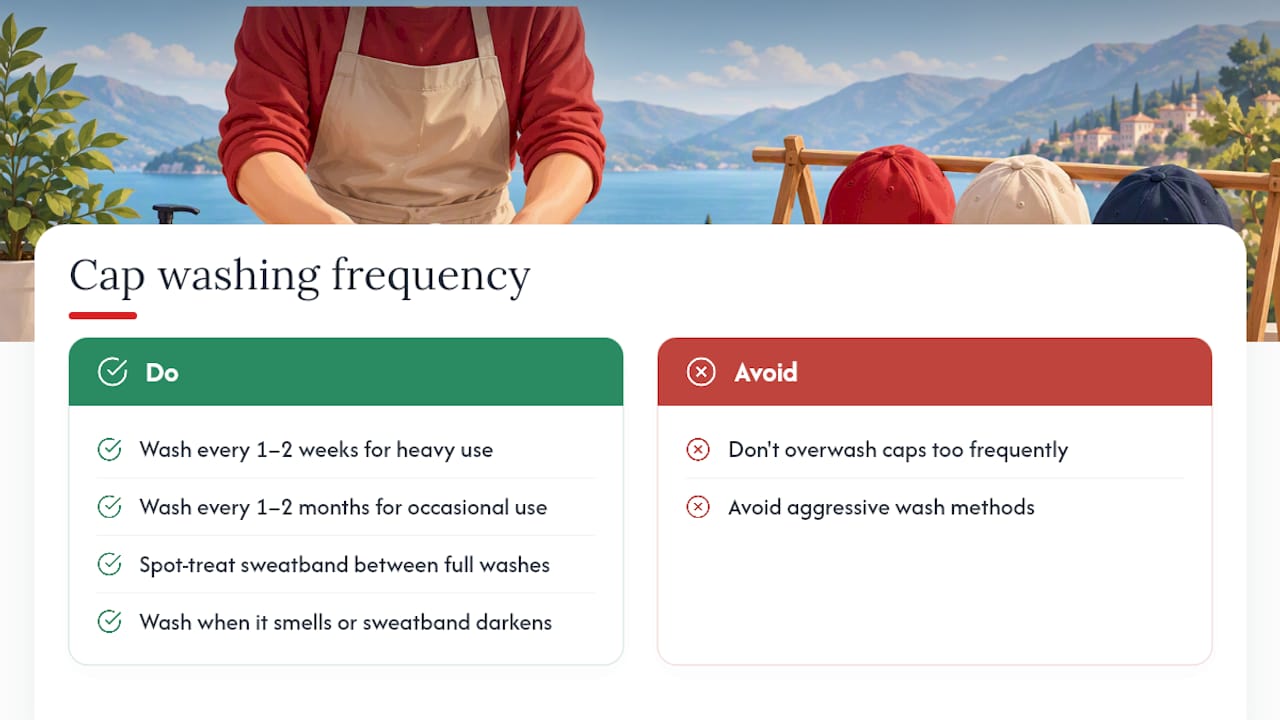
Most people wash caps far less often than they should, or they overdo it and wonder why the shape starts sagging after a few months. The honest answer depends on how the cap gets used. A cap worn for yard work, workouts, or daily outdoor labor picks up sweat and oil fast, and it benefits from a light hand wash every one to two weeks. A cap worn occasionally, for errands or the occasional weekend outing, can usually go a month or two between washes without any hygiene concern.
Sweat and body oil are the real drivers here, not visible dirt. A cap can look perfectly clean on the outside while the sweatband harbors bacteria and odor that only builds with wear. That’s why spot-treating the sweatband regularly, even between full washes, tends to matter more for hygiene than washing the entire cap on a rigid schedule.
Overwashing carries its own risk. Every wash cycle, even a gentle hand wash, puts some stress on the fibers and the internal structuring that gives a cap its shape. Caps washed too aggressively or too frequently tend to soften and lose crown structure faster than ones washed only when they actually need it. A reasonable middle ground: wash when the cap smells, when the sweatband visibly darkens, or when it’s been more than a month of regular wear, whichever comes first. That approach keeps both hygiene and shape in balance instead of sacrificing one for the other.
What’s the Best Way to Store a Freshly Washed Cap?
A cap that’s been carefully washed and dried can still lose its shape fast if it gets tossed into a drawer or stacked under other clothes right after. Storage matters almost as much as the wash itself.
Once the cap is fully dry, and not just dry to the touch but dry all the way through the sweatband, store it on a rounded support rather than laying it flat. A cap rack, a dedicated shelf where it sits crown up, or even the same coffee can or bowl used for drying all work fine for longer term storage. The goal is keeping the crown’s curve and the brim’s bend exactly where they landed after reshaping.
Avoid stacking multiple caps on top of each other. Weight from a stack flattens the top cap’s crown over time, even if each individual cap feels sturdy on its own. If closet space is tight, a wall-mounted cap rack or a row of hooks solves this without taking up shelf room.
Keep stored caps away from direct sunlight and away from damp areas like a garage shelf near a water heater or a closet with poor airflow. UV exposure fades color gradually even when the cap isn’t being worn, and residual humidity invites the same bacteria growth you just washed out. A closet shelf or a dry, indoor rack beats a car dashboard or a sunny window ledge every time.
Author Perspective: What We See Customers Get Wrong
Working around caps and hats regularly, the damage pattern is consistent: it’s almost never the wash itself, it’s the heat and the aggressive machine cycle that follows it. Customers reach for the dryer to speed things up, and that’s the exact moment a good cap turns into a misshapen one.
Three things matter more than people expect. Run the colorfastness test before every wash, not just the first one, since dye behaves differently as fabric ages. Pre-treat the sweatband on its own before soaking the whole cap. And always dry on a rounded form, never flat. If you’re also curious about how construction differs between softer knit styles and structured caps, the beanie versus dad hat breakdown is worth a look.
— Nicholas
Caps Built to Handle Regular Wear and Regular Washing
Some sellers offer hats and beanies made for the kind of everyday wear that eventually needs a wash, which is exactly why the care steps above matter before you buy, not just after.

Most caps use cotton twill or structured cotton blends with flexible brims rather than the cardboard-stiffened brims found in older vintage styles, so a careful hand wash following the steps above is generally safe once you’ve confirmed the specific material on your piece. Beanies in the collection lean toward knit materials that respond better to a gentle hand wash than a machine cycle. If you’re shopping for a design that can take regular cleaning without falling apart after a few months, browse the hats, caps, and beanies collection and check the product details on each listing for material specifics before you buy.
Sources
This guide draws on Stanford’s hands-on cap cleaning research for timing and technique, the American Cleaning Institute’s stain guide for heat and stain science, The Art of Manliness for dishwasher warnings, and Real Simple for stepwise treatment escalation.
- How Do You Clean A Baseball Cap - Great Research
- Stain removal guide | American Cleaning Institute
- The Best Way to Clean a Baseball Cap | The Art of Manliness
FAQ
Can You Wash a Baseball Cap in the Washer?
Yes, but only when the brim is flexible plastic rather than cardboard and the care label doesn’t restrict it to hand washing. Use a hat cage or mesh bag, cold water, and a gentle cycle, and never follow it with a dryer.
Does Washing a Hat Ruin the Brim?
Washing itself rarely ruins a brim when done correctly. What ruins brims is submerging a cardboard-stiffened brim in water, using high heat, or letting a cap air-dry flat instead of on a rounded support.
Can You Use Dawn Dish Soap to Clean Baseball Hats?
Yes, mild dish soap works well as a gentle detergent for both the full hand wash and spot-treating the sweatband. Stick to cool water and rinse thoroughly to avoid leaving residue that attracts more dirt.
How Do You Clean a Sweaty Baseball Cap?
Pre-treat the sweatband directly with mild detergent or an enzyme cleaner and a soft toothbrush before soaking the whole cap. A light soak of 5 to 15 minutes usually handles routine sweat, while heavier buildup can call for a soak of up to two hours.