
Is Fan Art Legal to Create and Sell in the US?
Fan art is legal to draw and post for personal enjoyment, but it’s technically copyright infringement the moment you sell it without permission, because you’re creating a derivative work of someone else’s copyrighted characters. Narrow exceptions exist for parody, transformative fair use, and public domain material, but courts have tightened those defenses since 2023. The lowest-risk path for anyone who wants to sell character-based art commercially is licensing or an official partner program, not a disclaimer.
TL;DR:
- Selling fan art without a license is technically copyright infringement because it creates a derivative work based on protected characters.
- Fair use and parody defenses are weaker post-2023 and usually do not protect commercial fan art due to market harm and purpose.
- Most platforms and rights holders enforce copyright through takedown notices or legal threats, with small sellers facing potential claims via the Copyright Claims Board.
- Licensing or official partner programs offer the safest route to sell character-based art legally, but many marketplaces only approve designs through review processes.
- Avoid using logos, trademarks, or real celebrity images, and consider creating original designs inspired by genres rather than specific copyrighted characters for safer sales.
Table of Contents
- Why Fan Art Usually Counts as a Copyrighted Derivative Work
- Fair Use and Parody: When a Fan Piece Might Be Lawful
- Licensing, Permissions, and Official Fan-Art Programs
- Other Legal Risks: Right of Publicity and Trademark on Merchandise
- How Rights Holders Enforce Fan Art Violations
- Your Pre-Listing Checklist for Selling Fan Art
- What to Do the Moment You Get a Takedown Notice
- When to Bring in an Intellectual Property Attorney
- Balancing Fandom and a Sustainable Business
- Shop Original Pop-Culture Apparel Without the Legal Gray Area
- Sources
Why Fan Art Usually Counts as a Copyrighted Derivative Work
U.S. copyright law gives creators the exclusive right to make “derivative works” based on their original material, under 17 U.S.C. §106. A derivative work is anything that adapts, transforms, or builds on a protected work, and courts read that definition broadly. Draw Spider-Man in your own art style, put Naruto in a new outfit, or reimagine a Pixar character as a tattoo design, and you’ve built on someone else’s protected expression even though you never copied a single line of their art.
This is the finding that surprises most new artists: redrawing a character from memory, in a completely different medium, still creates a derivative work. What matters legally is that the character’s distinctive elements, design, name, and personality traits came from someone else’s copyrighted universe. Legal analysis of fan art sales confirms most fan art is technically infringing unless one of three things applies:
- The rights holder gave permission or a license.
- The underlying character is genuinely in the public domain (think Sherlock Holmes’ earliest stories, not the Robert Downey Jr. films).
- A fair use or parody defense actually holds up in court.
Public domain status is trickier than fans assume. Early Mickey Mouse (the 1928 Steamboat Willie version) entered the public domain in 2024, but Disney still owns trademark rights to the character and copyright on every later redesign. Drawing “public domain Mickey” wearing his modern gloves or in a modern art style can still infringe a newer copyrighted version.
Fair Use and Parody: When a Fan Piece Might Be Lawful
Fair use is a defense, not a right, and it’s decided case by case using four factors: the purpose and character of your use, the nature of the original work, how much of it you used, and the effect on the market for the original. Selling your art commercially weighs against you on the first factor almost automatically, since courts have historically treated commercial use as less favorable than educational or noncommercial use.
The ground shifted in 2023. Andy Warhol Foundation for the Visual Arts, Inc. v. Goldsmith reached the Supreme Court and narrowed what counts as “transformative” for commercial works. Before that ruling, artists often argued that a new style or medium alone made a piece transformative enough to qualify for fair use. The Court rejected that logic when the new work serves a similar commercial purpose to the original, which makes the transformative defense far less reliable for fan art sold as merchandise.
Fair use snapshot: Courts weigh four factors, but commercial fan art usually loses on the first one (purpose and character of the use) and the fourth (market harm), since selling a shirt or print competes directly with official merchandise.
Parody survives more often than generic fan art, but only when the piece actually comments on or critiques the original work itself. A shirt that mocks a franchise’s plot holes has a real argument. A shirt that just puts a beloved character in a funny pose, with no critique attached, generally does not.
Licensing, Permissions, and Official Fan-Art Programs
A direct license from the rights holder is the cleanest way to sell character-based art, though most individual artists never pursue one because studios and publishers rarely license to small sellers directly. Licensing agreements typically restrict which products you can make, where you can sell them, and how much royalty you owe, and they almost always require approval of each design before production.
The more realistic option for independent artists is a marketplace or brand partner program. Some online marketplaces run formal partner programs that let artists submit designs tied to specific franchises for review, and approved designs get authorized for sale. This removes the legal gray area entirely because you’re operating with permission rather than hoping nobody notices.
Pro Tip: Before submitting anywhere, search the rights holder’s own website for a “brand guidelines” or “licensing” page. Many entertainment companies list submission portals or authorized vendor programs that never show up in a general search.
Here’s how to check whether a program exists for a franchise you love:
- Search the studio, publisher, or IP holder’s official site for licensing or partner program pages.
- Check whether the marketplace you plan to sell on runs its own approved-artist program.
- Look for public statements about fan tribute policies, which some franchises publish for their fan communities.
Our guide to marketplace alternatives breaks down which platforms run these programs and how they differ.
Other Legal Risks: Right of Publicity and Trademark on Merchandise
Copyright isn’t the only legal exposure fan artists face. Realistic portraits of real, living people can trigger a separate claim called the right of publicity, which protects a person’s name, image, and likeness from unauthorized commercial use. State laws vary widely here. California and New York have strong publicity protections; some states have almost none, but the platform you sell through operates nationally regardless of where you live.
Trademark law adds a third layer. Even a public-domain character’s logo, wordmark, or stylized name can remain trademarked, and using it can imply an endorsement that never existed. Practical rules worth following:
- Never reproduce a studio, team, or franchise logo, even on public-domain characters.
- Avoid realistic celebrity portraits without a signed release.
- Skip official taglines and stylized fonts tied to a specific brand.
How Rights Holders Enforce Fan Art Violations
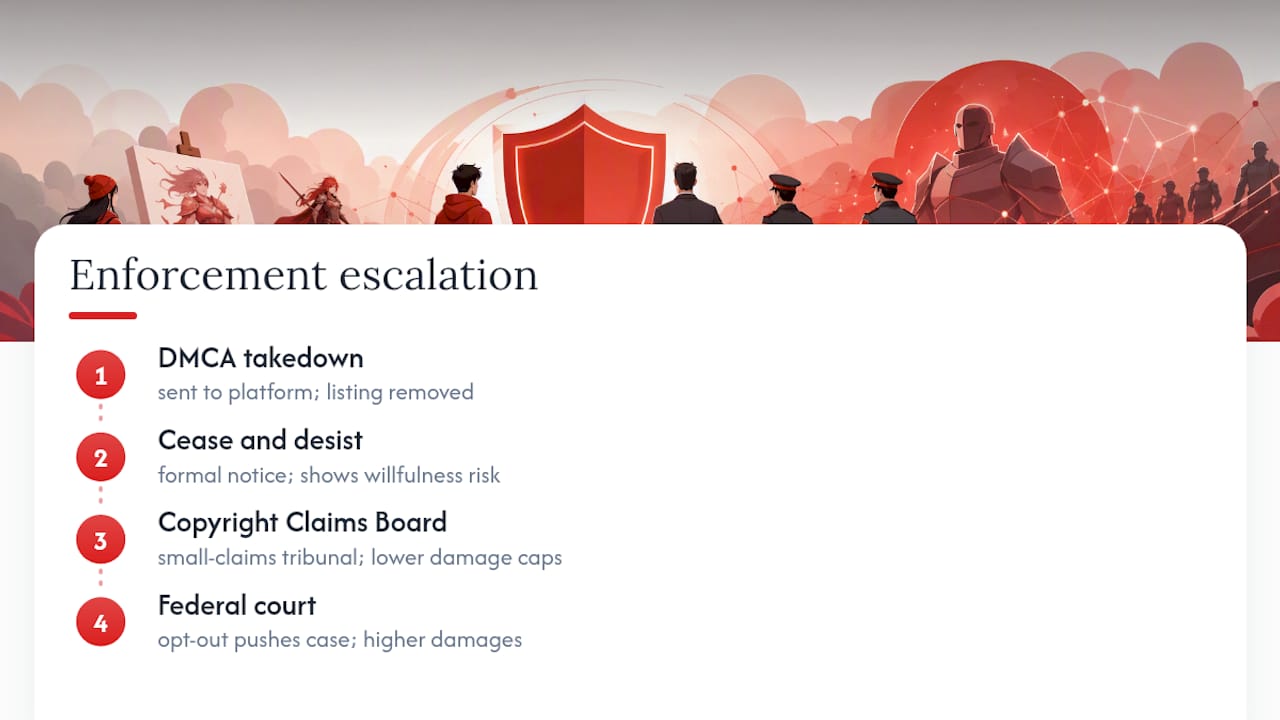
Most enforcement starts small and escalates only if you ignore it. The most common first step is a DMCA takedown notice under 17 U.S.C. §512, sent to the platform hosting your shop rather than to you directly. Platforms typically remove the listing fast to preserve their own safe-harbor protection, and you’ll usually get an option to file a counter-notice if you believe the removal was wrong.
Cease-and-desist letters come next for repeat or larger sellers. These letters don’t file a lawsuit, but they put you on formal notice, and ignoring one can be used later as evidence that your infringement was willful, which increases potential damages.
What enforcement actually looks like: The Copyright Claims Board, created inside the U.S. Copyright Office, functions as a small-claims tribunal with damage caps far below federal court. Because it lowered filing costs, claims that once weren’t worth pursuing now are, which raises real exposure for small sellers who previously assumed they were too small to bother suing. Respondents can opt out of a CCB claim within 60 days, pushing the dispute into federal court instead, where statutory damages can reach far higher figures than actual damages alone.
Your Pre-Listing Checklist for Selling Fan Art
Run through this before you upload a single product listing:
- Confirm ownership status. Search whether the character or franchise is genuinely public domain, not just old.
- Check for a partner program. See if the platform or the IP holder has an approved-artist path.
- Strip out logos and wordmarks. Trademark risk survives even when copyright risk doesn’t.
- Skip the disclaimer strategy. A line reading “I don’t own these characters” offers no legal protection and can actually prove you knew you needed permission.
- Label clearly as unofficial fan work if you do proceed, since this at least avoids consumer-confusion claims even though it won’t stop a copyright claim.
- Consider original characters inspired by a genre instead of a specific franchise.
- Pick your platform carefully, since some marketplaces don’t pre-screen listings and only act after a complaint, which means your shop can operate fine for months before a sudden suspension.
Sales tax adds another layer once you’re selling in volume. Most U.S. states now require online sellers to collect sales tax once they cross state-specific revenue or transaction thresholds, so check your obligations early rather than after your first big month.
Pro Tip: If a franchise genuinely resonates with your customers, use that audience as a bridge to your own original characters and art style. Fans who buy tribute pieces from you today are often the easiest audience to convert once you launch something wholly yours. Our guide to fan merchandise categories walks through which product types carry the most and least legal exposure.
What to Do the Moment You Get a Takedown Notice
Don’t panic and don’t delete anything. Preserve your original files, screenshot the notice, and read the stated deadline carefully.
- Note whether it’s a DMCA notice (platform-level) or a cease-and-desist (direct legal threat), since they call for different responses.
- Filing a DMCA counter-notice reinstates your listing, but you’re swearing under penalty of perjury that removal was a mistake, so only file one if you have a real fair-use or public-domain argument.
- A cease-and-desist letter doesn’t require an immediate legal response, but ignoring it can hurt you later if the dispute escalates to a CCB claim or federal suit.
- Weigh the cost of fighting a CCB claim against simply complying, since the Board’s damage caps mean even a loss is usually less catastrophic than federal litigation.
When to Bring in an Intellectual Property Attorney
Talk to an IP attorney once you receive a formal cease-and-desist, once your sales scale beyond pocket money, or once you’re facing a Copyright Claims Board or federal filing. Bring copies of the artwork, your sales records, any correspondence with the platform or rights holder, and any license applications you’ve submitted. A good attorney can assess your actual exposure, negotiate directly with the rights holder, draft a counter-notice, or represent you before the CCB, often resolving what feels like a crisis with a single phone call.
Balancing Fandom and a Sustainable Business
Fan art matters. It’s how a lot of artists find their style and their first audience, and most franchises quietly tolerate small-scale tribute work because it costs them nothing and builds goodwill. But tolerance isn’t permission, and enforcement patterns can shift overnight when a franchise changes ownership or licensing strategy. The artists who build lasting businesses are usually the ones who treat fan art as a stepping stone toward original intellectual property or toward legitimate, licensed collaborations, not as a permanent business model. That’s the standard Mclarenteehub holds its own catalog to: original pop-culture-inspired designs built to celebrate genres and moods rather than to lean on someone else’s copyrighted characters.
— Nicholas
Shop Original Pop-Culture Apparel Without the Legal Gray Area
Mclarenteehub sells original designs inspired by movies, anime, and horror without leaning on trademarked logos or copyrighted character likenesses, which means you get the pop-culture energy without the licensing headache that fan art carries. Every design draws from genre and mood rather than lifted characters, so you can wear the aesthetic you love without wondering whether the seller had permission to make it.
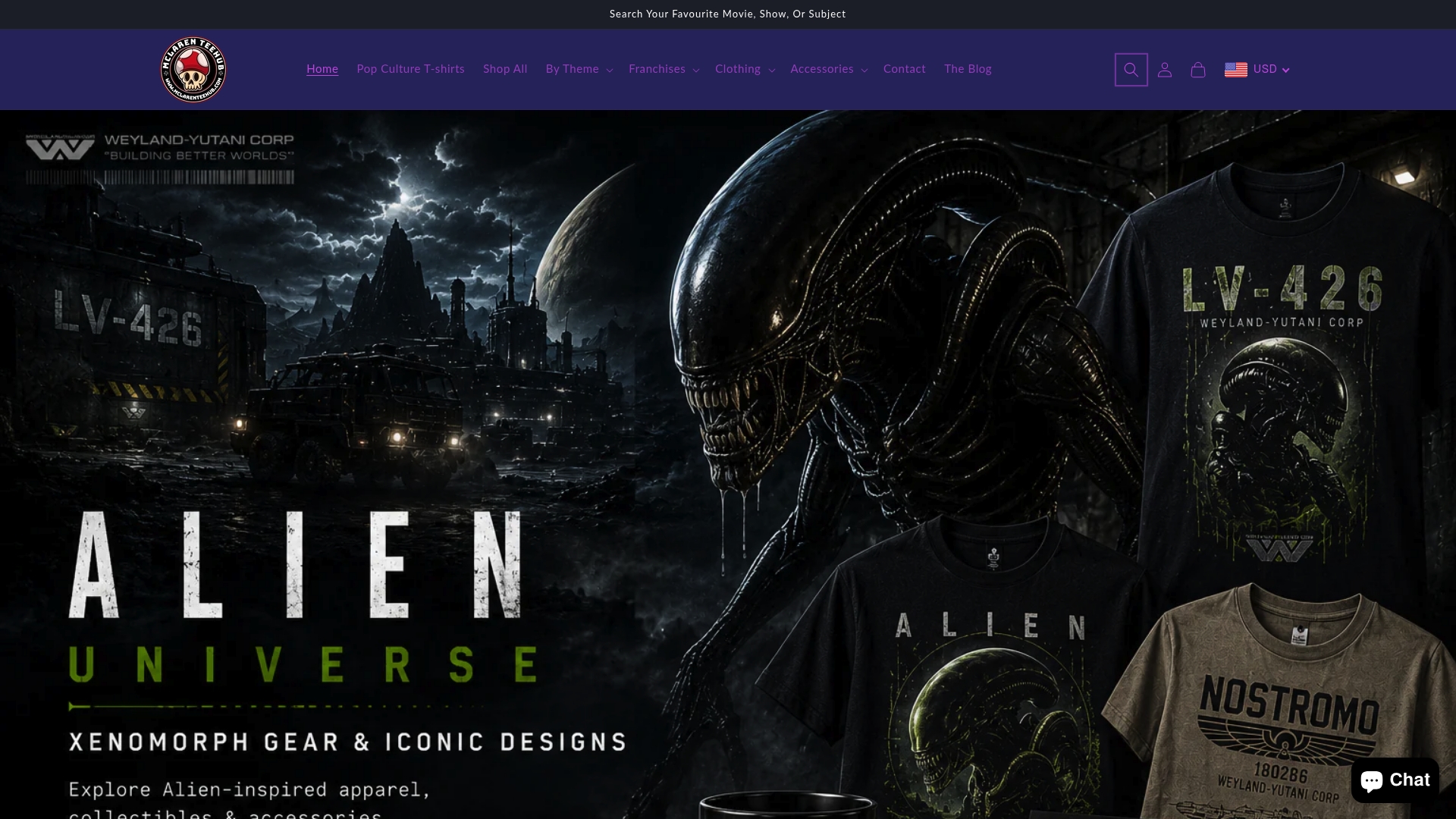
Browse the Pulp Fiction-inspired “Morning Motherfuckers” tee for a sharp example of tribute-style design done the original way, or check the Facehugger coffee mug if sci-fi horror is more your speed. If you’re designing your own apparel line and want guidance on picking artwork that won’t land you in legal trouble, Handmade Ohio’s guide to choosing custom shirt art is worth a read before your next print run. Pick a design, add it to your cart, and get pop culture on your shirt the legal way today.
This article is general information, not a substitute for advice from a qualified lawyer. Consult a qualified legal professional about your own circumstances before acting on anything here.
Sources
- Can You Legally Sell Fan Art Online? - Nolo
- How to Sell Fan Art Legally: Fair Use, Risks & Licenses - LegalClarity
- Conventional protections for commercial fan art (Fordham IP paper)