

Shoe Size Online: Measure With Your Phone and Buy Right
Measure your longest foot heel to toe, convert that length using the brand’s own size chart, and add the width or margin the brand recommends. That’s the whole method. Three steps, five minutes, and you’ve got a real answer instead of a guess.
Most sizing mistakes happen because people skip step two. They know their “usual size” from one brand and assume it carries over everywhere else. It doesn’t. A foot measurement in inches or centimeters is portable across every brand; a size label like “9.5” is not.
Here’s the checklist to run before you buy anything online:
- Measure your longest foot (not both, one is usually bigger) heel to toe, in the evening, wearing the socks you’ll actually wear with the shoes.
- Convert that number using the specific brand’s size chart, not a generic universal chart, since foot length in centimeters transfers far more reliably than a size number does.
- Apply the brand’s suggested margin for width or activity type. Running shoes need more toe room than dress shoes.
Pro Tip: Measure at night. Feet swell throughout the day and can run up to half a size larger by evening than they measured that morning. Measuring in the morning is the single most common reason people order a size that turns out too tight.
Key Takeaways
Accurate online shoe sizing comes down to measuring your longest foot correctly, converting that length with the brand’s own chart, and applying its recommended margin.
| Point | Details |
|---|---|
| Measure the right foot | Measure both feet in the evening, in your usual socks, and size to the larger one. |
| Convert with brand data | Use the brand’s own foot-length column in centimeters rather than a generic size chart. |
| Check reviews for fit signals | Repeated comments like “runs small” or “narrow” are stronger evidence than a single review. |
| Verify with a printable backup | Confirm any printed chart’s scale box before trusting a phone-scan measurement against it. |
| Use Mclarenteehub’s sizing notes | Product pages include fit guidance and a support contact for tricky sizing questions. |
Tools and Guides Worth Bookmarking
- Calculator.net’s shoe size conversion tool for formulas and full US/UK/EU/Japan conversion tables.
- FitScan for a look at phone photo-scan and LiDAR-based measurement, useful if you want to compare an app-based reading against your own manual trace.
- StyleNextStep’s home measurement guide for the printable paper-and-wall method in more detail.
- Shoe Finale’s measurement walkthrough for re-measurement guidance, especially useful for parents tracking kids’ growth.
- SoleCare’s guide to avoiding sizing surprises for a broader rundown on using reviews and return policies as part of your sizing strategy.
Table of Contents
- How to Measure Your Foot for Shoe Size Online With Your Phone
- Measuring With Paper, a Ruler, or a Brannock-Style Chart
- Converting Foot Length to US, UK, EU, and Mondopoint Sizes
- Why Does the Same Shoe Size Fit Differently Across Brands?
- Common Measurement Mistakes That Lead to Returns
- Measuring Kids’ Feet Without the Guesswork
- How Mclarenteehub Helps You Get the Right Fit the First Time
- Sources
How to Measure Your Foot for Shoe Size Online With Your Phone
Your phone camera can get you a usable foot measurement in under two minutes, provided you follow a few basic rules that most people skip.
Set your phone on the floor, not in your hand. A handheld shot introduces angle distortion that throws off length by several millimeters, which sounds trivial until you realize that’s often the difference between a half size. Place a reference object next to your foot, a standard sheet of paper or a credit card works, so the scanning tool has a fixed measurement to calibrate against. Stand with your full weight on the foot being measured; feet flatten and lengthen slightly under load, and a scan taken while you’re seated will read short.
Look for these features when choosing a phone-based sizing tool:
- Photo-scan capability that uses a flat reference object for calibration rather than guessing scale from the image alone.
- LiDAR support on newer phones, which maps depth directly and tends to be more forgiving of camera angle.
- Brand-specific offsets built into the tool’s output, so it doesn’t just give you a raw length but maps that length to the actual brand you’re shopping.
- Width capture, not just length, since a foot that’s long and narrow needs a different fit than one that’s short and wide.
Platforms like FitScan build their pitch around exactly this: a single photo or LiDAR scan mapped across many brands at once, with claims of high precision on the length measurement. Take vendor precision claims with a grain of salt and always cross-check the output against the brand’s own printed chart before you check out; a scan can nail your foot length and still steer you wrong if the brand mapping behind it is off by even a few millimeters.
Pro Tip: If a phone scan gives you a number that surprises you (a size and a half off from what you normally wear) don’t just trust the app. Run the printable ruler check below. Two independent measurements that agree are worth more than one confident-sounding app result.
Measuring With Paper, a Ruler, or a Brannock-Style Chart
No phone, no problem. The paper-and-wall method has worked for decades and it’s still the most dependable fallback when you don’t trust a scan or don’t have the right phone hardware.
- Place a sheet of paper on a hard floor against a wall. Skip carpet; it compresses under your foot and adds false length to the trace.
- Stand on the paper with your heel touching the wall.
- Mark the point where your longest toe ends. For most people that’s the big toe, but plenty of people have a longer second toe, so check before you mark.
- Measure heel to mark in both inches and centimeters, and record both numbers somewhere you’ll actually find again later.
- Measure the width of your foot at its widest point, usually across the ball, since width errors cause almost as many bad-fit returns as length errors do.
Before you trust any printed chart, confirm it’s actually printing to scale. Most retailer PDFs, including Shoe Carnival’s own printable charts, include a small reference box, usually one inch or one centimeter, that you check with a ruler after printing. If your printer’s default scaling is set to “fit to page,” that box will print short, and every measurement you take against the chart will be wrong in the same direction.
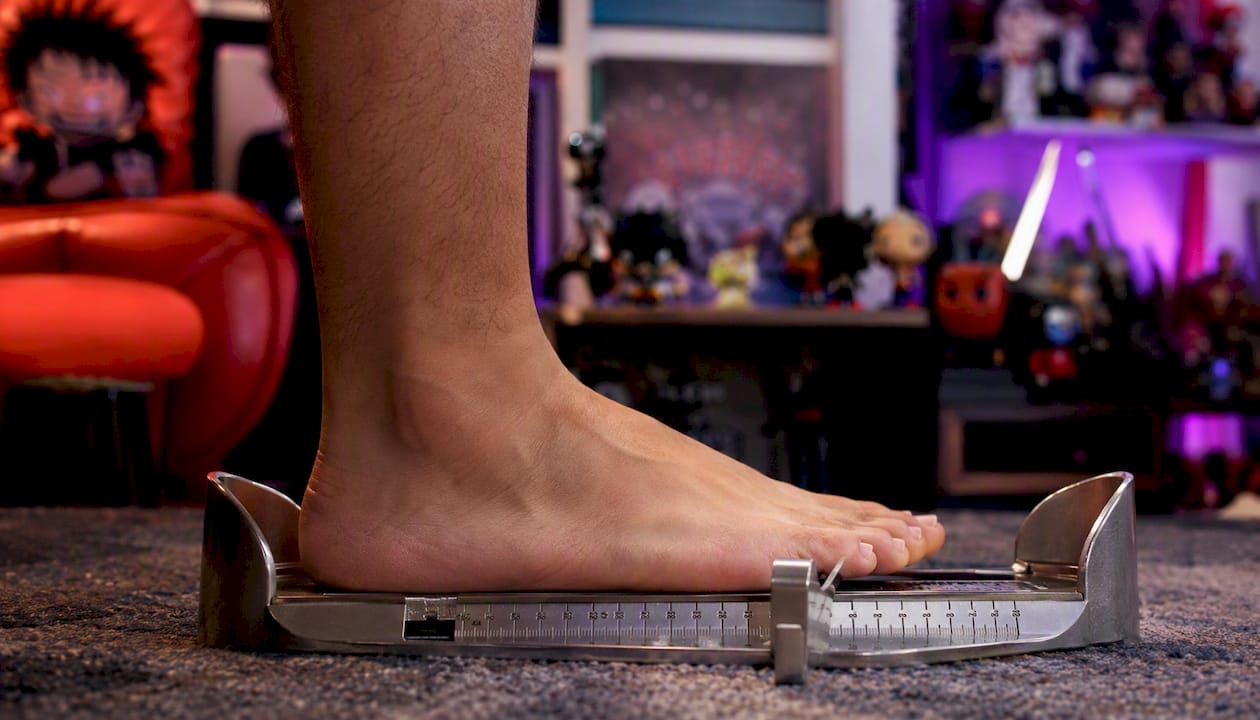
The Brannock device, the metal foot-measuring tool you’ve stood on at shoe stores your whole life, measures three things at once: overall length, arch length (heel to the ball of the foot), and width. Home methods only replicate the length part reliably, which is fine for most shopping, but if your feet have an unusual arch-to-toe ratio, that’s information a flat paper trace can’t give you.
| Measured Length | Approximate Size Range |
|---|---|
| 9.25 in / 23.6 cm | US women’s 6 |
| 9.625 in / 24.4 cm | US women’s 7 to 8 |
| 10.25 in / 26 cm | US men’s 8 to 8.5 |
| 10.75 in / 27.9 cm | US men’s 9.5 to 10 |
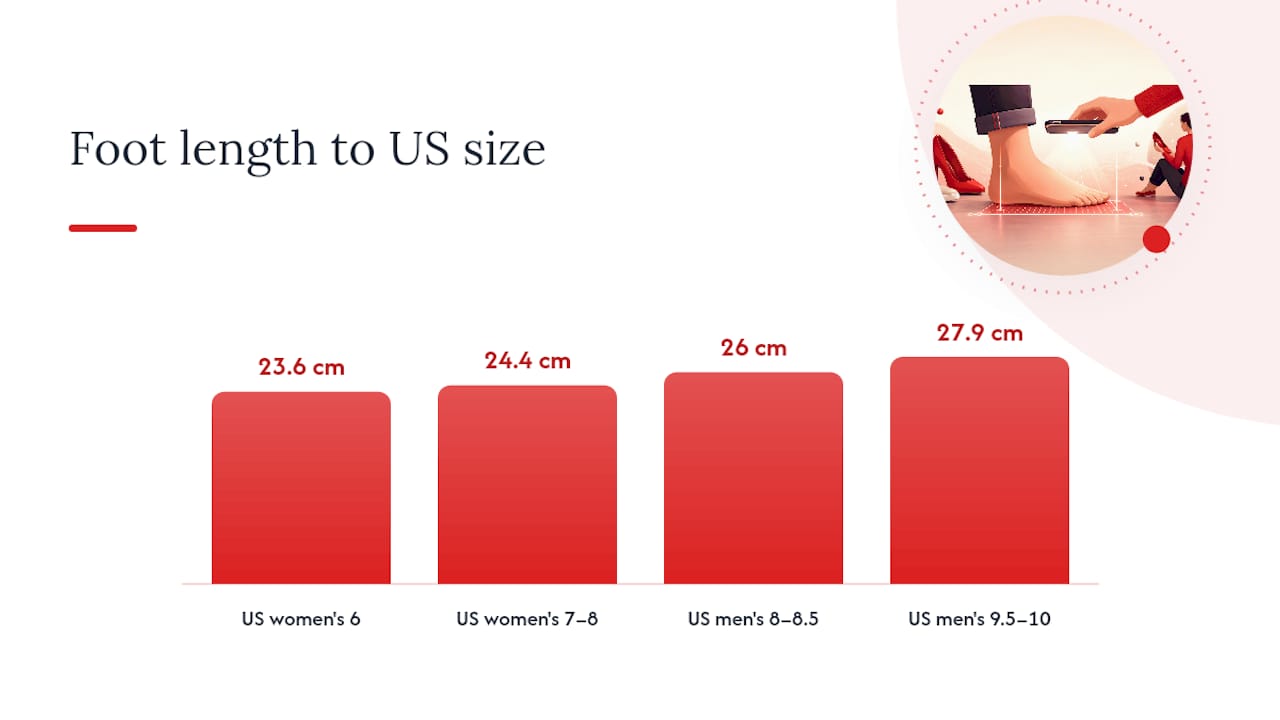
A foot measuring 26 centimeters, for example, generally lands around a US men’s 8 to 8.5, but that range shifts depending on the specific brand’s last shape. Treat any table like this as a starting point, never a final answer, and always check it against the brand’s own foot-length column when one exists.
Converting Foot Length to US, UK, EU, and Mondopoint Sizes
Once you’ve got a length in inches, a formula gets you into the right neighborhood fast. The standard Brannock-derived formulas are straightforward: US men’s sizing runs roughly at 3L minus 22, and US women’s sizing runs roughly at 3L minus 21, where L is your foot length in inches. Plug in a 10-inch foot for a man and you get 3 times 10 minus 22, which lands at size 8.
These formulas and the conversion tables built from them are laid out in detail on Calculator, which is worth bookmarking if you shop across regions often.
Here’s a compact reference for a few common lengths:
Worked example: say you measure a 10.75-inch foot. Running that through the men’s formula, 3 times 10.75 minus 22, gives you 10.25, so you’d land right around a US men’s 10 to 10.5, depending on how the brand rounds. Mondopoint, the system many athletic brands and international manufacturers use, is simpler in one respect: it’s just your foot length in millimeters, so a 27.9 centimeter foot is a Mondopoint 279, no formula required.
None of these formulas are gospel. They’re solid starting math, but every brand applies its own tolerances on top, which is exactly why the next section matters more than the formula itself.
Why Does the Same Shoe Size Fit Differently Across Brands?
There’s no universal shoe-size standard, and treating a size 9 as a fixed, portable unit across every brand is the single most common assumption that leads to returns. Industry analysis on footwear sizing confidence points to a mix of causes: different last shapes (the foot-shaped mold a shoe is built around), manufacturing tolerances that vary by factory, regional sizing conventions, and model-specific design choices like a narrower toe box on a fashion sneaker versus a wider one on a running shoe.
Run through this checklist before you commit to a size on an unfamiliar brand:
- Find the brand’s own foot-length column, usually listed in centimeters, on its size chart page, and match your measurement to it directly.
- Search recent reviews for phrases like “runs small” or “true to size but narrow.” Repeated comments from multiple buyers are a stronger signal than any single review.
- Prefer the foot-length number over the numeric size label whenever both are available; length in centimeters doesn’t lie the way a size number can.
- If reviews are split roughly evenly on fit, order two adjacent sizes and return whichever doesn’t work, using the retailer’s return window as your safety net.
A typical fit note might read something like “runs small, order a half size up.” Act on that literally: if your measurement puts you at a 9, and the reviews consistently say the brand runs small, order the 9.5. That single adjustment, informed by practical guidance on avoiding online sizing surprises, prevents more bad orders than any formula alone. The same logic applies outside footwear, too. Sizing guides for lingerie run into the identical problem: generic charts get you close, but brand-specific fit notes are what actually save the return trip.
Common Measurement Mistakes That Lead to Returns
Most sizing complaints trace back to a handful of repeat mistakes, and every one of them is easy to fix once you know to check for it.
- Measuring only one foot. Feet are rarely identical; always measure both and size to the larger one.
- Measuring in the morning instead of the evening, when feet have already swollen from a day of walking and standing.
- Measuring barefoot when you plan to wear thick socks, or vice versa. Match the sock thickness to how you’ll actually wear the shoe.
- Measuring on carpet, which compresses under your foot and pads the length by several millimeters.
- Trusting a printed chart without checking its scale reference box first.
- Skipping the toe-clearance margin entirely. A thumb’s width of space beyond your longest toe is the general rule, though athletic shoes generally warrant a bit more room than dress shoes, since feet swell during activity and a tight toe box turns painful fast.
Pro Tip: Start a “size passport”: a simple note on your phone with your foot length in centimeters, your measured width, and any brand-specific adjustments you’ve learned. Photograph your measuring setup once so you can replicate the exact same conditions next time. Future you will thank present you.
Measuring Kids’ Feet Without the Guesswork
Children’s feet grow fast enough that a chart from six months ago is often already wrong, so the method needs to be quick, repeatable, and painless for a squirming toddler.
- Have the child stand if they’re old enough, or sit with their foot flat on the paper if standing isn’t happening. Either way, keep the foot pressed flat and their weight on it if possible.
- Hold the tracing pencil at a slight inward angle against the side of the foot rather than straight down, since kids rarely hold perfectly still for a top-down trace.
- Measure both feet. Kids frequently have one foot noticeably larger than the other, more so than adults.
- Add growth room based on age and shoe type. Younger children in everyday shoes typically need a bit more allowance than older kids in structured athletic shoes, though this is general guidance, not a substitute for a fit check in person when possible.
- Re-measure every three to six months for toddlers and preschoolers. Home measurement guidance for growing feet recommends treating any children’s measurement as temporary by design, not a one-time task.
Most children’s shoe brands publish their own printable size charts separate from adult charts, since kids’ lasts are shaped differently to accommodate wider, less-developed arches. Always pull the brand’s kids-specific chart rather than scaling down an adult one.
Why Accurate Measurement Actually Changes the Online Shopping Experience
Getting a foot measurement right isn’t just a box to check before checkout. It’s the difference between opening a package that fits and starting a return process that costs you time, and sometimes costs the retailer more than the sale was worth. I’ve watched how often a single overlooked step, measuring in the morning instead of the evening, skipping the width note, trusting a size label instead of a length column, turns a good purchase decision into a frustrating exchange. Mclarenteehub builds product pages with sizing notes and fit guidance specifically because footwear sold online carries more fit risk than a t-shirt or a hoodie, and getting that guidance right is part of taking the product seriously, including footwear tied to pop culture styles that fans want to get right the first time.
How Mclarenteehub Helps You Get the Right Fit the First Time
Mclarenteehub puts sizing information directly on the product page instead of burying it in a separate help document you have to go hunting for. Each footwear listing includes measurement notes and fit guidance so you can compare your own foot measurement against that specific product before you commit, not after the box shows up.
If a fit still looks uncertain, reaching out before you order beats guessing and hoping the return window saves you. Mclarenteehub’s support page is the fastest route to a real answer if a chart leaves you unsure, and it’s also where you’ll find current return policy details, worth reading before checkout since a return window is your safety net if a measurement turns out slightly off despite your best effort. Browse the current apparel and footwear lineup with your measurement in hand, check the product-specific sizing notes, and order with an actual number backing your choice instead of a guess.
Sources
- Calculator
- Buying Shoes Online: How to Avoid Sizing Surprises – SoleCare
- How to Choose the Right Shoe Size When Shopping Online - StyleNextStep
- How to Find Your True Shoe Size Online (Measure at Home) | Shoe Finale
- FitScan — Perfect Shoe Size, Every Time
Recommended
- Movie Character Inspired Footwear: The Collector’s Guide – McLaren Tee Hub
- How to Judge Print on Demand Quality Before You Buy – McLaren Tee Hub
- Snake wine Unisex T-Shirt, Snake t-shirt, t-shirt snake, snake shirt, shirt snake, - McLaren Tee Hub – McLaren Tee Hub
- Chameleon t shirt - McLaren Tee Hub – McLaren Tee Hub