

Order the Right Fit: Unisex vs Men's Sizing, Size Down One Letter
Short answer: unisex sizing usually follows a men’s block, so it tends to run roomier in the shoulders and longer in the body than a women’s equivalent size. If you want a tailored fit, size down one letter from your usual women’s size, or better yet, measure your chest and pick the unisex letter that matches plus a couple inches of ease. The conversion chart and measuring steps below will get you to an order-ready decision in a few minutes.
TL;DR:
- Unisex sizes are typically based on men’s pattern blocks, leading to wider shoulders, longer torsos, and no waist tapering compared to women’s cuts.
- Sizing down one letter from a women’s size often yields a better fit, but it does not account for body shapes with fuller hips or shorter torsos, which may need a women’s cut instead.
- Measuring chest, waist, hips, and body length accurately and adding appropriate ease is essential for selecting the correct size, rather than relying solely on the letter label.
- Brand differences mean a Gildan medium and a Next Level medium can fit differently; always check specific measurements, not just size labels.
- For a tailored look, choose a women’s cut or size down; for layering or a relaxed fit, size up one letter or opt for a unisex in your measured size with added ease.
Table of Contents
- Unisex vs Men’s Sizing: Why the Cut Is Different in the First Place
- How to Measure and Convert Your Size in Four Steps
- Unisex Size Chart: Example Chest, Waist, and Hip Ranges
- Choosing Unisex vs a Gendered Cut for Your Garment
- Sizing Advice From the Team
- Why We Publish Real Measurements Instead of Just Letters
- Get the Right Fit Before You Order
- Sources
- FAQ
Unisex vs Men’s Sizing: Why the Cut Is Different in the First Place
Unisex doesn’t mean neutral. It almost always means built from a men’s pattern block, sometimes softened slightly at the shoulder and hem, but rarely reshaped around a woman’s proportions. That’s the core issue behind every “unisex vs men’s sizing” comparison you’ll find online: the label says one thing, the pattern says another.
A men’s block is cut for a straighter torso, wider shoulder seams, and a boxier waist. A women’s block narrows the shoulders, adds a waist taper, and shortens the body slightly. A true neutral or “boxy” block, which fewer brands actually use, splits the difference: straight sides, no waist shaping, a shorter overall drop than a men’s tee.
Shoppers notice the gap in four specific places:
- Shoulders run wider on unisex tees than on a women’s fitted equivalent, sometimes by an inch or more per side.
- Torso length is longer, since men’s blocks account for a taller average frame.
- Hip shaping is nearly absent. Unisex shirts stay straight from chest to hem instead of tapering in at the waist and flaring slightly at the hip.
- Sleeve length runs longer, which is the detail that tips most women off that something’s off before they even check the tag.
None of this is standardized. Bella+Canvas 3001, Gildan 5000, Champion, Comfort Colors, and Next Level all label their tees “unisex,” and all five fit differently at the same letter size. A Comfort Colors medium and a Next Level medium are not interchangeable, which is exactly why chasing the letter on the tag gets you nowhere. You have to chase the measurement.
How to Measure and Convert Your Size in Four Steps
Measuring takes less time than reading a size chart wrong twice, and it’s the only method that works across every brand you’ll encounter.
- Measure your chest first, since it’s the single most reliable predictor of overall fit. Wrap a soft tape around the fullest part of your chest, under your arms, keeping the tape level and snug but not tight.
- Measure your waist and hip next, especially if you’re deciding between unisex and a women’s cut. Waist goes around the natural crease above your belly button; hip goes around the widest point below.
- Measure body length from the highest point of your shoulder straight down to where you want the hem to fall, using a tee you already own and love as a reference.
- Pick your ease. A close fit means adding almost nothing to your chest measurement. A standard, everyday fit adds 2 to 4 inches. An oversized, streetwear-style fit adds 6 inches or more. Match your measured chest plus your chosen ease against the brand’s actual spec chart, not the letter label.
The widely repeated rule is that women size down one letter from their usual number to land a tailored fit in a unisex cut, and testing across brands backs that up: in sampled cases, women sized down one size 62% of the time to get the fit they actually wanted. That rule breaks down, though, for anyone with fuller hips relative to their chest or a shorter torso than average. Because unisex shirts don’t taper at the waist, sizing down shrinks the shoulders and length but does nothing to add curve. If your shape needs shaping, not just a smaller number, a women’s cut will serve you better than any unisex size-down trick.
Pro Tip: If you’re ordering for a group, buy one sample in your best-guess size before committing to a bulk run. A five-dollar mistake on one shirt beats a fifty-shirt reorder because the whole team runs a size big.
Unisex Size Chart: Example Chest, Waist, and Hip Ranges
Every brand publishes its own spec sheet, and the numbers below reflect typical ranges pulled from common blank suppliers rather than one universal standard. Always check the specific blank’s chart before you order, since a Bella+Canvas 3001 and a Gildan 5000 in the same letter size can differ by an inch or more at the chest.
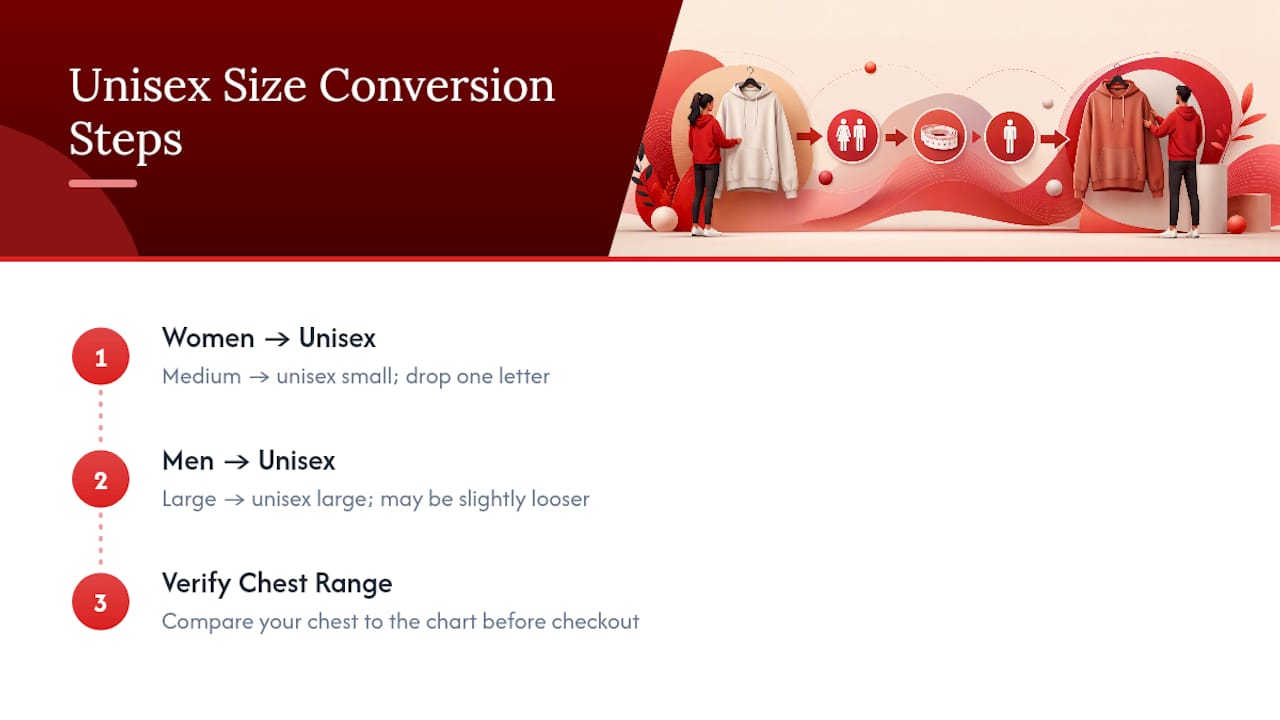
Rough conversion pairs shoppers ask about most: a women’s medium commonly maps to a unisex small, and a men’s large tends to run close to a unisex large, sometimes a hair looser through the body. If you’re moving from a women’s size chart to unisex, drop one letter as a starting point, then verify against the chest range above before you check out.
Choosing Unisex vs a Gendered Cut for Your Garment
Garment type decides more of this than gender does. A boxy fit that looks intentional on a graphic tee looks sloppy on a blazer, so match the cut to what you’re actually buying.
- Unisex works well for graphic tees, hoodies, polos, event merch, and anything meant to layer over other clothing or fit a mixed group without separate men’s and women’s runs.
- Gendered cuts win for fitted tops, dresses, blazers, and anything tailored, where waist shaping and shoulder width need to match a specific body type rather than a general average.
- Fabric changes the math too. A tri-blend tee drapes closer to the body than heavyweight cotton, so a unisex tri-blend can read more fitted than the chest measurement alone suggests. Print placement matters as well: an oversized front graphic looks intentional on a boxier fit but stretches awkwardly on anything sized too close.
- The simple rule: size up one letter if you’re layering or want an oversized look, and size down one letter from your converted women’s number if you want the unisex piece to read tailored.
Sizing Advice From the Team
Nicholas, who put together our hoodie size guide and graphic tee sizing guide, builds every recommendation around the same principle: measure the body, not the label. That habit carries over from shoe sizing, where a US to EU conversion gets misread constantly for the same reason letters get misread on tees.
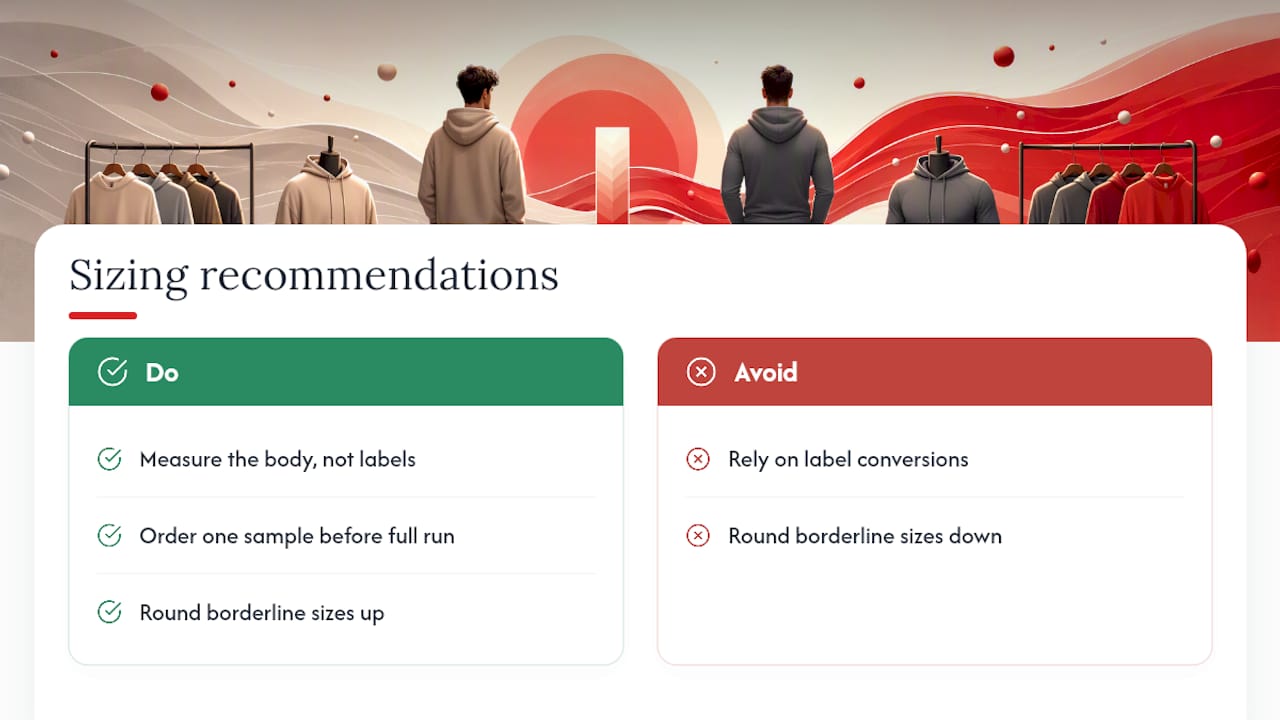
For team and group orders, we recommend ordering one sample in your best-guess size before committing to a full run, then rounding borderline sizes up rather than down. Shirts that run slightly loose get worn; shirts that don’t fit get returned.
Why We Publish Real Measurements Instead of Just Letters
We’d rather hand you a tape measure than a guess. Publishing flat garment measurements, not just size letters, is the fastest way to cut down on returns and mismatched orders, and it’s a habit worth demanding from any brand you buy from. We also encourage ordering a sample before a bulk run, because one accurate shirt beats a dozen reorders.
Get the Right Fit Before You Order
You’ve got the measurements and the conversion rule. Now put them to use on an actual product page. Every unisex tee in the Mclarenteehub catalog lists its own chest and length specs on the product page, so you’re never guessing off a generic size letter. That’s the real difference between shopping with us and shopping blind on a marketplace listing with no spec sheet at all: you check your measurement against the actual garment, not a label someone slapped on based on a men’s block from a decade ago.
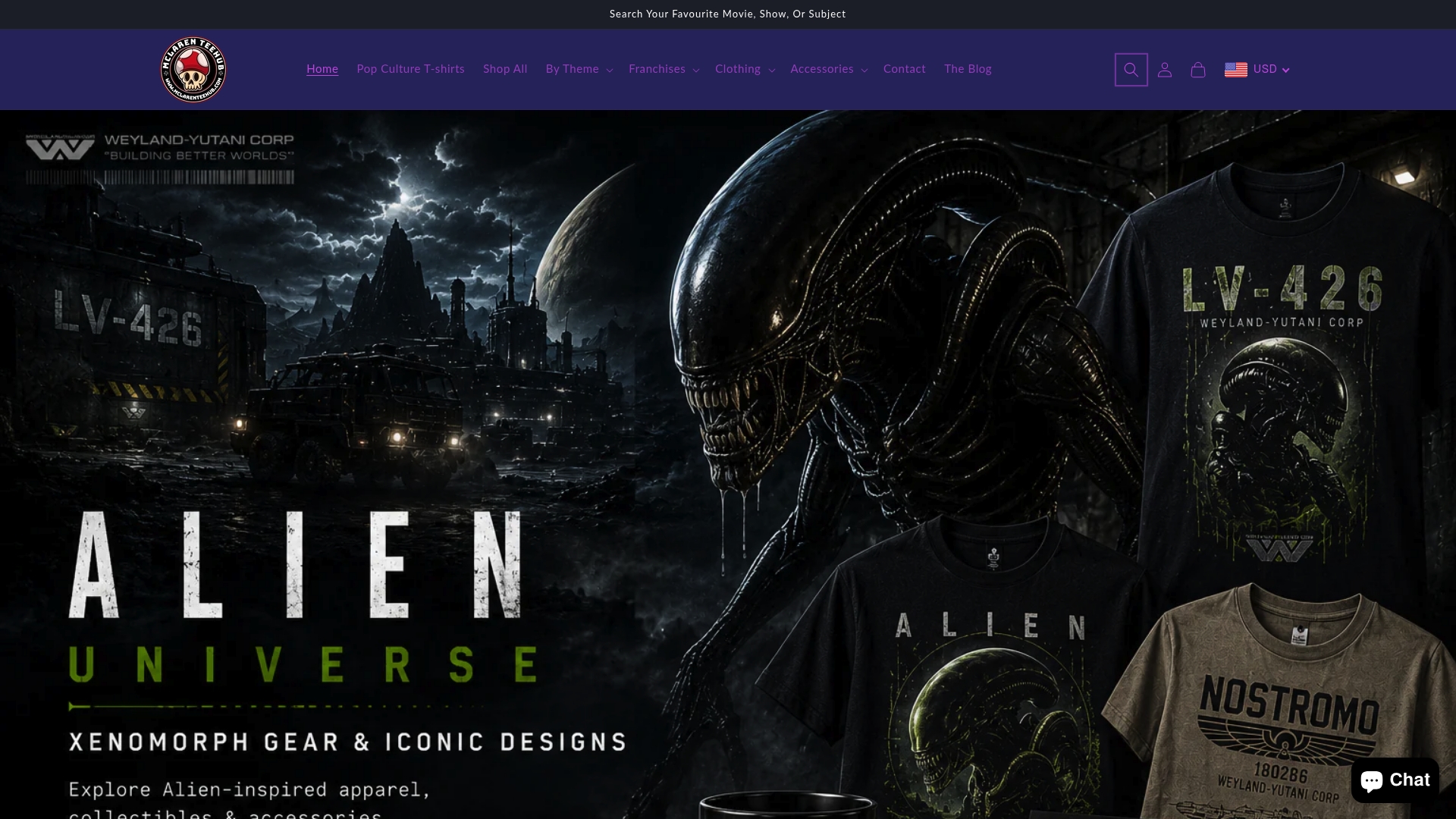
If tees aren’t the only thing on your list, browse the full catalog for hoodies, mugs like the Facehugger coffee mug, and other pop culture gear. Not sure which size to commit to for a group order? Order one sample first, check it against your measurements, and then place the bulk order with confidence instead of hoping the letter on the tag tells the whole story.
Sources
For deeper reference, the Arklavo unisex size converter breaks down brand-by-brand specs, and Real Thread’s comparison of women’s cut vs unisex shirts explains the pattern differences in more depth. Our own graphic tee sizing guide covers print placement and fit together.
FAQ
Is women’s XL the same as men’s L?
Not typically. A women’s XL usually corresponds closer to a men’s medium or small large depending on the brand, since women’s charts run on narrower chest and shoulder measurements at every letter.
Is a women’s size 42 the same as a men’s size 42?
No. Numeric sizing scales differ by brand and category, and a woman’s 42 (common in some international dress or pants charts) doesn’t share the same body measurements as a men’s 42 chest or waist size. Always check the specific chart, not just the number.
What is a men’s medium in unisex sizing?
A men’s medium and a unisex medium are usually the same, since most unisex tees are built directly from a men’s block. Chest range typically falls around 38 to 41 inches, though this varies by brand.
What size should I order in unisex?
Measure your chest, add your preferred ease, and match that number to the brand’s actual spec chart rather than the letter alone. If you’re moving from a women’s size and want a tailored fit, start by trying one letter down from your usual number.