

Best TeeFury.com Alternatives for Pop Culture Tee Collectors
TL;DR:
- Daily-drop sites offer rare designs through short-term releases for dedicated collectors. Evergreen artist marketplaces provide consistent access to a large, searchable catalog for casual buyers and gift shoppers. Mclarenteehub combines both approaches, offering original fan-art designs available now, not just during limited countdowns.
If you want daily limited-edition geek tees, a dedicated daily-drop site is your fastest path to something rare. If you want a searchable catalog you can browse any time, an open artist marketplace is the better call. Mclarenteehub blends both approaches, offering original fan-art designs across tees, hoodies, and gifts without forcing you to race a 24-hour countdown every time.
Quick picks by priority:
- Best for daily-drop collectors: A 24–48 hour limited-release site where scarcity is the whole point
- Best for evergreen variety: An open artist marketplace with a large, searchable catalog
- Best hybrid option: Mclarenteehub, for fans who want original pop-culture designs available now, not just during a drop window
TL;DR: Graphic tees on these platforms typically run $14–$32 depending on the model and site type. Daily drops last a limited time; evergreen marketplaces never expire.
Table of Contents
- How the main site models compare at a glance
- Why shoppers go looking for TeeFury alternatives
- How to choose the right alternative for your situation
- The best graphic tee alternatives, ranked by buyer type
- What to watch out for when buying limited-edition tees
- Short profiles of the top alternative sites
- How long drops last and what you’ll typically pay
- What the shopping experience actually feels like
- Payment options and currency support
- Limited editions and exclusives: what’s actually scarce
- Community features: voting, forums, and fan engagement
- Shipping regions and estimated delivery times
- Returns and refunds: what each model actually allows
- Key Takeaways
- Mclarenteehub: original fan-art designs without the countdown
How the main site models compare at a glance
| Model | Typical price / deal window | Best for | Artist royalties | US shipping & returns |
|---|---|---|---|---|
| Daily-drop site | $14–$20 / 24–48 hours | Collectors, scarcity buyers | Fixed per-sale fee or % of drop revenue | Standard POD lead times; limited returns on custom items |
| Evergreen artist marketplace | $20–$32 / always available | Casual buyers, gift shoppers | % of sale, varies by platform | Usually ships within 5–10 business days; returns vary |
| Curated fan-art platform | $18–$28 / rotating + permanent | Fans who want higher curation | Higher % payout, artist-named shops | Standard POD; some offer exchanges |
| Mclarenteehub (recommended hybrid) | Competitive with market / drops + catalog | Collectors AND casual buyers | Original fan-art, artist-attributed designs | Global fulfillment; ships to US |
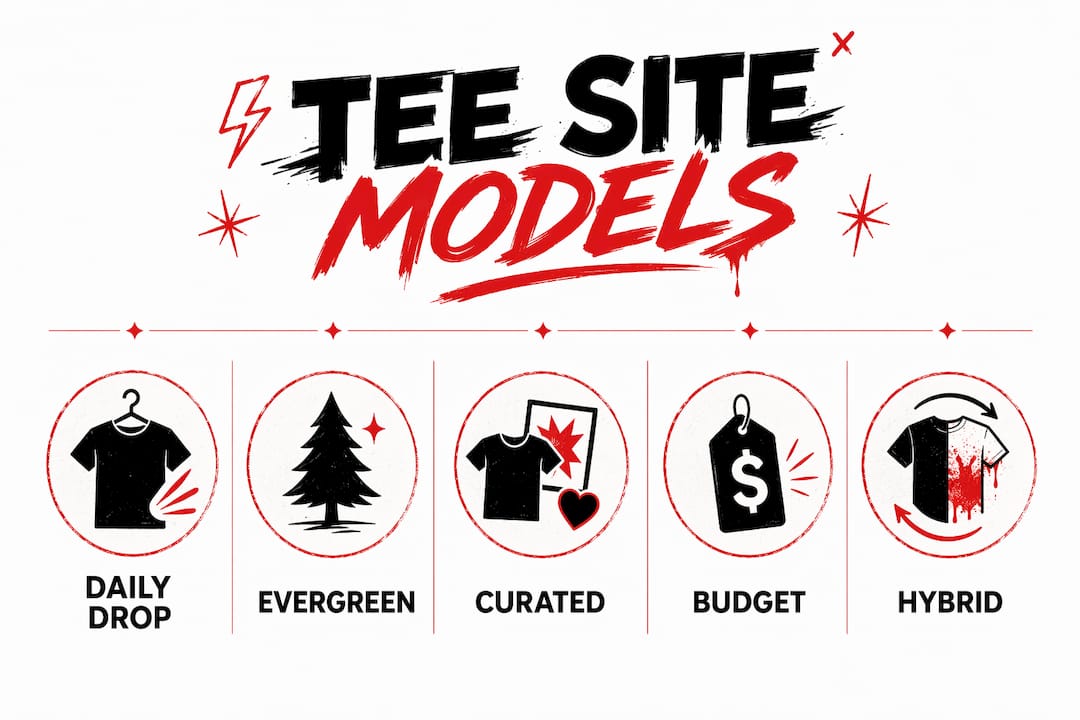
Daily-drop models prioritize urgency and community energy, but they are not a substitute for an evergreen shop when you want a specific design on demand.
Why shoppers go looking for TeeFury alternatives
The most common reason is simple: the drop window closed and the design is gone. That urgency is part of the appeal, but it is also the friction that sends buyers elsewhere.
Price is the second driver. Some collectors want to spend under $20 on a tee; others are willing to pay more for a premium blank or a licensed design. The best t-shirt sites cover a wide band, and knowing which end of that range a site targets saves a lot of wasted browsing.
Shipping speed and return policies matter more than most buyers admit upfront. Because many daily-drop retailers use print-on-demand production, items are often made after the sale closes, which pushes lead times longer than stocked retail. Factor that in before ordering a birthday gift with a two-week runway.
Secondary motivators include community features like design voting, artist transparency (knowing who drew the shirt and what they earn), and whether a site carries officially licensed merch versus fan-art parody. Style-conscious buyers also start caring about hand-illustrated designs over poster-style prints once they want tees that work outside fan events.
How to choose the right alternative for your situation
The single most useful question to ask yourself: do you want the thrill of a limited window, or do you want to find a specific design whenever you feel like it? Most serious collectors end up doing both, using drop sites for the chase and open marketplaces as a reliable fallback.
Criteria checklist:
- Model fit: Daily-drop vs. evergreen vs. hybrid. Match this to how you actually shop, not how you wish you shopped.
- Price and sale cadence: Daily-drop tees often run at prices lower than evergreen marketplace tees, which are generally higher. Know your budget before the countdown starts.
- Print and blank quality: Look for named blank suppliers in product descriptions. Bella+Canvas and Stanley/Stella are reliable markers of fabric weight and durability. Sites that list their blank supplier are more trustworthy than those that don’t.
- Artist transparency: Can you see who designed the shirt? Does the site state what artists earn? Platforms that publish royalty rates or name their artists are a better long-term bet for the community.
- Shipping times: POD production adds lead time. Budget 10–14 business days for most daily-drop or POD sites, not the 3–5 days you’d expect from stocked retail.
- Returns policy: Many custom-printed items are non-returnable unless there’s a defect. Check this before you buy, especially for gifts.
- Payment and currency: Most US-facing sites accept major credit cards and PayPal; some add Apple Pay or Shop Pay. Currency support matters if you’re buying from an international platform.
- Fabric certifications: GOTS-certified organic cotton and OEKO-TEX dyeing are quality markers worth checking if fabric sourcing matters to you.
Red flags to skip past:
- No blank supplier listed anywhere on the product page
- “Limited edition” claims with no stated production cap
- No sizing guide or only a single generic size chart
- Returns policy buried in fine print or absent entirely
- Shipping estimates that read “2–4 weeks” with no tracking
Pro Tip: Build a two-list system. Keep a drop-site bookmark for daily checks, and maintain a wishlist on an evergreen marketplace for designs you want but missed in a drop window. You’ll spend less and regret fewer impulse buys.
The best graphic tee alternatives, ranked by buyer type
The right alternative depends entirely on whether you value scarcity or variety. Here’s how the main categories stack up.
1. Daily-drop collector site (24–48 hr releases) Model: New design every 24–48 hours, then gone. Typical price: $14–$20. Best for: collectors who love the hunt. Artist support: fixed per-drop fee. Shipping: POD lead times apply. Verdict: great for the thrill, frustrating if you miss the window.
2. Evergreen artist marketplace (large searchable catalog) Model: Always-on, artist-run shops. Typical price: $20–$32. Best for: casual buyers and gift shoppers. Artist support: percentage of each sale. Shipping: standard POD, 5–10 business days. Verdict: reliable and browsable, but no scarcity buzz.
3. Curated fan-art platform (higher curation, named artists) Model: Mix of rotating features and permanent artist shops. Typical price: $18–$28. Best for: fans who want quality over quantity. Artist support: higher royalty percentage, artist attribution visible. Shipping: standard POD. Verdict: better for buyers who care about who made the design.
4. Budget-value tee seller (volume-focused) Model: Always-on, lower price point. Typical price: $12–$18. Best for: bargain hunters buying multiples. Artist support: minimal or unclear. Shipping: varies widely. Verdict: fine for casual wear, risky for quality-sensitive buyers.
5. Mclarenteehub (recommended hybrid) Model: Original fan-art designs across tees, hoodies, mugs, hats, and gifts, available as both featured drops and a stable evergreen catalog. Typical price: competitive with the market. Best for: pop-culture fans who want original designs without the pressure of a countdown. Artist support: original fan-art and parody tributes with artist attribution. Shipping: global fulfillment, ships to the US. Verdict: the pick for anyone who wants both the drop experience and a catalog they can browse on their own schedule.
What to watch out for when buying limited-edition tees
Most disappointments in this space come from one of four things: a print that fades after three washes, a blank that fits nothing like the size chart suggested, a shipping estimate that turned out to be aspirational, or a “limited edition” that was never actually limited.
Common pitfalls:
- Low-resolution prints: Artwork that looks sharp on screen can print poorly on fabric. Check customer photos, not just the product mockup.
- Unknown blank suppliers: If the product page doesn’t name the garment manufacturer, assume the cheapest available option.
- Hidden production lead times: “Ships in 5–7 days” sometimes means “ships 5–7 days after production completes,” which adds another 7–10 days.
- Fake scarcity: “Limited edition” without a stated print run is a marketing phrase, not a production constraint.
- No artist attribution: Sites that don’t credit designers often have murky licensing. Fan art without attribution can mean unauthorized use of source material.
- Vague sizing: A single “standard” size chart across all garments is a red flag. Different blanks fit differently.
Before buying from a new site, search for customer photos on social media, read the return policy in full, and check whether the blank supplier is named. For fan-art designs specifically, look for language like “original fan art,” “parody tribute,” or “artist-designed” rather than official licensing claims the site can’t substantiate.
How we evaluated and date-checked these alternatives
Availability and typical prices were checked in July 2026. Site audits covered product-description completeness (blank supplier named, sizing guide present, return policy accessible), artist payout transparency, and shipping estimate clarity.
Ranking factors were weighted as follows: model fit for the target audience (30%), price and deal window (20%), print and blank quality (20%), artist support and transparency (15%), and shipping and returns (15%).
No site was included based on traffic alone. Sites with opaque artist payout structures or missing fabric details were downgraded regardless of popularity.
Short profiles of the top alternative sites
Qwertee
Ireland-based daily-drop site running 24-hour limited tee sales, heavily focused on gaming, anime, and pop culture. Prices typically land in the lower price range typical for daily-drop tees. The community votes on upcoming designs, which creates genuine engagement before a drop even launches. Shipping to the US takes longer than domestic alternatives, so factor in 2–3 weeks.
RIPT Apparel
US-based, 24-hour drops with a strong geek-culture focus. Prices are competitive within the usual range for daily-drop tees. RIPT has a solid back-catalog section where past designs occasionally return, which softens the “missed it” sting. Artist attribution is visible on most listings.
The Yetee
Daily drops with a tight focus on gaming and indie game art. The Yetee works directly with artists and is transparent about that relationship, which is a genuine differentiator. Prices run within the typical range for daily-drop tees. They also carry a small evergreen section for past fan favorites.
ShirtPunch
24-hour drops, often bundled with other geek merchandise. Prices are on the lower side for daily-drop tees, but blank quality is inconsistent. Good for bargain hunters; less reliable for buyers who care about fabric weight.
Shirt.Woot
Amazon’s daily-deal tee offshoot. Designs rotate, prices are on the lower end typical for daily-drop tees., and Prime shipping applies for eligible members. The catalog skews humorous and pop-culture adjacent. Artist royalties are not prominently disclosed.
Redbubble
One of the largest evergreen marketplaces for independent artists. Massive catalog, searchable by fandom, character, or style. Prices run within the typical range for evergreen marketplace tees. Artist royalties are percentage-based and publicly explained. No drop model; everything is always available.
TeePublic
Similar to Redbubble but with a stronger focus on pop culture and fandom art. Regular sitewide sales bring tees down to prices lower than normal. Artist shops are named and browsable. Good for finding a specific fandom niche. If you want more options in this space, the TeePublic alternatives guide on Mclarenteehub covers the POD artist marketplace landscape in more depth.
Threadless
Artist-submitted designs with community voting. Threadless runs frequent sales and carries a wide range of apparel beyond tees with typical price ranges. Artist payouts are percentage-based. The catalog is large but less fandom-specific than TeePublic or Redbubble.
Day of the Shirt
An aggregator rather than a retailer. Day of the Shirt pulls daily deals from multiple drop sites into one feed, so you can check several platforms at once. No direct purchasing; it links out to the source site. Useful as a discovery tool if you’re monitoring multiple drop calendars.
How long drops last and what you’ll typically pay
Drop duration and price vary significantly by model. Here’s what to expect across the main types:
24-hour drops: The most common format for dedicated daily-drop sites. The design goes live at midnight (or a set time), runs for exactly 24 hours, and then closes. Price: typically $14–$20 for a standard tee.
48-hour drops: Some platforms extend the window to 48 hours to capture more time zones and reduce FOMO-driven impulse buys. Price range is similar to 24-hour drops.
Weekly or rotating drops: Less common, but some curated platforms feature a design for 5–7 days before rotating. Prices often run moderately higher, reflecting a more curated selection.
Evergreen / always-on: No expiration. You pay the listed price whenever you want. Typical range: $20–$32 for a standard tee on major marketplaces. Sales and sitewide discounts are common, especially on TeePublic and Threadless.
Hybrid (drops + catalog): Mclarenteehub operates this way. Featured designs get prominent placement, but the catalog stays accessible. No artificial countdown pressure.
What the shopping experience actually feels like
Daily-drop sites are built around urgency. The homepage is a countdown timer. The design is front and center. There’s usually a community section showing recent purchases or comments. Mobile experience varies: some sites have dedicated apps, but most are mobile-responsive websites rather than native apps.
Evergreen marketplaces like Redbubble and TeePublic are built for browsing. Search filters by fandom, character, color, and style are the core UX. No countdown, no pressure. The mobile experience on these platforms is generally strong, with responsive design and saved wishlists.
Aggregators like Day of the Shirt are purely functional. The interface is a feed. No account needed, no cart. You click through to the source site to buy.
Mclarenteehub is a direct-to-consumer store with a clean product catalog organized by theme and category. No countdown gimmicks. You browse, you find something you like, you buy it. The site covers tees, hoodies, mugs, hats, beanies, shoes, and gifts, so it functions as a one-stop shop for pop-culture merchandise rather than just a tee-of-the-day destination.
Payment options and currency support
Most US-facing platforms accept Visa, Mastercard, American Express, and PayPal as standard. Larger platforms like Redbubble and TeePublic also support Apple Pay, Google Pay, and Shop Pay. Shirt.Woot processes through Amazon’s checkout, so your saved payment methods there apply.
Currency support is worth checking if you’re buying from a non-US platform. Qwertee, for example, is Ireland-based and prices in euros by default, though it accepts international cards and converts at checkout. Always check whether the displayed price is in USD or another currency before confirming.
Mclarenteehub processes in USD and accepts standard card payments and PayPal, which covers the vast majority of US buyers without friction.
Limited editions and exclusives: what’s actually scarce
“Limited edition” means different things depending on the site. On a true daily-drop platform, the design is only available during the drop window and is not reprinted. That’s genuine scarcity. On some platforms, “limited” means a featured placement for a week, after which the design moves to the back catalog. On others, it’s purely a marketing label with no production cap.
The most reliable signal of genuine scarcity is a stated print run or a hard close date with no reprint policy. Sites like The Yetee and RIPT Apparel have built their reputations on honoring those limits. Platforms with large catalogs and no stated limits are not offering limited editions in any meaningful sense.
Exclusives are a separate category. Some platforms carry officially licensed designs that are exclusive to that retailer. Others feature artist exclusives, where a designer releases a design only through one platform. Artist exclusives tend to be more interesting from a collector standpoint because they’re tied to a specific creator’s work.
Community features: voting, forums, and fan engagement
Community is one of the things that separates dedicated fandom tee platforms from generic print-on-demand marketplaces. Qwertee runs a design submission and voting system where the community influences which designs get featured. Threadless has a long history of community voting on artist submissions. The Yetee engages its audience through social media and artist spotlights rather than formal voting.
Redbubble and TeePublic are more transactional. You can follow artists and get notified of new work, but there’s no community voting or forum structure. The engagement happens on social media outside the platform.
For buyers who want to feel like part of a community rather than just a customer, the dedicated drop sites win on atmosphere. For buyers who want a reliable pop culture apparel catalog they can trust, the marketplace model is more practical.
Shipping regions and estimated delivery times
Most platforms covered here ship to the US. Delivery estimates vary by model:
- Daily-drop / POD sites: 10–18 business days is realistic for most orders, accounting for production time after the drop closes.
- Evergreen marketplaces (Redbubble, TeePublic): 7–14 business days for standard shipping to the US. Expedited options are available on most platforms.
- Shirt.Woot: Amazon fulfillment applies where available; Prime members may see 2–5 day delivery on eligible items.
- International platforms (Qwertee): Add 5–10 business days over domestic estimates for US delivery.
- Mclarenteehub: Global fulfillment with US shipping available. Delivery estimates are listed at checkout.
If you’re buying a gift with a hard deadline, add a buffer of at least 5 business days over the stated estimate for any POD platform.
Returns and refunds: what each model actually allows
This is where daily-drop and POD sites diverge most sharply from stocked retail. Because items are produced after purchase, most platforms treat custom-printed tees as final sale unless there’s a manufacturing defect or a fulfillment error.
Standard policy across most POD platforms: Defective or incorrect items are replaced or refunded. Size exchanges are not guaranteed. If you ordered the wrong size, most platforms will not accept a return.
Redbubble and TeePublic both offer replacements for defective items and have customer service processes that are generally responsive. Neither offers open returns for fit issues.
Shirt.Woot follows Amazon’s return framework for eligible items, which is more flexible than most POD platforms.
Qwertee and RIPT Apparel have limited return windows and focus on defect-based replacements rather than general returns.
The practical takeaway: measure carefully before ordering, use the size guide on every platform (they differ by blank supplier), and don’t expect to return a tee because it fits differently than you imagined.
Key Takeaways
The strongest move for pop-culture tee collectors is pairing a daily-drop site for scarcity buys with an evergreen marketplace for reliable catalog access, using Mclarenteehub as the recommended hybrid that covers both without the countdown pressure.
| Point | Details |
|---|---|
| Match the model to your habit | Daily-drop sites suit collectors who check in daily; evergreen marketplaces suit casual browsers who shop on their own schedule. |
| Check the blank supplier | Product pages that name Bella+Canvas or Stanley/Stella give you a reliable signal of fabric quality before you buy. |
| Budget for POD lead times | Most drop and POD sites need 10–18 business days from order to delivery; plan ahead for gifts. |
| Verify scarcity claims | A stated print run or hard close date is genuine scarcity; “limited edition” without those details is a marketing phrase. |
| Mclarenteehub for hybrid access | Mclarenteehub offers original fan-art designs across tees, hoodies, mugs, and gifts with no countdown pressure and a stable catalog. |
The shortlist I’d actually hand a fellow fan
The daily-drop format is genuinely fun, and I don’t want to undersell it. There’s something satisfying about catching a design in the window and knowing most people missed it. But the model has a real cost: you either check in every day or you miss things that matter to you. Most collectors I’ve seen talk about this on Reddit end up building a hybrid habit anyway, bookmarking a drop site and keeping a marketplace wishlist running in parallel.
What I’d push back on is the assumption that you need to choose between scarcity and variety. The sites that have lasted in this space are the ones that figured out how to offer both. Mclarenteehub sits in that category: original fan-art designs you can buy today, not just during a 24-hour window, across a range of products beyond just tees. For readers who want more comparison options in this space, the tvstoreonline.com alternatives guide covers adjacent retailers worth knowing.
The one thing I’d tell any buyer new to this space: the blank garment matters as much as the artwork. A great design on a cheap blank is a shirt you’ll stop wearing in six months. Check the supplier name, check the weight, and if the product page doesn’t list either, that tells you something.
Mclarenteehub: original fan-art designs without the countdown
If you’ve been hunting for a pop-culture tee store that doesn’t make you race a timer, Mclarenteehub is built for exactly that. The store carries original fan-art and parody tributes across movies, TV, anime, sci-fi, and horror, available as tees, hoodies, hats, beanies, mugs, shoes, and gifts. No artificial scarcity, no drop window you have to catch.
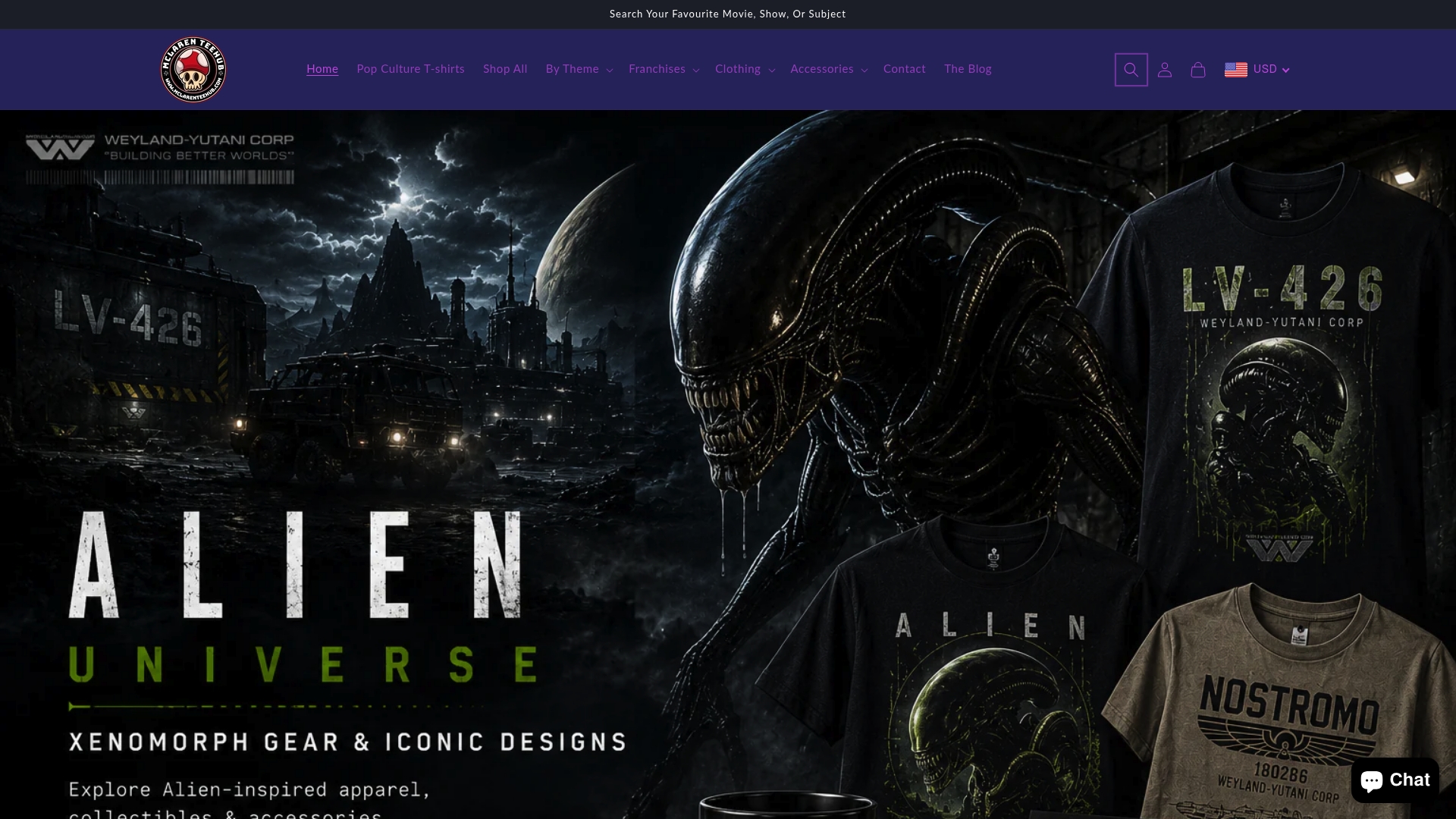
The catalog is organized by theme, so finding something for a specific fandom doesn’t require scrolling through thousands of unrelated designs. Prices are competitive with the broader market, shipping goes to the US and internationally, and the product range goes well beyond tees if you want a gift that isn’t another shirt. Check out the Brainwashed Retro Graphic Mug as one example of the store’s aesthetic: bold, pop-culture-rooted, and designed to stand out. Browse the full catalog at mclarenteehub.com and find something you’ll actually wear.
Sources and further reading
Availability and typical prices were last verified in July 2026. If a link is broken, the site may have updated its URL structure.
| # | Source | Notes |
|---|---|---|
| 1 | Best 15 T-Shirt Online Stores (Tested & Ranked) | Price ranges, blank quality guidance, model comparisons |
| 2 | TeeFury POD Marketplace Overview | Drop model mechanics, POD lead times, artist revenue context |
| 3 | The Grown Man’s Guide to Graphic T-Shirts | Design style guidance for everyday wearability |
| 4 | Mclarenteehub: TeePublic Alternatives Guide | POD artist marketplace context and alternatives |
| 5 | Mclarenteehub: Pop Culture Graphic Tees Buying Guide | Selection, sizing, and quality guidance for buyers |
| 6 | Mclarenteehub: tvstoreonline.com Alternatives | Adjacent retailer comparisons for further reading |