

Ensemble Cast Films: Definition, Examples, and How to Spot One
An ensemble cast film is a production where multiple principal actors share roughly equal screen time and narrative importance, so no single character functions as the sole lead. The story belongs to the group. According to the Cambridge Dictionary, an ensemble is “a group of actors who act together and have approximately the same importance in the story or similar amounts of screen time.” Think Ocean’s Eleven, Love Actually, or The Avengers: pull any one of those principal characters out and the whole architecture shifts. That narrative dependence is the defining test, not the size of the cast.
Key Takeaways
An ensemble cast film is defined by narrative dependence across multiple principals, not by cast size, and that structural choice shapes everything from pacing to awards recognition.
| Point | Details |
|---|---|
| Core definition | Multiple principals share roughly equal screen time and narrative importance; no sole protagonist. |
| The essential test | Remove one principal and the story weakens structurally, not just loses a scene. |
| Linking techniques | Filmmakers connect arcs through shared events, locations, themes, or relationship networks. |
| Ensemble vs. lead-driven | Ensembles trade depth for breadth, covering more viewpoints at the cost of production complexity. |
| Industry recognition | The SAG Award for Outstanding Performance by a Cast specifically honors ensemble work as a distinct craft. |
Table of Contents
- What makes a cast truly an ensemble?
- How do filmmakers actually build ensemble narratives?
- Where did ensemble filmmaking come from?
- Notable ensemble films and TV shows worth watching
- How ensemble storytelling differs from lead-driven films
- How to tell if a movie or show is an ensemble
- Why ensemble films matter more than people give them credit for
- Sources
What makes a cast truly an ensemble?
A large cast does not automatically make an ensemble. Plenty of blockbusters pack in dozens of characters while still centering every scene on one hero. A true ensemble, as Wikipedia’s entry on ensemble casts explains, is defined by narrative structure, not headcount. The practical threshold tends to fall around four to six principal characters, each carrying their own arc that the story genuinely needs.
The core characteristics look like this:
- Shared narrative importance: Every principal character drives plot, not just reacts to the lead.
- Roughly balanced screen time: No single actor dominates the runtime by a wide margin.
- Multiple interlocked arcs: Each character’s story intersects with others in ways that matter to the outcome.
- Narrative dependence: Remove one principal and the collective story weakens, not just thins.
A common mistake is confusing an ensemble with a cameo-heavy film. Cameos add star power; they do not add structural weight. The distinction is whether a character is essential to the plot’s architecture or merely decorative.
Pro Tip: Ask yourself four quick questions: Does this character have their own arc? Does their arc affect at least one other principal’s arc? Would removing them require rewriting the story, not just trimming a scene? Do at least three other characters share that same status? If yes across the board, you have an ensemble.
How do filmmakers actually build ensemble narratives?
The mechanics behind a well-functioning ensemble are more deliberate than they look on screen. StudioBinder compares an ensemble cast to an orchestra: diverse performers contributing unique parts that combine into a coherent whole. That metaphor points directly at the director’s challenge. Every instrument needs its moment; none can drown the others out.
The main narrative techniques filmmakers use:
- Shared event: A single crisis or occasion pulls all characters into the same story. The Towering Inferno (1974) uses a high-rise fire to force a dozen principals into the same desperate situation.
- Shared location: Characters occupy the same physical space, and their paths cross organically. The Grand Budapest Hotel (2014) layers characters through a single legendary hotel across different time periods.
- Thematic linking: Characters never meet but face versions of the same question. Babel (2006) connects four storylines across three continents through the ripple effects of a single gunshot.
- Network of relationships: Characters are linked by overlapping personal connections rather than one event. Love Actually (2003) maps ten romantic storylines through a web of London relationships.
- Referential acting: Actors play off each other rather than orienting all their reactions toward a single lead. Directors coach the cast to treat the group as the protagonist, which changes rehearsal dynamics entirely.
Pacing is where ensemble films most often stumble. Screen time has to be managed almost mathematically. Give one character three consecutive scenes and the audience starts reading the film as a single-lead story. The best ensemble directors, from Robert Altman to Steven Soderbergh, cut between arcs at the moment of maximum tension in each one, so no thread ever goes cold.
Where did ensemble filmmaking come from?
The form is older than most people assume. D.W. Griffith’s Intolerance (1916) intercut four separate storylines across different historical eras, making it one of cinema’s earliest experiments with multi-protagonist structure. It was unwieldy by modern standards, but it proved the format was possible.
The 1970s disaster cycle turned ensemble storytelling into a commercial formula. Films like The Towering Inferno (1974) and Airport (1970) assembled all-star casts because the genre demanded it: a disaster affects everyone, so the story needed everyone. Studios discovered that audiences would follow multiple characters simultaneously if the stakes were high enough.
Modern ensemble filmmaking split into two distinct streams. Character-driven dramas like Crash (2004) and Babel (2006) used the form to explore social and moral complexity across intersecting lives. Franchise blockbusters like The Avengers (2012) used it to combine pre-established characters from separate films into a single story, which required its own kind of narrative engineering.
Industry recognition caught up with the form. The Screen Actors Guild Award for Outstanding Performance by a Cast specifically honors ensemble work, acknowledging that collective performance deserves its own category separate from individual lead or supporting roles. That award matters because it validates the ensemble as a distinct craft, not just a production choice.
Notable ensemble films and TV shows worth watching
The following titles are frequently cited as clear examples of the ensemble form, each qualifying for a different structural reason:
- Intolerance (1916): Four parallel storylines across separate historical eras; the original multi-protagonist experiment in cinema.
- The Towering Inferno (1974): Shared-event structure; a high-rise fire forces a dozen principals into one crisis with no single hero.
- Ocean’s Eleven (2001): Large-team dynamics; eleven characters each contribute a specific skill the heist requires, making every one of them load-bearing.
- Love Actually (2003): Network-of-relationships structure; ten romantic storylines linked by overlapping London connections.
- Crash (2004): Thematic linking; racially diverse characters in Los Angeles whose lives collide over 36 hours around shared social tensions.
- Babel (2006): Geographic and thematic linking; four storylines across Morocco, Japan, Mexico, and the U.S. connected by a single incident.
- Little Miss Sunshine (2006): Family-unit ensemble; six characters on a road trip, each carrying a crisis that feeds the collective story.
- Tropic Thunder (2008): Large-team comedy; five actors-within-the-film each parody a Hollywood archetype, and the comedy depends on all five playing off each other.
- The Avengers (2012): Franchise ensemble; six pre-established heroes from separate films forced into one story, with screen time negotiated across competing mythologies.
- The Grand Budapest Hotel (2014): Location-based ensemble across time periods; the hotel itself functions as the connective tissue for a layered cast of principals.
FilmDaft’s overview of ensemble casts notes that many of these titles appear consistently on curated lists precisely because they satisfy the structural test: remove any principal and the story breaks, not just shrinks.
Genre variety here is worth noting. Ensembles appear in disaster films, heist comedies, family dramas, social thrillers, superhero blockbusters, and dark satire. The form is not tied to a mood or a budget. It is a structural choice, and it works across the full tonal range of cinema.

How ensemble storytelling differs from lead-driven films
| Dimension | Ensemble films | Lead-driven films |
|---|---|---|
| Principal characters | Four to six or more with balanced arcs | One clear protagonist, supporting cast |
| Screen time | Distributed roughly equally | Concentrated on the lead |
| Storyline connection | Shared event, location, theme, or relationship network | Single protagonist’s journey |
| Emotional range | Multiple viewpoints; broader thematic scope | Deep dive into one perspective |
| Audience identification | Viewers find their own entry point | Viewers follow one character’s arc |
| Production complexity | Higher: scheduling, screen-time balance, referential acting | Lower: story centers on one performance |
| Awards recognition | SAG Award for Outstanding Cast; ensemble-specific nominations | Individual lead/supporting categories |
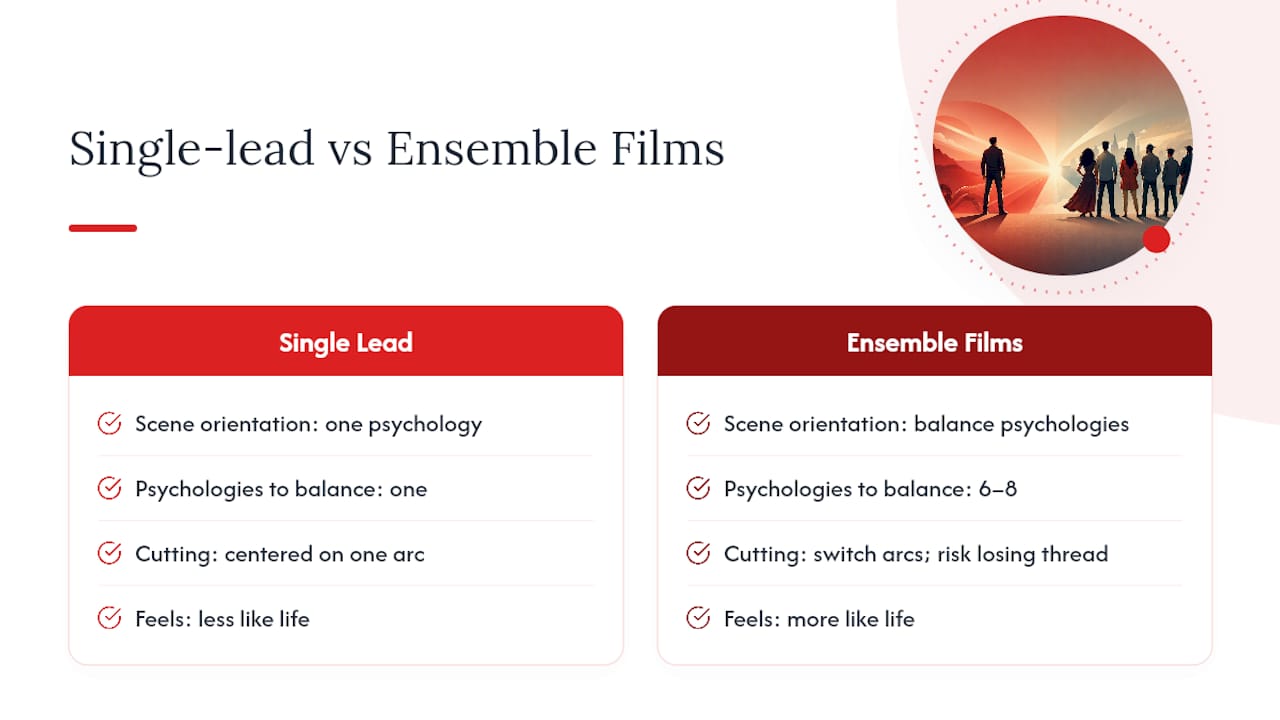
The core trade-off is depth versus breadth. A lead-driven film can go very deep into one psychology. An ensemble distributes screen time across multiple viewpoints to explore a theme from several angles simultaneously, which increases emotional range but demands more from both the director and the audience.
For TV, the ensemble form is even more common. The Wire, Game of Thrones, and Grey’s Anatomy all use it because a multi-season series has the runtime to develop six or eight principals fully. A two-hour film has to be more selective, which is why the best ensemble films tend to keep their principal count tight even when the total cast is large.
How to tell if a movie or show is an ensemble
Run through this checklist while watching:
- [ ] Do at least four characters have their own named storyline?
- [ ] Is screen time distributed without one actor dominating the runtime?
- [ ] Do the storylines intersect in ways that change each character’s outcome?
- [ ] Would removing one principal require rewriting the story, not just cutting a scene?
- [ ] Does the film lack a single character whose name would appear alone above the title?
Three or more “yes” answers strongly suggest an ensemble structure. Four or five make it nearly certain.
Apply it quickly: Little Miss Sunshine checks every box. Six family members, each in personal crisis, each affecting the others’ resolution. No single character could carry the film alone. That is the ensemble test in action.
Why ensemble films matter more than people give them credit for
The conventional take on ensemble films is that they are crowd-pleasers, a way to hedge bets by putting multiple stars in one film. That reading misses what actually makes the form interesting.
Ensemble storytelling is genuinely harder to pull off than a single-lead narrative. A director working with one protagonist can orient every scene around one psychology. An ensemble director has to hold six or eight psychologies in balance simultaneously, manage referential acting across the whole cast, and cut between arcs without losing the audience’s emotional thread. When it works, as in Little Miss Sunshine or The Grand Budapest Hotel, the result is a film that feels more like life than most movies do. Life does not have one protagonist. Ensemble films acknowledge that.
For pop culture fans, the ensemble form also drives some of the deepest fandom. Characters from ensemble casts tend to generate more merch, more fan art, and more debate precisely because no single figure owns the story. Every viewer has a different favorite. That plurality is why crossover and ensemble films create such sustained merch demand, and why blockbuster ensembles continue to dominate merchandise sales long after their theatrical run. At Mclarenteehub, the catalog reflects exactly that: characters from ensemble-driven films and shows that fans want to wear, display, and gift because the attachment runs deeper than one hero’s journey.
Love the films? Wear the fandom. Mclarenteehub carries pop culture gear inspired by the movies and characters that define ensemble cinema. From classic film tributes to franchise favorites, the collection is built for fans who know their references. Check out the Facehugger coffee mug or browse the full store at Mclarenteehub for film-inspired apparel and gifts.
Sources
- Ensemble cast
- What is an Ensemble Cast — Examples & Characteristics
- ensemble - Cambridge Dictionary
- What is an Ensemble Cast? Definition, Traits & Film Examples - FilmDaft