

Ecommerce Return Policy Basics for Small Businesses
An ecommerce return policy is the written rules your store publishes for accepting returns, exchanges, or refunds on items customers bought online. It spells out the return window, eligible items, condition standards, refund method, who pays shipping, and any exceptions, so both you and your customer know exactly what happens if a purchase doesn’t work out.
Every policy, no matter how small the store, needs to answer the same handful of questions in plain language. Skip one, and you’ll spend more time in email back-and-forth than you will running your business.
- Return window: how many days after delivery a customer can request a return
- Eligible items: what qualifies and what’s excluded (final sale, custom prints, hygiene items)
- Condition standards: tags attached, original packaging, unworn or unused
- Refund method: original payment, store credit, or exchange only
- Who pays shipping: the store, the customer, or a shared arrangement
- Exceptions: clearly separated so they don’t get buried in the fine print
Pro Tip: Post a summary of your policy right on the product page, not just buried in the footer. A one-line note like “Returns accepted within 30 days of delivery” next to the Add to Cart button answers the question before it becomes a support ticket.
The policy belongs in three places at minimum: a dedicated page linked in your footer, a short summary at checkout, and a callout on product pages for anything with special rules, like made-to-order apparel.
Key Takeaways
A usable ecommerce return policy states the return window, condition standards, refund method, and shipping responsibility in plain language, posts it conspicuously, and backs it with an RMA workflow to control costs and fraud.
| Point | Details |
|---|---|
| Definition first | An ecommerce return policy is the written rules covering eligibility, time limits, condition, fees, and refund method. |
| Base windows on delivery date | Starting the return clock at delivery, not purchase, avoids disputes caused by shipping delays. |
| Disclosure isn’t optional | States can impose a default refund window of 7 to 30 days if a restrictive policy isn’t conspicuously posted. |
| Build an RMA workflow | Every return should generate an RMA number to track fraud, grade condition, and route inventory. |
| See it in practice | Mclarenteehub applies these same principles across its product pages, from delivery-based windows to clear exceptions for made-to-order prints. |
Table of Contents
- Why Does a Clear Return Policy Matter for Online Stores?
- What Legal Rules Actually Govern Ecommerce Returns?
- What Should Every Return Policy Include?
- Where Should You Display Your Return Policy?
- How Do You Reduce Return Rates and Prevent Fraud?
- What Does a Copy-Ready Return Policy Template Look Like?
- How Does McLaren Tee Hub Handle Print-on-Demand Returns?
- What Should You Do This Week?
- Where Can You Learn More About Return Policies?
- An Editorial Take: What Most Return Policy Advice Gets Backward
- Get a Head Start With a Store That Already Gets This Right
- Return Policy FAQs
- Sources
Why Does a Clear Return Policy Matter for Online Stores?
A vague or hidden return policy costs you sales before a customer even clicks “buy.” Shoppers read the fine print, especially first-time buyers who don’t know if your sizing runs true or if your mugs survive shipping. When the answer is unclear, they abandon the cart rather than risk being stuck with an item they can’t send back.

Returns are also a bigger financial reality than most new merchants expect. Holiday shopping alone generates billions of dollars in returned merchandise every season, and that volume forces every retailer, from big-box chains to one-person print-on-demand shops, to treat returns as a real line item rather than an afterthought.
Communication matters just as much as the policy itself. One industry survey found that 89% of consumers want status updates on their returns by email or text, not silence followed by a surprise refund three weeks later.
- Clear terms reduce pre-purchase hesitation and cart abandonment
- Fast, predictable refunds build repeat-purchase trust
- Vague policies generate more support tickets and chargeback disputes
- Automated status updates cut down on “where’s my refund” emails
Pro Tip: Don’t write your policy to be as restrictive as legally possible. A 14-day, store-credit-only policy might protect margin on paper, but it also tanks conversion. Test a slightly longer window on a few product lines and watch what happens to both your return rate and your sales.
What Legal Rules Actually Govern Ecommerce Returns?
Here’s the part most merchants get wrong: there’s no federal law in the United States requiring you to accept returns for buyer’s remorse. If a product isn’t defective and matches its description, federal law doesn’t force a refund. Your store policy, not some universal consumer right, is what actually governs the transaction.
That doesn’t mean anything goes. State disclosure laws fill the gap federal law leaves open. States including California, New York, and Florida require retailers to conspicuously post their return policy, particularly if that policy says “no refunds” or “final sale.” Skip the disclosure, and the state can impose a default refund window lasting from about one week to one month that overrides whatever restrictive terms you meant to enforce.
Federal rules do kick in at specific points. The FTC’s Mail, Internet, or Telephone Order Merchandise Rule governs shipping timelines and requires refunds when you can’t ship an ordered item as promised. The Cooling-Off Rule applies mainly to door-to-door sales, and ROSCA governs negative-option billing like subscriptions, which matters if you sell any kind of recurring box or membership alongside one-off merchandise.
A few practical moves keep you out of trouble:
- Post your full policy on a dedicated page linked from every footer, not just the homepage
- State “final sale” exceptions explicitly on the product page itself, not only in the policy document
- Use plain language over legal jargon so a disclosure actually counts as conspicuous
- Review your state’s specific rule if you sell heavily to customers in California, New York, or Florida
What Should Every Return Policy Include?
Think of your policy as two separate documents stitched together: the physical rules about what can come back, and the financial rules about what happens to the money. Separating those two layers makes the policy easier to write and easier for customers to understand.
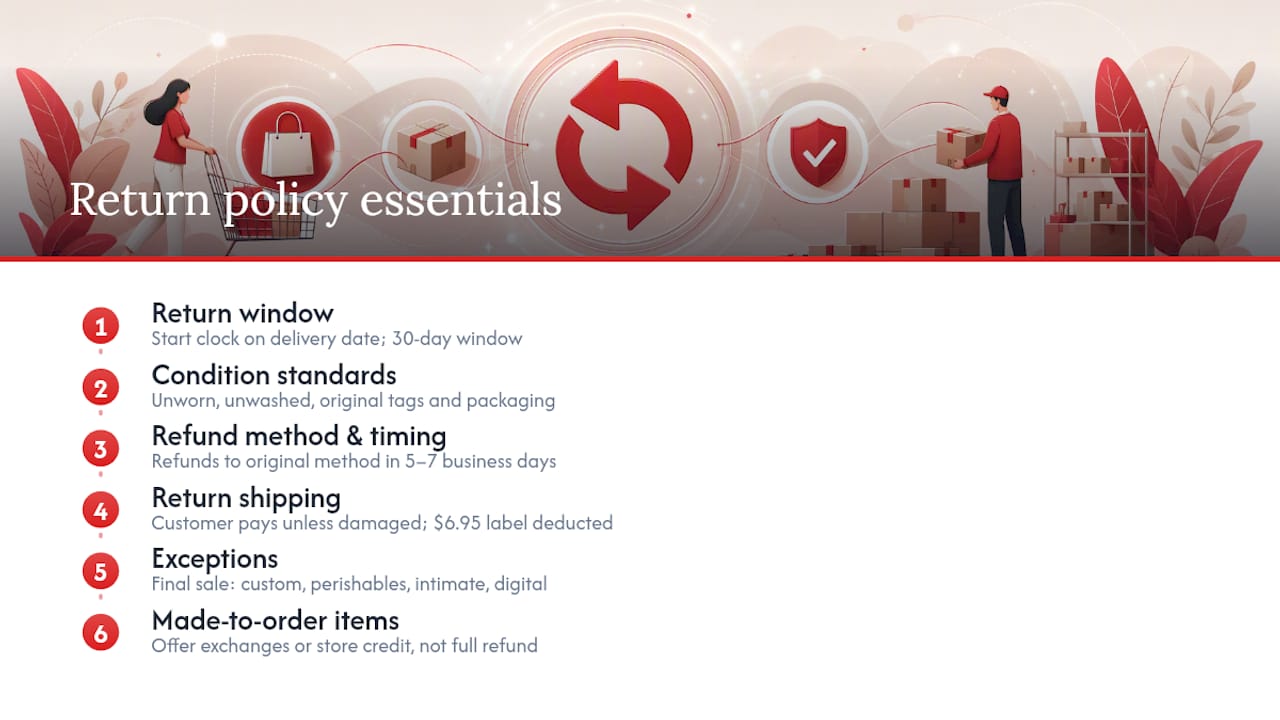
Return window. Start the clock on the delivery date, not the purchase date. A delivery-based window avoids the common dispute where a customer’s package sits in transit for eight days and eats into their return period before it even arrives. Sample wording: “Items may be returned within 30 days of the delivery date shown on your tracking confirmation.”
Condition standards. Be specific about what “unused” means for your product category. Sample wording: “Items must be unworn, unwashed, and returned with original tags and packaging intact.”
Refund method and timing. Decide upfront whether refunds go back to the original payment method or as store credit, and whether exchanges are the only option for certain categories. Sample wording: “Refunds are issued to your original payment method within 5 to 7 business days of our warehouse receiving your return. Store credit is issued instantly upon approval.”
Return shipping. Say plainly who pays. Sample wording: “Return shipping is the customer’s responsibility unless the item arrived damaged or defective. A prepaid label is available for a flat $6.95 fee, deducted from your refund.”
Exceptions. List final-sale items, perishables, custom or personalized goods, intimate apparel, and digital products in one short block. Sample wording: “Custom and made-to-order items, including personalized apparel, are final sale and not eligible for return unless defective.”
Pro Tip: If you sell custom or print-on-demand merchandise, don’t offer full refunds on made-to-order items by default. Offer exchanges or store credit instead, since the item can’t be restocked or resold to another customer.
Where Should You Display Your Return Policy?
Placement determines whether your policy prevents disputes or just documents them after the fact. A policy nobody reads until after a problem starts is worthless as a trust signal.
The dedicated policy page still matters, linked from your footer where customers expect to find it. But the real conversion impact comes from shorter touchpoints: a one-line summary at checkout (“Free returns within 30 days”), a callout on product pages for anything non-returnable, and a link in the order-confirmation email so the terms travel with the receipt.
Product pages carry the heaviest lift for reducing confusion. A short, linked snippet like “See our return policy” next to a product listing answers the sizing-and-fit question before it turns into a support message. Pair that with a brief FAQ addressing your three most common return questions, and you’ll cut a noticeable chunk of pre-purchase emails.
Automation closes the loop after a return starts. Sending status updates by email or SMS when a return is received, approved, and refunded directly answers what most consumers already expect, and it heads off the chargeback filed simply because someone didn’t know their refund was already processing.
- Footer link to the full policy page
- One-line checkout summary before purchase confirmation
- Product-page callouts for non-returnable or exception items
- Order-confirmation email with a policy link included
- Automated return-status notifications as customers prefer
Pro Tip: Look at how other direct-to-consumer brands structure their policy pages, like Moonswords’ return and exchange policy. Notice how the eligibility rules come first and the exceptions come last, in short, scannable blocks rather than dense legal paragraphs.
How Do You Reduce Return Rates and Prevent Fraud?
Most returns trace back to a mismatch between what the customer expected and what arrived, which means the fix often starts on the product page, not in the policy. Better photography, honest size charts, and a short video showing fabric weight or fit can head off a meaningful share of “it wasn’t what I thought” returns before they happen. Reviewing your listing copy for common gaps, the kind covered in guides on movie merchandise listing mistakes, is a fast way to find where expectations and reality diverge.
On the operational side, a repeatable workflow matters more than any single policy clause. Every return should generate an RMA (Return Merchandise Authorization) number the moment a customer requests one. That number ties the return to inspection, grading, and a routing decision: resell as-is, refurbish, or write off. Without it, you’re guessing at your true return costs instead of measuring them.
Fraud deserves a direct, transparent response rather than silence. Retail loss-prevention teams increasingly treat return policies as a proactive defense, watching for serial returners and building in guardrails, like requiring original packaging or capping the number of returns per customer per year, that deter abuse without punishing everyday shoppers.
- Improve photos, sizing, and descriptions for high-return SKUs
- Require an RMA number before accepting any return
- Grade returned inventory (resale, refurbish, write off) instead of dumping it
- Watch for repeat-return patterns and add reasonable limits
- Track return reasons by SKU monthly to spot problem listings early
Pro Tip: If print quality is driving your returns rather than sizing or fit, the fix is upstream. Review your production partner against a print-on-demand quality checklist before the next batch ships, not after the returns start piling up.
What Does a Copy-Ready Return Policy Template Look Like?
Here’s a template you can adapt directly, filling in your own numbers where noted:
Return Policy We want you to love what you ordered. If something isn’t right, you may return eligible items within [30/60/90] days of the delivery date for a refund to your original payment method or store credit, your choice. Items must be unused, unwashed, and returned with tags and original packaging. Customers are responsible for return shipping unless the item arrived damaged or defective, in which case we cover the cost. Custom, personalized, and made-to-order items are final sale. Refunds are processed within 5 to 7 business days of our warehouse receiving your return.
For a product page, a one-line version works better: “30-day returns on all standard items. Custom prints are final sale.” At checkout, a two-line summary covers it: “Free 30-day returns on unworn items with tags. See full policy for exceptions.”
The window length and refund method you choose come with real trade-offs, not a single right answer:
| Policy Choice | Typical Trade-off |
|---|---|
| 30-day window | Standard expectation, lower fraud exposure, may feel short for gift purchases |
| 60 to 90-day window | Builds trust and reduces holiday-return friction, increases inventory uncertainty |
| Refund to original payment | Customer preference, direct cost to cash flow |
| Store credit only | Protects revenue, some customers view it as a downgrade |
| Free return shipping | Removes purchase hesitation, adds a direct cost per return |
| Customer-paid return shipping | Protects margin, can suppress return rate but also suppress conversion |
Pick the combination that fits your margin structure, then state it clearly rather than burying the trade-off in vague language.
How Does McLaren Tee Hub Handle Print-on-Demand Returns?
A short excerpt from how a print-on-demand shop might phrase its own exceptions clause shows the pattern worth copying: “Custom and print-on-demand apparel is made specifically for your order and is final sale. If your item arrives damaged, defective, or misprinted, contact us within 14 days of delivery for a free replacement or full refund.”
Three choices in that wording aren’t accidental. Calling out “made specifically for your order” explains, in plain terms, why the item can’t simply go back on a shelf, which protects margin on goods that can’t be resold. Separating “damaged, defective, or misprinted” from ordinary returns keeps quality issues, which are the merchant’s responsibility, distinct from buyer’s remorse, which isn’t. And measuring the window from delivery date rather than order date accounts for print-on-demand production time, so customers aren’t penalized for a manufacturing lag they didn’t cause.
Pro Tip: If you run a small direct-to-consumer shop, keep your customer service tone consistent with your brand voice even in return emails. A product like a graphic tee sold with a bold, irreverent brand identity shouldn’t suddenly sound like a legal disclaimer the moment a customer asks for a refund.
What Should You Do This Week?
Start with the highest-leverage fix, not the most comfortable one. If your policy isn’t posted conspicuously, that’s the first thing to change, since it carries actual legal exposure under state disclosure rules.
- This week: draft or update your policy page, set a delivery-based return window, and publish a link at checkout and in your footer
- This week: add a one-line policy summary to your top five product pages, prioritizing anything custom or made-to-order
- This month: set up an RMA workflow, even a simple email-based one, so every return gets tracked and graded
- This quarter: pull return data by SKU and flag any product with a return rate meaningfully above your store average
One line worth repeating: posting requirements vary by state, and getting this wrong can override your intended terms entirely. If you sell heavily into California, New York, or Florida, or if your return volume is significant enough to matter financially, a short conversation with a business attorney is worth the cost before you finalize the wording.
Where Can You Learn More About Return Policies?
- Signifyd’s ecommerce return policy guide covers the strategic case for treating returns as a margin and fraud-prevention lever, not just customer service.
- Avalara’s writing guide breaks down the operational side, including the consumer-expectation data on status updates.
- Refund Guides’ consumer protection overview is the clearest plain-language explainer on state disclosure laws and default refund windows.
- TechnologyAdvice’s returns management guide walks through building an RMA and inspection-routing workflow from scratch.
- Shopify’s return policy guide is the most practical source for sample wording merchants can adapt directly.
An Editorial Take: What Most Return Policy Advice Gets Backward
Most guides on this topic treat return policies as a defensive document, something you write to limit liability and then hope nobody reads closely. That instinct is backward, and it’s the reason so many small stores end up with policies that either scare off buyers or get quietly overridden by state disclosure law because nobody bothered to post them properly.
The stronger approach treats the policy as a sales tool first and a legal shield second. A 30-day, delivery-based window stated clearly on a product page does more to close a hesitant sale than almost any other single line of copy you can add to that page. Meanwhile, the merchants who get burned aren’t usually the ones with generous policies. They’re the ones with restrictive, vague policies that never got posted where a court or a state regulator would consider them conspicuous.
The other overlooked piece is operational, not legal. A policy without an RMA system behind it is just a promise with no way to keep it honest. You can’t tell whether your 30-day window is costing you money or protecting it if you’re not tracking return reasons by SKU. Indie merchants running print-on-demand shops especially need this discipline, since made-to-order goods can’t be restocked, and every returned item that goes unmeasured is margin quietly leaking out the back door.
Get a Head Start With a Store That Already Gets This Right
You don’t have to build your return policy from scratch or guess at what plain-language wording should sound like. Mclarenteehub runs its own store on exactly the principles covered here: delivery-based windows, clear exceptions for made-to-order prints, and product pages that state the terms upfront instead of hiding them in a footer link nobody clicks.
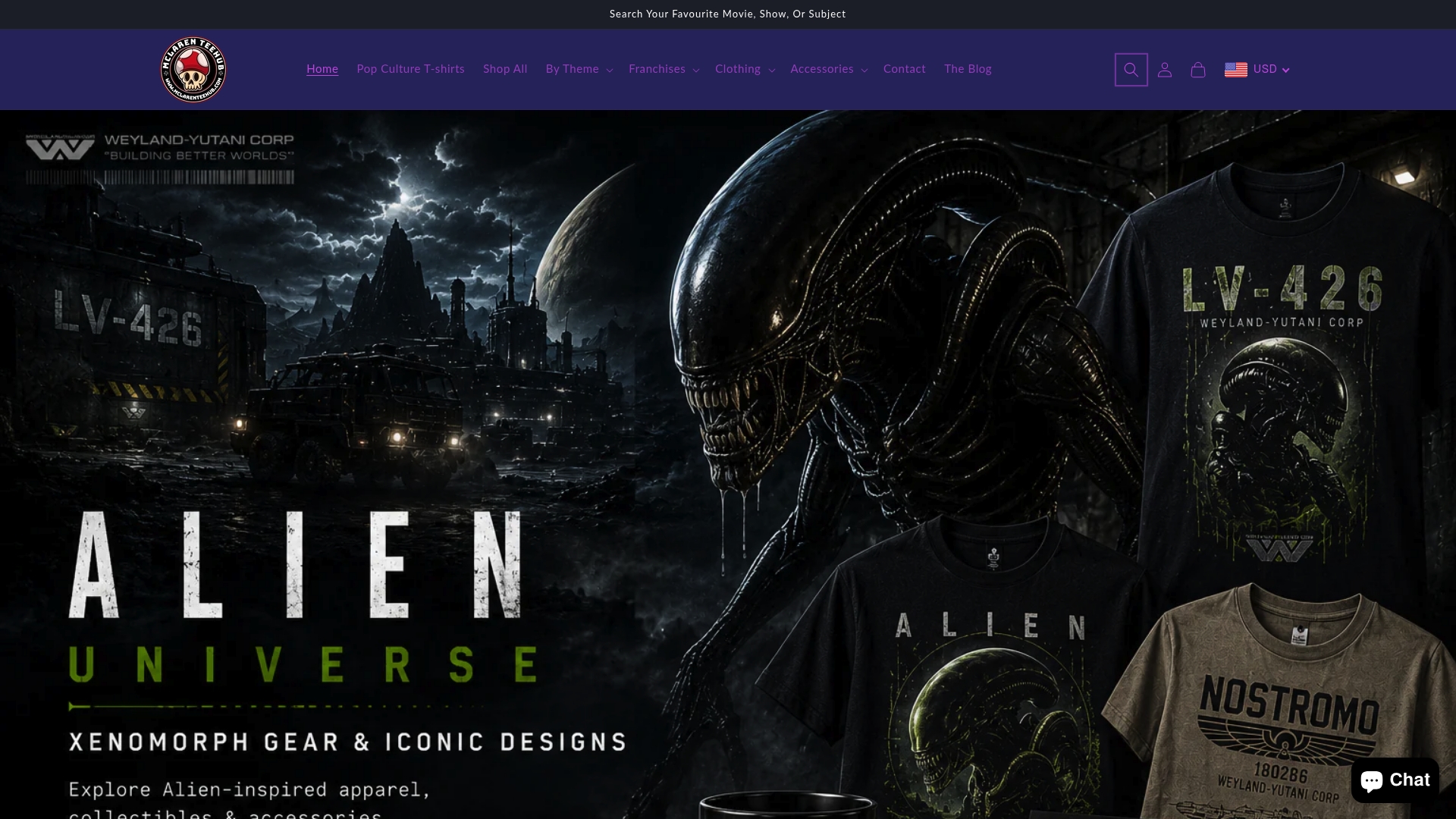
If you’re shopping for pop culture apparel, mugs, or gifts and want to see a return policy that’s actually easy to find and understand, browse a graphic mug like the Facehugger design and check the return terms listed right on the page. And if you’re a merchant building your own store, that same product-page structure, condition standards, refund method, and exceptions stated in one short block, is worth studying and adapting directly. Start your next order or review your own policy against it today.
Return Policy FAQs
What is an ecommerce return policy in simple terms? It’s the written document explaining how, when, and under what conditions a customer can return something they bought from your online store, plus how and when they get their money back.
Do online stores legally have to accept returns? Not for buyer’s remorse on non-defective items. There’s no general federal requirement, though state disclosure laws can force a default refund window if your policy isn’t posted where customers can see it.
Who usually pays for return shipping? Practices vary. Many stores charge the customer for standard returns but cover shipping when the item arrived damaged, defective, or misprinted.
How long should a return window be? Many stores use a return window based on delivery date; the length varies, with some opting for longer periods to build trust, especially during holiday shopping.
What items are typically excluded from returns? Final-sale items, perishables, custom or personalized goods, intimate apparel, and digital products are the most common exceptions across ecommerce stores.
Sources
- Ecommerce return policy best practices for retailers
- How to write a great ecommerce return policy
- US consumer protection laws: returns, refunds, warranties
- Ecommerce returns management guide for retailers
- How to write a return policy (Shopify guide)