

Why Blockbusters Dominate Merchandise Sales: A 2026 Analysis
Blockbusters dominate merchandise because they compress massive, coordinated attention into a short retail window, and studios have learned to convert that attention into product revenue before it fades. The mechanism is not complicated: a film with substantial marketing spend, exclusive retail partnerships at Amazon, Target, and Walmart, and a franchise fan base built over decades will always outpace a mid-budget standalone title on the shelf. What the 2026 data makes newly clear is where that revenue lands. An Omnisend analysis reported by Kidscreen tracked the top 20 movies across Amazon listings over a 30-day window and found significant revenue and units sold, with a majority of best-selling items classified as everyday essentials, not toys or collectibles. Star Wars built the modern licensing playbook in the late 1970s; Barbie demonstrated in 2023 that a single film can influence spending across various retail categories, according to consumer spending data. The essentials shift is the new chapter in that same story.
Key Takeaways
Blockbusters dominate merchandise because concentrated franchise attention, coordinated studio-retailer campaigns, and a shift toward everyday essentials convert short theatrical windows into high-volume, resilient retail revenue.
| Point | Details |
|---|---|
| Essentials outperform collectibles | The majority of best-selling blockbuster merch items are everyday essentials; apparel alone accounts for 43% of best-sellers. |
| Revenue is highly concentrated | The top five films in the Omnisend sample drove roughly 86% of the $97.4M in tracked revenue across 4.48M units. |
| Timing determines margin | The peak sell-through window runs 4–6 weeks post-release; missing it forces discounting that erodes program profitability. |
| Advertising signals retail allocation | Entertainment advertising elasticity averages approximately 0.33; pre-launch spend directly influences how much shelf space retailers commit. |
| Mclarenteehub applies this model | Mclarenteehub offers daily-use pop culture apparel and home goods, the exact categories the 2026 data identifies as the strongest performers. |
Table of Contents
- What does the latest blockbuster merchandise data actually show?
- Which films and franchises generate the biggest merchandise lift?
- Which product formats actually sell best for blockbusters?
- Why do consumers choose blockbuster merchandise over everything else?
- How do studios and retailers convert theatrical attention into retail revenue?
- How does advertising timing shape merchandise demand?
- What are the limits of the Omnisend data?
- What industry experts say about the essentials shift
- What merch teams should actually change right now
- Mclarenteehub brings the essentials trend to pop culture fans
- An editorial perspective on what the data is really telling us
- Sources
What does the latest blockbuster merchandise data actually show?
The Omnisend findings, summarized by PR Newswire, give the clearest recent snapshot of how blockbuster merchandise revenue distributes across categories and titles.
The top films in the sample accounted for a majority of tracked revenue, which tells you something important about concentration: a handful of titles pull most of the dollars, while the remaining 15 films split the rest. That concentration is itself a merchandise success factor, not a coincidence.
A note on methodology: this snapshot covers Amazon listings only, over a single 30-day period ahead of the summer release window. It does not capture specialty retail, direct-to-consumer studio stores, or international e-commerce. The category split likely overstates Amazon’s apparel skew relative to, say, a toy-focused specialty retailer. Use it as a directional signal, not a census.
Which films and franchises generate the biggest merchandise lift?
Family and animated titles consistently produce the highest merchandise volume relative to box office, and the Omnisend data reinforces that pattern. PAW Patrol: The Dino Movie, Moana, and Toy Story 5 all appear among the top performers in the tracked sample, driven heavily by apparel and baby products. Spider-Man: Brand New Day skews older, pulling more in apparel and accessories. The common thread is character recognition: kids who know a character from a streaming series before the film opens are already primed to want the shirt.
The animated movie merchandise dynamic is worth understanding separately from adult tentpoles. Family titles generate repeat purchases across a longer tail because children wear through clothing and parents replace it. Adult-skewing blockbusters like Oppenheimer generate a sharper, shorter spike, concentrated in apparel and home goods rather than baby or toy categories.
Historical precedents confirm the long-run mechanics. It is estimated that Star Wars merchandise revenue has exceeded $42 billion in cumulative licensing since 1977, establishing a franchise-as-retail-engine model that many studios have sought to emulate. Barbie (2023) demonstrated something newer: a single film, even without a pre-existing toy-franchise retail infrastructure, can generate measurable consumer spending spillovers into clothing and entertainment categories, according to Bank of America cardholder data. The pink merchandise wave that preceded the film’s release was not accidental; it was a coordinated pre-launch campaign that seeded retail before a single ticket was sold.
A few film-to-category mappings worth keeping in mind:
- PAW Patrol / Moana / Toy Story 5: apparel and baby dominate; parents are the buyer, not the child
- Spider-Man / superhero franchises: apparel and accessories lead; adult fans and teens drive volume
- Barbie (2023): apparel and home goods spiked; adult women were the primary buyer segment
- Star Wars (franchise): broad category coverage; collectibles remain strong alongside apparel because the fan base spans 50 years of age cohorts
Which product formats actually sell best for blockbusters?
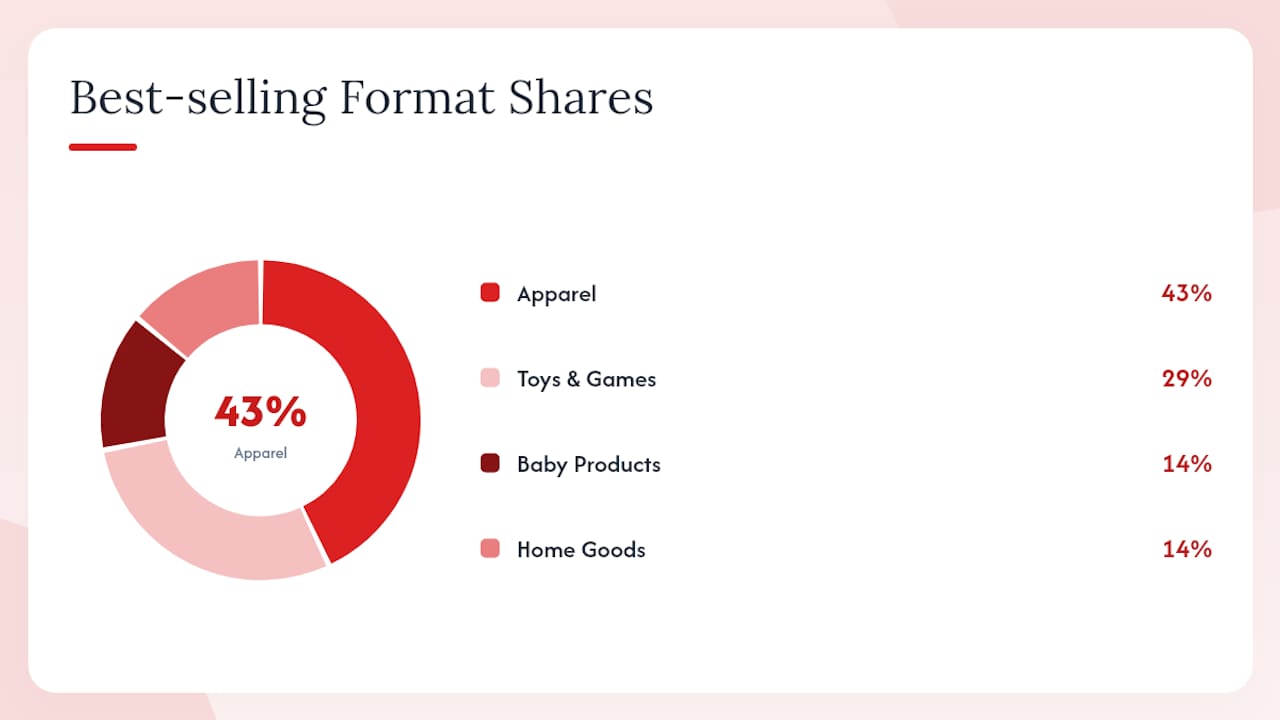
Apparel is the dominant format, full stop. Apparel represented 43% of best-sellers in the Omnisend sample, outselling every other category by a wide margin. The reason is straightforward: a t-shirt or hoodie serves a function beyond fandom display. You wear it to work, to the gym, to pick up your kids. A collectible figurine sits on a shelf. That ongoing utility is what makes blockbuster fan apparel the most resilient category across economic cycles.
Baby products at 14% and home goods at 14% tell a similar story. A Moana-branded onesie or a Toy Story mug gets used daily. Toys and games, at 29%, still matter, but they are concentrated in kid-targeted franchises where the child is the end user and the parent is the buyer. For adult-skewing titles, toys barely register.
For merch planners, the category decision maps roughly to buyer segment:
- Parents buying for children: prioritize apparel (especially basics: tees, onesies, pajamas) and functional home items; price sensitivity is moderate because parents already buy these items
- Adult fans: apparel leads, followed by mugs and home goods; fan art and parody designs outperform straight logo prints because they signal taste, not just fandom
- Casual fans and gift buyers: mugs, tote bags, and mid-price apparel work well; the buyer wants something recognizable but not so niche it confuses the recipient
On SKU depth: broad tentpoles support wide assortments, but the 80/20 rule applies hard. Two or three hero SKUs in apparel will outsell a catalog of 40 niche variants. Art style matters more than most planners expect. Character-forward, graphic-driven designs outperform text-only or logo-only prints, particularly for adult buyers who want to wear something that looks good, not just something that announces a franchise.
Why do consumers choose blockbuster merchandise over everything else?
Identity signaling is the primary driver. Wearing a Spider-Man hoodie or displaying a Barbie-pink mug is a social act. It tells people in your orbit what you care about, what you watched, what you belong to. Social media amplifies this: a fan who posts a photo in franchise apparel generates organic impressions that no paid campaign can fully replicate. Fandom dynamics and community engagement have shifted merchandise from a passive souvenir category into an active participation medium.
The economic context matters too. Marty Bauer, Omnisend’s e-commerce expert, frames the essentials trend as fans building ongoing relationships with characters rather than making one-time commemorative purchases. In tighter spending conditions, a $30 t-shirt that you wear twice a week is easier to justify than a $60 collectible that sits in a box. That calculus is driving the category shift the 2026 data captures.
Pro Tip: Design merchandise for repeat use and daily visibility. A well-designed graphic tee or a clean character mug gets seen by more people over its lifetime than any single social post. Build the product to earn its place in someone’s regular rotation, not just their collection.
Iconic characters drive repeat purchase behavior in a way that standalone films cannot. A fan who buys a Star Wars shirt in 2026 is drawing on 50 years of emotional investment. That depth of relationship is what separates franchise merchandise from one-off licensed products, and it is why studios invest so heavily in building characters across multiple media before a theatrical release.
How do studios and retailers convert theatrical attention into retail revenue?
The operational sequence is more deliberate than most outsiders realize. McKinsey’s analysis of integrated merchandising argues that the retailers who capture theatrical spikes are those with integrated product, marketing, and distribution capabilities, plus the in-season flexibility to respond when a title overperforms.
Here is how the typical tentpole merchandising program runs:
- Product design and licensing sign-off (12–18 months pre-release): studios approve product designs, set royalty structures, and identify anchor retail partners
- Retailer exclusives and shelf allocation (6–9 months pre-release): Amazon, Target, and Walmart negotiate exclusive SKUs or early-access windows in exchange for promotional placement and co-funded marketing
- Pre-launch seeding and co-marketing (4–8 weeks pre-release): retailers activate in-store boutiques, online landing pages, and paid media; studios cross-promote retail availability in trailers and social content
- Release-window sell-through (weeks 1–6 post-release): peak demand window; full-price sell-through is the goal; inventory shortfalls at this stage are unrecoverable
- Long-tail management and markdown strategy (weeks 7+): demand decays; studios and retailers decide whether to discount or hold inventory for sequel cycles
Retailers participate because exclusive movie merchandise drives incremental traffic. A Target customer who comes in for a Moana-branded onesie often leaves with a full basket. That traffic value is why retailers co-fund promotional support and give tentpoles premium shelf placement. Amazon’s advantage is data: it can identify demand signals early and adjust inventory allocation faster than any brick-and-mortar chain.
Historical trade reporting from Variety documents how exclusive retail pacts and in-store boutique builds became standard practice, with studios and retailers sharing both the marketing cost and the revenue upside. The exclusivity creates a competitive moat: if the only place to buy the official Toy Story 5 pajama set is Target, that drives traffic Target’s competitors cannot match.
How does advertising timing shape merchandise demand?
Advertising does two things simultaneously in entertainment: it drives consumer demand and it signals quality to distributors and retailers. A Springer meta-analysis of advertising elasticity finds that entertainment goods carry an average advertising elasticity of approximately 0.33, substantially higher than most other consumer categories. Pre-launch spend in particular functions as a credibility signal to retail buyers deciding how much shelf space to allocate.
The practical implication is that a studio’s marketing budget is also a retailer’s inventory decision input. A film with $150M in global advertising spend gets more shelf space at Walmart than a film with $20M, not just because the studio asked for it, but because the retailer’s buyer reads the ad spend as a demand forecast.
The effective sell-through window is tight. Variety’s trade reporting documents a peak sales window of several weeks for tentpole merchandise, after which demand decays sharply and unsold inventory moves to markdown. Missing that window by even two weeks can turn a profitable program into a margin-destroying clearance event. Studios that synchronize their advertising calendar with retail inventory arrival dates consistently outperform those that treat marketing and distribution as separate workstreams.
The causal chain runs in both directions. A CMU instrumental-variable study finds that a 10% increase in theatrical attendance causes roughly an 8% increase in subsequent home-channel retail demand. Theatrical attendance is not just a box office metric; it is a leading indicator for merchandise sell-through across every downstream channel.
What are the limits of the Omnisend data?
Any analyst citing the $97.4M figure in a briefing should flag four structural limitations:
- Channel bias: the sample covers Amazon listings only. Specialty retailers, direct-to-consumer studio stores, mass-market chains like Target and Walmart, and international markets are excluded. Amazon skews toward apparel and home goods relative to toy-focused specialty retail, which likely inflates the essentials share.
- Time-window bias: 30 days is a snapshot, not a trend. It captures the pre-summer release window, which is structurally different from holiday or back-to-school periods when toy and collectible categories typically spike.
- Concentration bias: with the top five films accounting for roughly 86% of tracked revenue, the average figures are heavily skewed by a few outliers. A mid-tier film’s merchandise performance looks nothing like the sample mean.
- Product categorization limits: SKU-level category mapping on Amazon is inconsistent. A “baby” item might be a onesie that adults also buy; a “home” item might be a novelty collectible. Category splits should be treated as directional, not precise.
To validate findings from a single-channel snapshot like this, request: the full sample frame (which SKUs were included and how they were selected), the SKU-to-category mapping methodology, the exact date range, and whether returns were netted out. Cross-reference against box office data, broad e-commerce panels like Circana or NPD, and retailer point-of-sale data where accessible.
What industry experts say about the essentials shift
The move toward everyday essentials in blockbuster merchandise reflects something deeper than a category preference. Marty Bauer’s interpretation, drawn from the Omnisend analysis, is that fans are building ongoing relationships with characters rather than making commemorative purchases. A collectible marks a moment; a t-shirt or a mug extends the relationship into daily life.
That framing has direct implications for licensing strategy. Studios that license primarily into collectibles and toys are optimizing for the most economically sensitive buyer segment. Studios that license into apparel and home goods are building a more resilient revenue base, one that holds up better when consumer budgets tighten.
Three implications analysts can use when modeling merchandise revenue for tentpole financing:
- Essentials-weighted assortments reduce revenue volatility: apparel and home goods carry lower fad-cycle risk than collectibles, which means revenue forecasts for essentials-heavy programs carry tighter confidence intervals
- Theatrical attendance is a leading indicator for all downstream channels: the CMU causal evidence means box office tracking is a legitimate input into merchandise demand models, not just a separate metric
- Franchise depth multiplies per-unit revenue: a title with 10+ years of fan history supports premium pricing and broader SKU depth than a standalone film, which affects both licensing royalty rates and retailer shelf allocation
What merch teams should actually change right now
The 2026 data and the underlying mechanics point to a clear set of operational priorities. Here is a numbered checklist merch teams can run against any property they are evaluating:
- Assess franchise depth first. Does the property have an existing fan base, or is this a cold launch? Franchise titles support broader assortments and higher price points; cold launches need tighter SKU focus.
- Default to essentials for broad-appeal tentpoles. Apparel, home goods, and baby products outperform toys for adult and family audiences. Reserve toys and collectibles for kid-targeted franchises where the child is the end user.
- Use inventory-light models early. Print-on-demand fulfillment for apparel reduces inventory risk during the uncertain pre-release period. Lock in bulk inventory only after early demand signals confirm the title is tracking above forecast.
- Plan exclusive retail windows deliberately. Negotiate exclusives with one anchor retailer (Amazon, Target, or Walmart) for the first 4–6 weeks, then open distribution. Exclusivity drives traffic and co-marketing support; broad distribution too early dilutes both.
- Synchronize creative and distribution calendars with advertising spend. Product must be on shelves when advertising peaks. A two-week lag between ad spend and retail availability is a direct revenue loss.
- Evaluate art-friendliness of the IP. Properties with strong character visuals and flexible art styles support broader apparel SKU development. Text-only or logo-driven IP underperforms in adult apparel.
- Build in a markdown decision point at week 6. If sell-through is below 70% at the end of the peak window, decide immediately whether to discount or hold for a sequel cycle. Delayed decisions compound margin loss.
For crossover and franchise films, the checklist above applies with one addition: map the fan overlap between franchises before finalizing the assortment. A Spider-Man/Avengers crossover has a different buyer profile than a standalone Spider-Man film, and the SKU mix should reflect that.
Mclarenteehub brings the essentials trend to pop culture fans
The data makes the case clearly: everyday essentials, apparel above all, are where blockbuster merchandise revenue concentrates. Mclarenteehub is built around exactly that insight. The store carries pop culture graphic tees, hoodies, mugs, hats, beanies, and gifts, all featuring original fan art and parody tributes to movies, TV shows, anime, sci-fi, and horror. Every product is designed to be worn or used daily, not shelved. The Facehugger coffee mug and the Die Hard-style mug are exactly the kind of home-goods items the Omnisend data shows outperforming collectibles. Fulfilled globally, no minimum order, and priced for fans who want quality without a licensing premium.
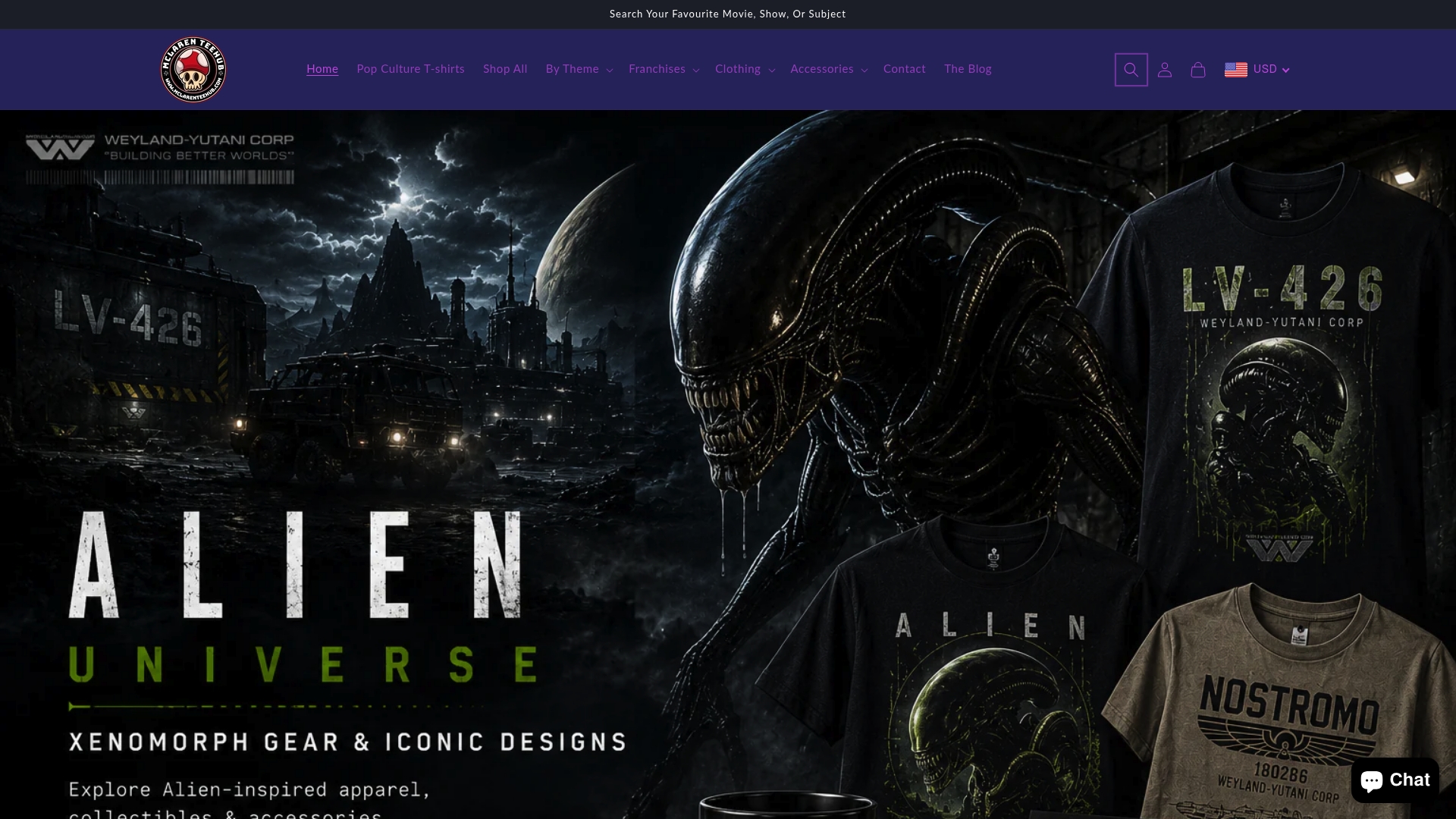
Browse the full collection at Mclarenteehub and find the piece that earns a permanent spot in your daily rotation.
An editorial perspective on what the data is really telling us
The essentials trend in blockbuster merchandise is not a surprise to anyone who has watched how fans actually live with the properties they love. What the 2026 Omnisend data does is put numbers on something practitioners already sensed: people want to carry their fandoms into daily life, not display them on a shelf. A Toy Story mug on your desk is a different kind of statement than a Buzz Lightyear figurine in a box. One is identity; the other is inventory.
What I find underappreciated in most merchandise analysis is how much the retail mechanics, not just the IP, determine outcomes. A great property with poor retail timing and no exclusive partnership will underperform a mediocre property with a well-executed Target boutique and synchronized ad spend. The CMU causal evidence on theatrical attendance and the Springer elasticity findings both point to the same conclusion: the marketing infrastructure around a film is as important as the film itself when it comes to merchandise revenue.
For pop culture merchandise brands operating outside the studio system, the implication is clear. Build for daily use. Design for the fan who wants to wear their taste, not just collect it. That is exactly what Mclarenteehub does, and the data says it is the right call.
Sources
The findings in this article draw on the following primary sources:
- Kidscreen » Archive » REPORT: Essentials are dominating movie merch sales
- Movie Merch Hits $97.4M Ahead of Summer Blockbusters
- Great merchandising never goes out of fashion
- THE PERFECT STORM: Using Snowstorms to Analyze the Effect of Theatrical Attendance on the Demand for Subsequently Released DVDs
- Advertising elasticities and the entertainment industry (Springer article)
- Barbie and Oppenheimer movies show economic spillover (CNN)